

Main Points :
- Bitcoin is currently in a post-decline consolidation phase, with bearish sentiment still dominant, but selling pressure appears to be gradually exhausting.
- Despite price instability, long-term accumulation addresses continue to increase their Bitcoin holdings, signaling structurally resilient demand.
- The market is increasingly shaped by capital with longer time horizons, though this alone does not yet confirm the start of a new bull trend.
- Downside risk is partially supported by long-term capital, but upside momentum remains constrained without improvement in ETF flows and short-term holder profitability.
1. Market Context: From Decline to Consolidation
Bitcoin’s current market environment can best be described as a transitional consolidation phase following an initial downward move. After experiencing a notable correction from recent highs, the price action has shifted into a range-bound structure rather than a continuation of aggressive selling.
While overall sentiment remains skewed toward caution, there are emerging signs that forced selling and panic-driven exits are losing momentum. This does not imply an imminent reversal, but it does suggest that the market may be forming a structural base.
In historical Bitcoin cycles, such phases often mark the point where weak hands gradually exit, while stronger, longer-term participants begin to reassert influence. Importantly, this process can persist for extended periods before any visible upside breakout occurs.
2. Divergence in Participant Behavior
One of the most notable characteristics of the current market is the clear divergence in behavior among different types of participants.
Retail-oriented traders and short-term speculators have tended to reduce exposure amid declining prices and elevated volatility. This response is typical, as uncertainty increases and risk appetite contracts during corrective phases.
By contrast, on-chain data reveals a steady increase in demand from so-called “Accumulator Addresses”—wallets with no meaningful history of distribution that consistently accumulate Bitcoin over time. These entities operate on a fundamentally different time horizon, prioritizing long-term value accumulation over short-term price fluctuations.
This divergence highlights a crucial structural insight: market control is gradually shifting away from emotionally reactive participants toward capital with greater patience and balance-sheet strength.
3. Understanding Accumulator Addresses Demand
“Accumulator Addresses Net Demand vs. Bitcoin Price (USD)”– Line chart showing BTC price and net accumulation trend)
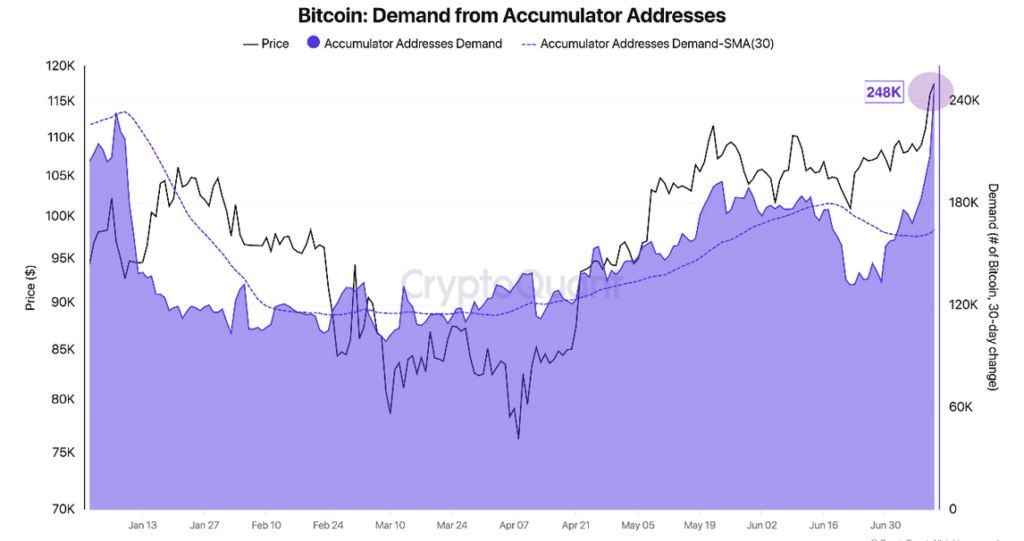
– Line chart showing BTC price and net accumulation trend)
Accumulator Addresses Demand is an on-chain metric designed to measure the net buying activity of long-term holders who have not historically sold Bitcoin. In essence, it answers a critical question: Are there silent buyers absorbing supply even when prices are unstable or declining?
When this metric trends upward, it indicates that long-term capital is steadily accumulating Bitcoin regardless of short-term market noise. Importantly, this behavior should not be interpreted as a short-term bullish signal. Instead, it reflects structural demand that often forms the foundation for future trend transitions.
Historically, sustained increases in accumulator demand have tended to appear during market corrections or late-stage consolidations, rather than during euphoric rallies.
4. Supply–Demand Structure: Quiet Support, Limited Upside
The current supply–demand structure suggests that downside pressure is increasingly absorbed by long-term buyers, creating a form of latent support beneath the market. This helps explain why recent price declines have not cascaded into deeper, disorderly sell-offs.
However, this support mechanism alone is insufficient to trigger a sustained upward trend. For that to occur, additional elements must align, including:
- Improved net inflows into Bitcoin spot ETFs (USD-denominated)
- Recovery in profitability metrics among short-term holders
- Stabilization of macro liquidity conditions
Absent these factors, Bitcoin may remain locked in a wide consolidation range, oscillating between long-term accumulation and short-term distribution.
5. ETF Flows and Institutional Signaling
“Bitcoin Spot ETF Net Flows (USD)”– Bar chart of daily or weekly ETF inflows/outflows
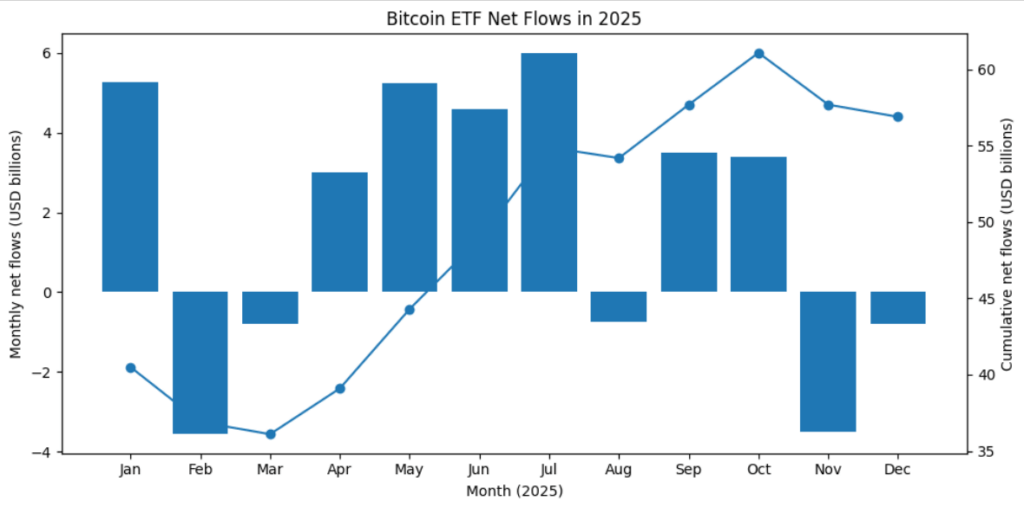
ETF flows serve as a crucial transmission channel between traditional financial markets and Bitcoin’s on-chain economy. While the introduction of spot Bitcoin ETFs has structurally expanded access, recent flow data shows hesitation rather than aggressive accumulation.
This suggests that institutional investors, while not exiting en masse, are adopting a wait-and-see approach—likely influenced by broader macroeconomic uncertainty, interest rate expectations, and cross-asset volatility.
Without a sustained improvement in ETF inflows, upside momentum in Bitcoin is likely to remain muted, even if on-chain accumulation continues.
6. Short-Term Holders and Market Fragility
Short-term holders—typically defined as entities holding Bitcoin for less than 155 days—play a disproportionately large role in amplifying volatility. When their unrealized losses increase, the probability of capitulation events rises.
At present, many short-term holders remain in a marginally unprofitable state. Until this cohort either exits or returns to profitability, upward price expansion is structurally constrained.
This dynamic reinforces the view that the market is not yet primed for a full bullish regime, despite the constructive signals emerging from long-term holders.
7. Implications for Investors and Builders
For investors seeking new crypto assets or yield opportunities, the current Bitcoin environment underscores the importance of time horizon alignment. Short-term trading remains challenging, while long-term positioning appears increasingly supported by structural demand.
For builders and operators focused on practical blockchain applications, this phase offers a reminder that infrastructure development and capital accumulation often occur during periods of price stagnation, not exuberance.
Historically, many of the most impactful developments in the Bitcoin and broader crypto ecosystem have taken shape during precisely such transitional periods.
8. Base Scenario and Risk Factors
The base scenario remains one in which Bitcoin’s downside is supported by long-term capital, while upside progress unfolds slowly and unevenly.
However, this outlook is contingent on several assumptions. Should any of the following occur, the scenario would need reassessment:
- A sharp slowdown or reversal in accumulator demand
- Renewed waves of forced liquidations
- Deterioration in macro liquidity conditions
Monitoring on-chain metrics alongside ETF flows and macro indicators remains essential.
9. Conclusion: A Market Quietly Rebalancing
Bitcoin’s current correction phase is not defined by dramatic capitulation, but by a subtle rebalancing of ownership and influence. While price action remains uninspiring for momentum-driven traders, deeper structural signals suggest that long-term capital continues to position itself deliberately.
This does not guarantee an imminent rally. Rather, it points to a market that is laying groundwork, absorbing supply, and gradually transitioning control toward participants with longer-term conviction.
In this sense, the “faint light” visible today is not a signal flare for immediate upside, but an indication that the market’s internal structure is evolving in a more resilient direction.
