

Main Points :
- A data input error at South Korea’s major exchange Bithumb led to the mistaken allocation of 620,000 BTC as event rewards.
- Although no on-chain transfer occurred, the incident caused a temporary price crash to $55,000 on Bithumb.
- Over 99.7% of the misallocated Bitcoin was recovered within hours through internal controls.
- The event highlights critical operational risks in centralized exchanges—and emerging opportunities in blockchain-based settlement, auditing, and automation.
- For investors and builders, this incident underscores why infrastructure, not just tokens, may be the next major revenue frontier.
1. What Actually Happened: A Human Error With Systemic Impact
On February 6, 2026, Bithumb disclosed that a serious operational error occurred during the distribution of promotional event rewards. The exchange had intended to distribute a reward worth approximately $1.50 per user, equivalent to around $2,000 KRW, but due to a numerical input mistake, the system interpreted the reward amount as 2,000 BTC per recipient.
As a result, 695 user accounts were temporarily credited with an aggregate total of 620,000 BTC—an amount that, at prevailing market prices, was worth approximately $44 billion.
Critically, Bithumb clarified that this allocation existed only within its internal ledger system. No actual Bitcoin was transferred on-chain, and the exchange’s cold or hot wallets were never exposed to an external drain.
However, internal balances alone were sufficient to trigger immediate market consequences.
2. Timeline of the Incident and Emergency Response
Bithumb’s official statement provided a precise timeline:
- 19:00 (KST) – Event rewards distributed to 695 users.
- 19:20 – Internal monitoring systems detect abnormal balances and transaction behavior.
- 19:35 – Trading and withdrawal restrictions applied to affected accounts.
- 19:40 – Restrictions fully enforced across all 695 accounts.
Within 35 minutes, the exchange effectively froze the situation.
[Timeline visualization of incident detection and response]
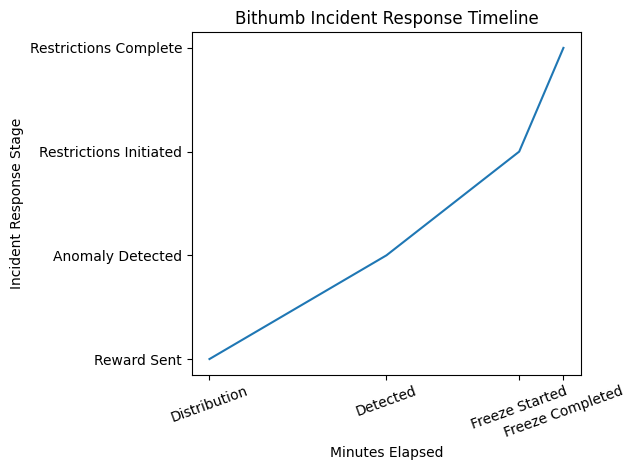
(Graph should show minutes elapsed vs. actions taken: detection, freeze initiation, freeze completion)
This rapid containment was made possible by Bithumb’s abnormal transaction detection system, which flagged sudden sell pressure and anomalous account balances.
3. Market Shock: Why Bitcoin Fell to $55,000—But Only on One Exchange
Despite no on-chain Bitcoin being moved, some users attempted to immediately sell their mistakenly credited balances. Because these trades occurred within Bithumb’s internal order book, the exchange’s local BTC price collapsed to $55,000, significantly below global market levels.
At the same time:
- Other major exchanges saw Bitcoin trading closer to $60,000.
- Within days, broader market prices recovered toward the $70,000 range.
[BTC price comparison—Bithumb vs. global average]
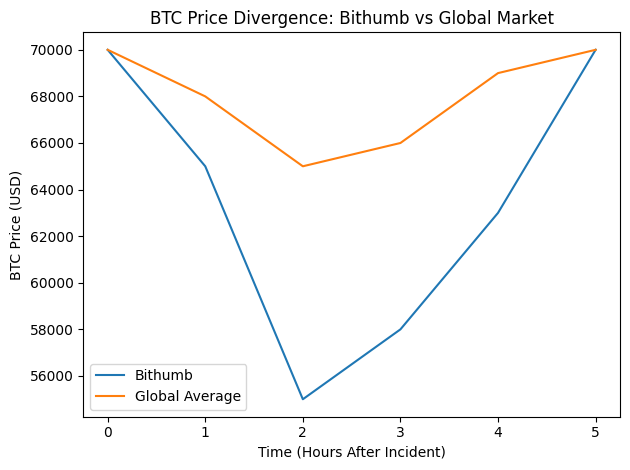
(Line chart comparing BTC/USD price on Bithumb vs. other exchanges during the incident window)
This divergence highlights a critical lesson: price discovery in crypto remains fragmented, and internal exchange events can create extreme—but localized—volatility.
4. Recovery Results: 99.7% Is Not an Accident
Bithumb reported the following recovery outcomes:
- 618,212 BTC recovered directly, representing 99.7% of the total misallocated amount.
- 1,788 BTC worth of assets had already been sold into KRW or other cryptocurrencies.
- Of those sold assets, 93% were successfully recovered through account-level adjustments.
- Zero BTC was transferred externally.
From a risk-management perspective, this is a near-best-case scenario. The exchange’s ability to:
- Freeze accounts,
- Reverse internal ledger entries,
- Reclaim sold assets,
demonstrates the power—and danger—of centralized control.
5. Why This Was Not a Hack—and Why That Distinction Matters
Bithumb emphasized that the incident:
- Was not caused by hacking,
- Involved no security breach,
- Did not compromise customer wallets.
This distinction is crucial for regulators and institutional partners. A hack implies external threat vectors and systemic security failure. A misallocation error, by contrast, points to operational risk, a domain traditionally addressed through:
- Dual-control procedures,
- Transaction simulation,
- Automated sanity checks,
- Segregation of duties.
Yet, as this case shows, human error at scale can rival the impact of a major cyberattack.
6. Broader Industry Context: Why Similar Incidents Keep Happening
This is not an isolated event. Over the past few years, the crypto industry has seen multiple cases where:
- Exchanges credited users incorrectly,
- Smart contracts distributed excessive rewards,
- Bridges mispriced assets due to oracle failures.
What unites these cases is complexity without sufficient automation.
Centralized exchanges still rely heavily on:
- Manual parameter inputs,
- Legacy database logic,
- Post-hoc reconciliation.
As trading volumes and asset diversity grow, these systems are reaching their limits.
7. Practical Lessons for Crypto Builders and Operators
For readers interested in blockchain’s real-world utility, this incident offers concrete takeaways:
Operational Controls Are a Product Opportunity
There is rising demand for:
- Immutable audit trails,
- On-chain reward distribution contracts,
- Pre-execution simulation layers,
- Multi-party authorization workflows.
These are not theoretical ideas—they are sellable B2B infrastructure products.
Internal Ledgers Are the Weakest Link
While blockchains are deterministic, internal exchange databases are not. Bridging this gap is a major opportunity for:
- Zero-knowledge accounting,
- Proof-of-reserves systems,
- Real-time solvency verification.
8. Investment Angle: Infrastructure Over Speculation
For investors seeking new revenue sources, the lesson is clear:
the next wave of crypto growth may come less from new tokens and more from:
- Exchange risk tooling,
- Compliance automation,
- Settlement infrastructure,
- Cross-ledger reconciliation systems.
Projects that reduce the probability or impact of events like Bithumb’s error are likely to see strong institutional demand.
9. Regulatory Implications in Asia and Beyond
South Korea already maintains one of the world’s strictest crypto regulatory regimes. Incidents like this will likely accelerate:
- Mandatory pre-trade validation rules,
- Event reward approval workflows,
- Enhanced reporting to regulators.
Globally, regulators are increasingly focused on operational resilience, not just custody.
10. Final Thoughts: A Crisis That Ended as a Case Study
Bithumb’s 620,000 BTC misallocation incident will be remembered not for the loss it caused—but for the loss it could have caused.
A $44 billion error resolved without on-chain impact is a reminder that:
- Crypto systems are powerful,
- Centralization magnifies both risk and recovery,
- And the industry’s next phase will be defined by boring—but essential—infrastructure.
For builders, operators, and investors alike, this was not just a scare—it was a roadmap.
