
Main Points :
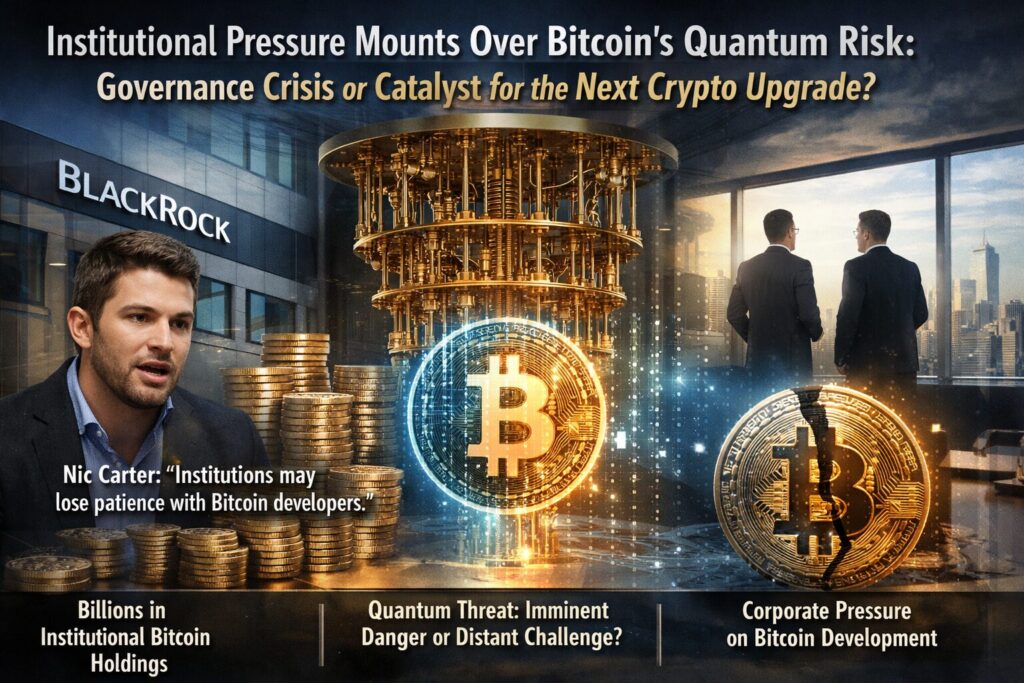
- Venture capitalist Nic Carter warns that major institutional holders could lose patience with Bitcoin developers over slow progress on quantum-resistant cryptography.
- Asset managers like BlackRock now hold hundreds of thousands of BTC, representing billions of dollars in exposure.
- Debate intensifies over whether quantum computing poses an imminent existential threat or a distant technical challenge.
- Some analysts argue only a small portion of Bitcoin is currently vulnerable to quantum attacks.
- Others believe failure to act quickly could trigger corporate influence over Bitcoin development.
- For investors and blockchain builders, the quantum debate may shape the next wave of protocol innovation and capital flows.
1. A New Flashpoint in Bitcoin Governance
Over the past decade, Bitcoin has survived exchange collapses, regulatory crackdowns, forks, and market crashes. Yet a new fault line is emerging—one that is not financial, political, or even regulatory, but technological: quantum computing.
Venture capitalist Nic Carter recently warned that institutional investors holding significant Bitcoin reserves may eventually push to replace core developers if quantum-resistant upgrades are not implemented quickly enough. According to Carter, large institutions—particularly asset managers entrusted with billions in client funds—may not indefinitely tolerate what they perceive as inaction.
The concern centers on the theoretical risk that sufficiently powerful quantum computers could break Bitcoin’s elliptic curve cryptography (ECDSA), potentially exposing public-key-based wallets to theft.
This raises a profound question:
If institutional capital becomes dominant, will Bitcoin remain decentralized in governance—or gradually drift toward corporate influence?
2. BlackRock’s Exposure and Institutional Scale

At the center of the debate is BlackRock, the world’s largest asset manager.
As reported, BlackRock holds approximately 761,801 BTC, valued at roughly $50.15 billion at current prices of around $70,281 per BTC. That represents about 3.62% of Bitcoin’s total supply.
For a passive ETF provider, this is already a meaningful ownership stake. But the implication is larger:
- If Bitcoin were compromised by quantum advances,
- If clients suffered losses due to cryptographic vulnerabilities,
- If developers appeared unwilling to accelerate mitigation,
Would fiduciary responsibility compel institutional actors to intervene?
Carter argues that corporate takeover pressure is plausible and could succeed if the community fails to coordinate around a timely upgrade.
3. How Real Is the Quantum Threat?

Bitcoin relies on elliptic curve cryptography (ECDSA). In theory, a sufficiently advanced quantum computer running Shor’s algorithm could derive private keys from exposed public keys.
However, the industry is divided over urgency.
The Existential Risk Argument
Charles Edwards of Capriole Investments considers quantum computing a potential existential threat to Bitcoin. His stance: upgrading now is cheaper and safer than waiting.
From this perspective:
- Bitcoin’s security model depends on computational infeasibility.
- Quantum breakthroughs could be nonlinear and unpredictable.
- Preemptive migration to post-quantum cryptography avoids catastrophic confidence shocks.
The Skeptical Counterargument
Others, including research leads at major crypto investment firms, argue the risk is overstated.
Christopher Bendiksen of CoinShares noted that out of approximately 1.63 million BTC associated with public-key-exposed wallets, only about 10,230 BTC appear meaningfully vulnerable.
Additionally, supporters such as Michael Saylor and Adam Back argue:
- Practical quantum attacks remain decades away.
- Migration paths would exist long before emergency conditions.
- Market fear may be driving exaggerated narratives.
4. Governance Tension: Developers vs. Capital
Bitcoin development historically prioritizes:
- Minimalism
- Backward compatibility
- Conservative upgrades
- Voluntary consensus
Developers are not employees of corporations. They are independent contributors.
But institutional exposure introduces new dynamics:
- Asset managers answer to shareholders.
- ETF structures demand legal accountability.
- Public companies holding BTC must manage risk disclosure.
If quantum concerns persist, tension could escalate between:
| Developers | Institutions |
|---|---|
| Gradual, consensus-driven upgrades | Accelerated, risk-managed changes |
| Ideological decentralization | Fiduciary duty |
| Volunteer governance | Capital-weighted pressure |
This structural divergence may shape Bitcoin’s next decade.
5. Market Context: Price Decline and Sentiment
At approximately $70,281, Bitcoin has fallen about 26.25% over the past 30 days.
While market declines are common in crypto cycles, Carter previously suggested Bitcoin’s “puzzling” stagnation could reflect quantum-related uncertainty.
Whether or not this interpretation is accurate, perception matters.
In markets:
- Narrative drives volatility.
- Fear amplifies downside.
- Institutional commentary influences flows.
Quantum computing has become a psychological variable in the macro crypto landscape.
6. Implications for Investors Seeking New Opportunities
For readers exploring new digital assets, revenue streams, and blockchain applications, this debate signals several strategic considerations:
A. Post-Quantum Cryptography Projects
Blockchain networks building with quantum-resistant cryptography from inception may attract capital.
Potential themes include:
- Lattice-based cryptography
- Hash-based signatures
- Hybrid cryptographic models
B. Infrastructure Migration Tools
Wallets, custody providers, and exchanges may require:
- Quantum-safe address generation
- Automated migration systems
- Risk-tier wallet classification
This creates opportunities for infrastructure startups.
C. Governance Innovation
Bitcoin’s debate highlights the need for:
- Transparent upgrade pathways
- Stakeholder communication frameworks
- Institutional–developer coordination models
Projects that balance decentralization with structured governance may benefit.
7. Inserted Graphs
Institutional BTC Holdings (Top Holders)
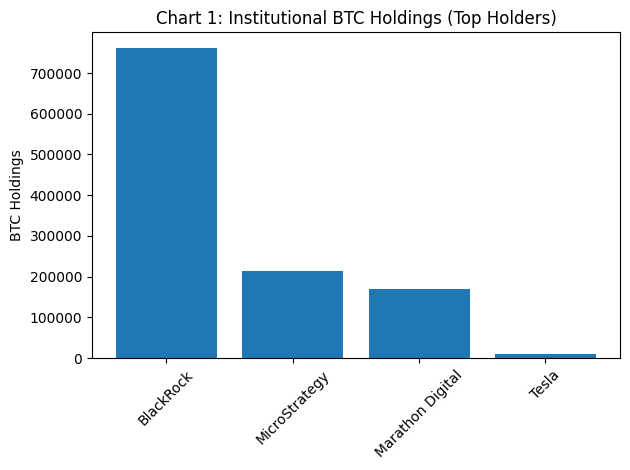
Bar chart comparing BlackRock’s 761,801 BTC to other major institutional holders.
Bitcoin Price (30-Day Decline)
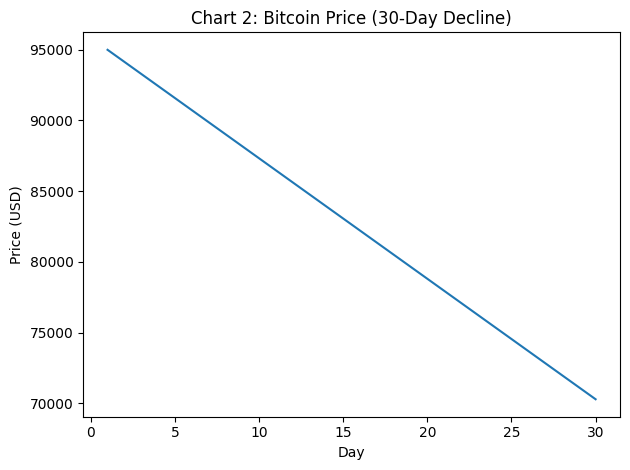
Line graph showing decline from approximately $95,000 to $70,281 over 30 days.
Vulnerable BTC Exposure
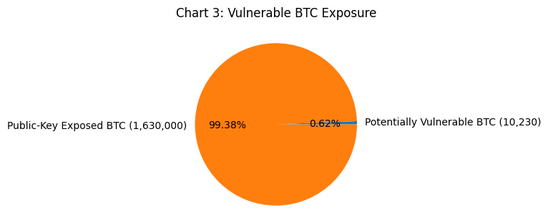
Pie chart showing 10,230 BTC potentially vulnerable vs. 1.63 million BTC public-key exposed.
(These graphs are to visually contextualize scale, market movement, and vulnerability proportion.)
8. Broader Strategic Outlook
Quantum computing may not threaten Bitcoin tomorrow. But the conversation reveals something more important:
Bitcoin is no longer a fringe asset. It is embedded in:
- Public ETFs
- Corporate balance sheets
- Sovereign reserve discussions
- Institutional portfolios
As capital concentration increases, governance complexity rises.
The central question is not merely technical:
Will Bitcoin adapt while preserving decentralization?
Or will institutional capital reshape its evolution?
Conclusion
The debate over quantum computing is more than a technical dispute. It is a governance stress test for Bitcoin’s future.
If the threat proves distant, Bitcoin developers’ cautious approach will appear prudent. If progress accelerates unexpectedly, critics may argue that upgrades should have come sooner.
For investors, this moment offers both caution and opportunity:
- Monitor cryptographic research.
- Evaluate quantum-resilient projects.
- Consider governance structures in long-term allocations.
Bitcoin has weathered many storms. Whether quantum computing becomes another footnote—or a defining catalyst—will depend not only on physics, but on coordination between code and capital.
