A blockchain can become technically more capable without becoming economically more useful. The distinction is particularly important when a network subsidizes data delivery, funds specialized infrastructure operators or expands into new chains. This edition examines three projects outside the dominant cryptocurrency narratives, each with a dated November 2026 development that makes its operating assumptions easier to evaluate. The focus is on the incentives that survive after the release announcement, not on anticipated token returns.
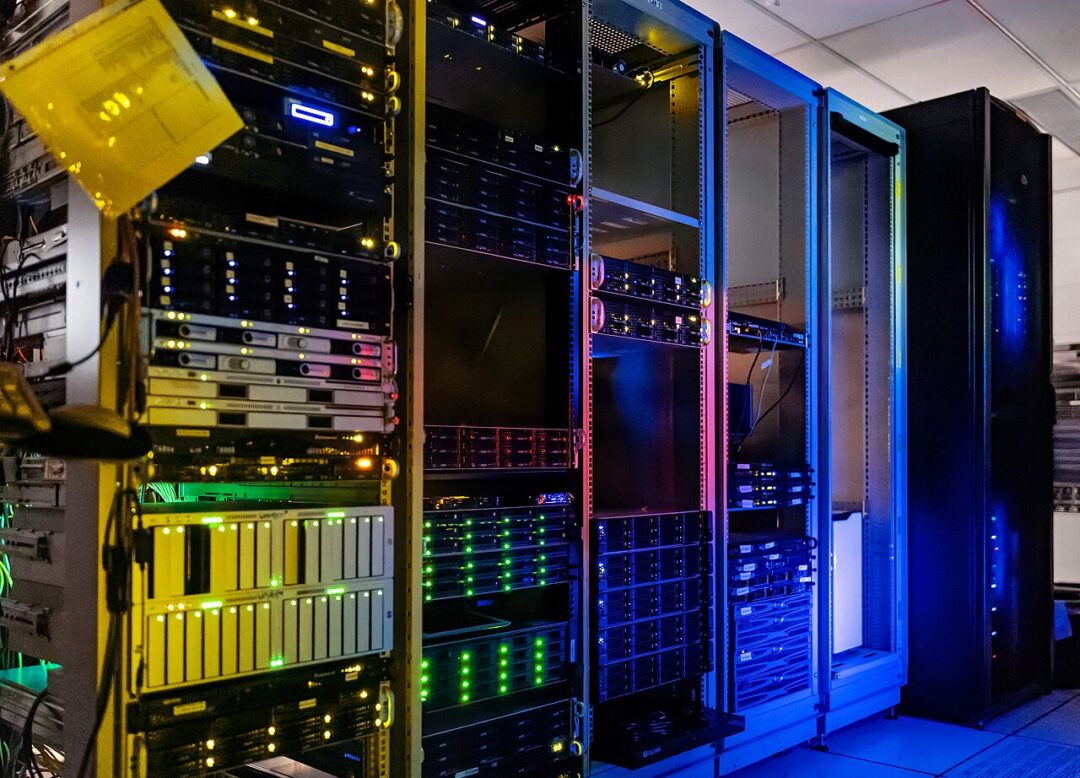
Cover photograph: NOIRLab server racks, NOIRLab/NSF/AURA/T. Slovinský, Wikimedia Commons, CC BY 4.0, resized. Contextual infrastructure photograph, not equipment operated by any featured project.
Three Projects at a Glance
Flare (FLR) combines smart-contract execution with native data services. A November client release limits certain transaction-fee reimbursements on two related networks, offering an opportunity to examine the cost of incentivizing useful data.

Dash (DASH) is a longstanding digital-payment network with a separate service-node layer. Its mandatory Core 24 upgrade introduces changes to node ownership and payment arrangements, but activation requires operator coordination.

Hyperlane (HYPER) provides interoperability between blockchains. Its November registry update records new deployments alongside changes to relayer restrictions and network-specific settings, illustrating why expansion also requires ongoing maintenance.
Why These Projects
The common question is how each system allocates the cost of reliability. Flare must make data accessible without allowing subsidy arrangements to undermine fee discipline. Dash must compensate independent infrastructure operators while keeping participation practical. Hyperlane must deliver messages across networks with different security assumptions and settlement behavior. None of these challenges is solved merely by distributing tokens.
These projects also offer different adoption signals. An oracle can be evaluated by recurring application consumption, a payment network by repeat transactions and merchant integration, and interoperability infrastructure by successful delivery across economically meaningful routes. The metrics are not interchangeable, and reported transaction volume alone is insufficient.
Flare (FLR)
What It Does
Flare is a smart-contract network built around access to external information. Its native token participates in validator security, governance and incentivized provision of price data through the Flare Time Series Oracle. The developer documentation also describes transaction-fee burning. This creates several channels through which actual network use could matter to token economics, although rewards and fees need to be assessed together.
Recent Development
The November 24, 2026 release of go-flare v1.15.2 updates the underlying AvalancheGo software and restricts fee refunds for prioritized contracts on Coston and Songbird. The specified effective times are November 24 at noon UTC for Coston and December 1 at noon UTC for Songbird. Flare mainnet and Coston2 have an optional client update; the announcement does not introduce a new mainnet fork schedule. Actual node adoption and activation on each network have not been independently measured here.
Potential
A network that supplies dependable external data as part of its infrastructure may reduce the integration burden on financial applications. Builders could spend less time assembling independent oracle arrangements and more time addressing collateral management, settlement and application logic. The economic benefit would depend on data quality, diversity of providers and whether applications remain active when incentives decline.
The final FlareDrop distribution occurred on January 30, 2026, according to the developer documentation. This leaves ongoing protocol incentives, staking and genuine application demand as more useful measures of long-term behavior than participation in the completed distribution program. Fee refunds deserve particular scrutiny because they can make observed activity a poor proxy for actual willingness to pay.
Risks and What to Monitor
The immediate question is whether limiting refunds changes costs or participation among affected contracts without degrading data availability. Track application retention, data-service reliability, fee expenditure and rewards paid to providers. The upgrade procedure also matters: older nodes cannot simply skip the required intermediate version when they have not passed the previous activation. FLR trades publicly, but exchange availability does not establish the size of a position that can be liquidated under stress. Assess order-book depth and circulating supply alongside staking economics.
Dash (DASH)
What It Does
Dash uses a proof-of-work base chain and collateralized service nodes to provide additional payment and network functionality. Its technical guide explains quorum-based payment confirmation and ChainLocks, which are designed to improve settlement assurance. DASH is the payment asset and also serves as collateral within the operator model. This connects token demand to infrastructure participation as well as transfers.
Recent Development
The Core 24.0.0 release announced November 5, 2026 is a mandatory network upgrade. Service-node operators were instructed to update before November 9. The earliest possible activation is block 2,580,480, estimated around November 28, and requires 85% of the relevant signing quorum to run the new version. As of this edition, that is a future estimated milestone, not a confirmed successful activation. Changes include shared masternode arrangements, multi-party payment distribution, updated platform asset-lock formats and more compact quorum proofs.
Potential
Shared collateral arrangements could make the economics of operating service nodes more flexible, especially for participants who cannot individually supply all required capital. Multi-party payouts can also reduce the need for an operator to distribute proceeds manually. Neither feature automatically decentralizes infrastructure: the parties controlling operational keys, hosting and collateral arrangements still matter.
The wider commercial case for Dash remains practical payment acceptance. A business requires reliable confirmation, usable accounting records, customer support and a workable conversion route. Better node software can reduce operational friction but cannot create merchant demand on its own.
Risks and What to Monitor
Watch actual activation status, operator version adoption, quorum reliability and any disruptions during migration. Some indexed nodes require a database migration on their first startup; service operators should budget for this rather than treating the update as instantaneous. Longer term, evaluate whether shared node participation disperses control or merely concentrates it among intermediaries. DASH has established exchange markets, but venue access, bid depth and conversion costs differ by jurisdiction. Issuance-funded operator income should not be mistaken for merchant-derived revenue.
Hyperlane (HYPER)
What It Does
Hyperlane provides a messaging layer through which applications on separate blockchains can exchange information. Developers can configure their own verification arrangements and deploy asset-transfer routes. The distinction matters: a message may be delivered through common software while its security depends on the particular verification and configuration choices made for that application.
Recent Development
The November 10 registry release v26.3.0 records Elysium mainnet configuration and core contract addresses, adds separately maintained mainnet and testnet relayer exclusion rules, and updates several transfer routes. It also adjusts Viction reorganization handling following a reported chain reorganization and removes fixed fee overrides for Katana. These are configuration and operational changes, not proof that every route has been independently tested or that new users have arrived.
Potential
A maintained registry lowers the integration cost of discovering supported networks and relevant contract addresses. More predictable configuration and environment-specific restrictions can make cross-chain operations easier to manage. The commercial opportunity is strongest where applications need repeated messages between networks and are willing to pay for their timely and reliable delivery.
The foundation’s token announcement identifies validator staking and usage-linked expansion incentives as parts of HYPER’s intended economic design. That creates a relationship between network activity and token distribution, but does not imply that all route fees accrue to holders or that every route relies on HYPER-backed security. Sustainable demand must be demonstrated beyond subsidized messaging.
Risks and What to Monitor
Each route can have different validator, upgrade and chain-finality risks. An expanding list of supported chains can increase maintenance obligations faster than paying demand. Monitor completed messages, failed deliveries, route-specific verification policies, fees relative to incentives and concentration of traffic. HYPER has active exchange markets, but market snapshots indicate limited executable depth relative to large transfers. A small tradable float or a token reward program can amplify the difference between reported activity and durable economic value.
What to Watch Next
For Flare, the next dated checkpoint is the scheduled Songbird fee-refund change on December 1. For Dash, confirmation of the actual Core 24 activation and subsequent stability is more informative than the estimated activation date. For Hyperlane, route-level performance after registry changes and recurring message activity without disproportionate incentives are the practical tests.
Market depth should be evaluated independently of protocol use. None of the three projects can guarantee that holders will be able to enter or exit at displayed quotes, particularly during disruption. Comparable live order-book and reward-adjusted revenue measurements were not established for all three networks, so no liquidity ranking or precise financial projection is presented.
Final Assessment
Flare, Dash and Hyperlane are addressing different costs of decentralized infrastructure: obtaining data, maintaining payment security and coordinating between chains. Their November releases offer observable technical progress, but the most useful evidence will be sustained service quality, recurring usage and the ability to finance infrastructure without relying indefinitely on token incentives. That is the standard by which their longer-term adoption should be judged.