Market Overview
Real-world asset tokenization is moving beyond experimental blockchain projects and into a new phase focused on usable financial infrastructure. Asset managers, financial institutions and technology platforms are increasingly exploring how bonds, private credit, equities, commodities and other off-chain assets can be represented and transferred through blockchain networks.
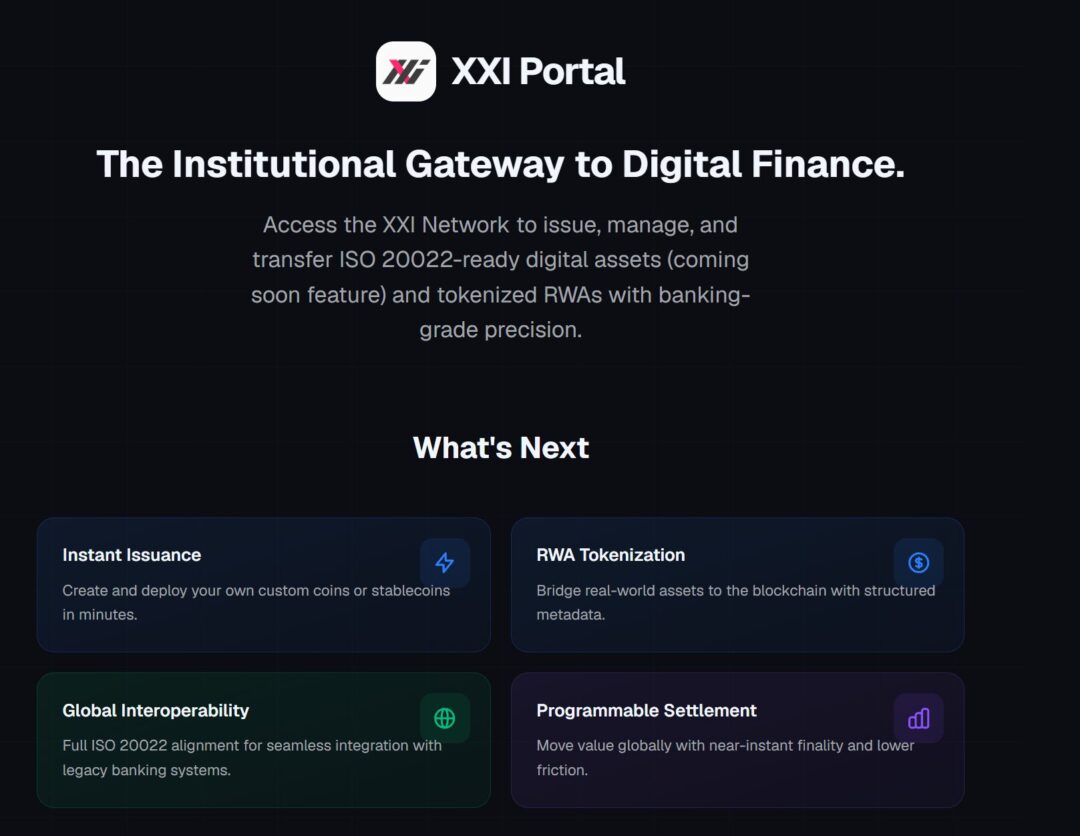
Against this backdrop, Xi Project has released the XXI Portal, a web-based access platform designed to simplify the issuance, transfer and management of digital assets on the XXI Network. The portal is now accessible through portal.xiproject.com.
The most important feature of the release is accessibility. Through social login and a simplified issuance interface, a user can register and begin creating a custom digital asset in a matter of minutes, without first developing a blockchain application or operating separate network infrastructure.
XXI Portal Moves From Development to Practical Release
XXI Portal serves as the user-facing gateway to the XXI Network. It allows projects, businesses and prospective asset issuers to create digital assets, enter basic asset information and transfer supported tokens through a web interface.
According to Xi Project’s platform description, the issuance process follows a straightforward sequence: users access the portal, create or select an asset, configure its name and asset code, confirm issuance and then manage transfers through the XXI Network. The platform is intended to reduce the technical burden normally associated with blockchain-based asset creation.
This does not mean that every token issued through the portal automatically qualifies as a legally recognized RWA, security or stablecoin. The portal supplies the technical issuance layer, while the issuer remains responsible for the asset’s legal structure, ownership documentation, valuation, custody, redemption rights and regulatory compliance.
Xi Project’s terms specifically state that users must obtain any licenses or legal permissions required for stablecoin issuance or asset tokenization. Transactions submitted to the XXI Network are also described as permanent and immutable, making pre-issuance review especially important.
From Token Creation to an RWA Market
The release establishes the first layer of a potential RWA ecosystem: the ability to create and transfer the digital representation of an asset. A complete RWA market, however, requires several additional layers around that token.
- A legal entity or contractual structure connecting the token to the underlying asset
- Verification that the asset exists and is controlled by the issuer or custodian
- Clear ownership, income, redemption and liquidation rights
- Investor identification and jurisdiction-based eligibility controls
- Reliable pricing, valuation and reporting procedures
- A compliant venue through which eligible participants can acquire or transfer the token
- Ongoing administration of dividends, interest, rent or other asset-generated proceeds
XXI Portal can therefore shorten the technical starting process from weeks of custom blockchain development to a guided issuance workflow. For a properly structured RWA, the actual legal, compliance and operational preparation will still take considerably longer than the token creation itself.
This distinction matters. Creating a blockchain token can now take only a few minutes. Creating a credible investment product backed by property, private credit, securities or another real asset remains a multidisciplinary process involving legal, financial, technical and compliance work.

Stellar Expands Into Tokenized Private Credit
The timing of the XXI Portal release coincides with growing RWA activity across several established blockchain ecosystems. Stellar, whose asset-issuance model provides part of the broader technological foundation from which the XXI ecosystem has developed, announced a significant private-credit initiative on July 6, 2026.
Tradable agreed to bring as much as $1 billion in tokenized private-credit assets to Stellar. The initiative is intended to place institutional credit products on-chain and make them usable within blockchain-based financial applications. It represents a shift from merely recording assets on a distributed ledger toward connecting those assets with settlement, collateral and liquidity services.
Stellar has also continued building compliance-oriented RWA infrastructure. Earlier in 2026, the Stellar Development Foundation made a strategic investment in Ascend, which is developing permissioned credit vaults, collateral monitoring and institutional liquidation infrastructure. Stellar already supports tokenized investment products associated with institutions including Franklin Templeton, WisdomTree and Paxos.
These developments demonstrate that RWA competition is increasingly centered on the complete lifecycle of an asset: issuance, compliance, custody, transfer, collateral use, liquidity and eventual redemption.
Solana’s RWA Market Surpasses $3 Billion
Solana entered July with rapid growth in tokenized equities and other real-world assets. In its ecosystem report published on July 6, the Solana Foundation said the network’s RWA value had exceeded $3 billion during June 2026.
The same report stated that cumulative tokenized-stock trading volume had passed $10 billion, while daily tokenized-stock volume reached a record $683 million. Among the month’s most visible developments was the issuance of tokenized SpaceX shares through Backpack Securities and Sunrise, with the tokens representing ownership of underlying securities for eligible investors.
Solana’s tokenized-equity activity continued into July. On July 10, tokenized shares linked to SK Hynix began trading on Solana, providing blockchain-based exposure to one of South Korea’s largest semiconductor companies.
The Solana example shows what can happen after issuance infrastructure is connected to regulated brokerage, custody, market-making and distribution. A token becomes commercially useful when users can understand what it represents, verify their rights and access sufficient liquidity to enter or exit a position.
XRP Ledger Builds Institutional Credit Infrastructure
The XRP Ledger is similarly being developed as an infrastructure layer for tokenized financial assets. Ripple has emphasized the network’s built-in asset issuance, decentralized exchange and compliance-oriented capabilities as foundations for institutional tokenization.
On June 29, 2026, Ripple presented the XRPL Lending Protocol as a way to bring fixed-term credit markets directly onto the ledger. The development is relevant to the RWA sector because tokenized treasuries, private-credit instruments and other financial assets need lending and collateral infrastructure if they are to become productive components of on-chain markets rather than passive wallet holdings.
Ripple has previously identified availability, accessibility and utility as the three foundations of successful tokenization. Under that framework, issuing the token is only the first step. The issuer must establish a sound legal basis, provide custody and compliance infrastructure, and give investors a practical reason to hold or transact with the asset.
On July 13, Ripple also announced a university-focused digital asset accelerator in Brazil intended to expand development within the XRP ecosystem. Although the program is broader than RWA tokenization alone, the expansion of developers, research and institutional partnerships can support future credit, payment and tokenization applications on XRPL.
Where XXI Portal Fits in the Emerging Market
Stellar, Solana and the XRP Ledger demonstrate three overlapping directions for the RWA industry. Stellar is emphasizing regulated asset issuance, payments and private credit. Solana is building highly liquid markets for tokenized equities and other externally issued assets. XRPL is combining tokenization with stablecoins, compliance controls and native credit infrastructure.
XXI Portal enters this market from a different starting point: making digital asset issuance simple enough for smaller businesses, projects and prospective asset issuers to begin without assembling a specialized blockchain engineering team.
Its immediate opportunity is not necessarily to compete directly with the largest institutional tokenization platforms. It can instead provide an accessible issuance environment through which businesses test asset structures, create demonstration tokens and prepare projects for more advanced legal, custody and market infrastructure.
The platform is also being positioned for future stablecoin, RWA and ISO 20022-compatible financial applications. ISO 20022 readiness could become particularly relevant when tokenized assets need to interact with bank payment messages, reconciliation systems and regulated settlement processes. However, practical banking integration will depend on future technical connections and partnerships rather than token issuance alone.
What Prospective RWA Issuers Should Prepare
Businesses considering XXI Portal should determine the commercial and legal purpose of an asset before issuing it. A demonstration or utility token has a different risk profile from a token promising ownership, investment returns, repayment, profit participation or redemption against an underlying asset.
Before launching an RWA token, an issuer should be able to answer several essential questions: What asset supports the token? Who owns or controls it? How is its value calculated? What rights does each token provide? How can a holder redeem it? What happens if the issuer becomes insolvent? Which investors and jurisdictions are permitted?
Once those questions are resolved, XXI Portal can provide a faster route to the technical issuance stage. The portal’s simplified process may be especially useful for companies that already possess an asset, legal structure and prospective user base but do not want to construct their own blockchain issuance system from the ground up.
Outlook
As of July 15, 2026, the direction of the market is increasingly clear. Major blockchain ecosystems are no longer discussing RWA tokenization only as a future possibility. Private credit is moving onto Stellar, tokenized equities are recording substantial volume on Solana, and XRPL is developing the credit and compliance infrastructure required for institutional on-chain finance.
XXI Portal brings this movement closer to smaller issuers by simplifying the first technical step. Users can access the portal, create an account and begin issuing a digital asset within minutes. Turning that asset into a trusted and legally enforceable RWA will require additional work, but the blockchain issuance barrier itself has become considerably lower.
The next stage for XXI will be determined by what develops around the portal: verified issuers, compliant asset structures, custody arrangements, pricing data, investor controls, secondary-market access and connections to conventional financial systems.
If these elements are successfully introduced, XXI Portal could progress from a convenient token-creation interface into an accessible gateway for real-world assets, stablecoins and internationally connected digital finance.
This article is provided for informational purposes only and does not constitute investment, legal or financial advice. The issuance and distribution of tokenized assets may be regulated differently depending on the asset, transaction structure and jurisdiction.