

Main Points :
- Crypto-related crime losses reached $11.36 billion in 2025, up 22% YoY
- Investment scams alone accounted for $7.2 billion, dominating total losses
- AI-driven fraud caused $893 million in losses, with deepfake scams accelerating
- Organized crime networks in Southeast Asia are industrializing crypto scams
- Governments are scaling countermeasures, but technology is evolving faster
- For investors and builders, security and trust layers are now core business models
1. A Record-Breaking Year for Crypto Crime
The global cryptocurrency ecosystem has entered a new phase—one defined not only by growth and institutional adoption, but also by escalating criminal sophistication. According to the FBI’s 2025 Internet Crime Report, crypto-related losses reached $11.36 billion, marking a 22% increase year-over-year. This surge reflects both the expansion of crypto adoption and the parallel scaling of exploitative mechanisms targeting users and institutions.
The number of complaints rose to over 181,000 cases, indicating that crypto crime is no longer a niche risk affecting only early adopters. Instead, it has become a mainstream financial threat. The average loss per victim exceeded $62,000, highlighting the severity and financial impact of these attacks.
More concerning is the distribution of losses: nearly 18,600 victims reported losing over $100,000 each, suggesting that criminals are increasingly targeting higher-value individuals and entities. This aligns with a broader shift toward precision-targeted fraud, enabled by data analytics and AI.
2. Investment Scams: The Dominant Threat
Among all categories, crypto investment scams accounted for approximately $7.2 billion, making them the single largest contributor to total losses. These scams are often structured as highly convincing financial opportunities, leveraging both psychological manipulation and technological sophistication.
The typical scam follows a multi-stage funnel:
- Initial contact via social media, dating apps, or targeted ads
- Migration to private messaging platforms such as Telegram or WhatsApp
- Introduction to a “trusted investment group” or “expert advisor”
- Gradual encouragement to deposit funds into a fraudulent trading platform
What distinguishes modern scams is their long-term engagement strategy. Victims are often nurtured over weeks or months, building emotional trust before financial extraction begins. This tactic, often referred to as “pig butchering,” has proven devastatingly effective.
Furthermore, scammers frequently simulate trading profits within fake platforms, reinforcing trust and encouraging larger deposits. By the time victims attempt withdrawal, access is blocked or additional “fees” are demanded.
3. Industrialization of Scam Operations
A critical insight from the report is the industrial scale of organized crypto fraud, particularly in Southeast Asia. Countries such as Cambodia and Laos have been identified as hubs for large-scale scam operations run by transnational criminal organizations.
These operations often involve:
- Human trafficking victims forced to operate scam systems
- Large call-center-like environments executing scripted fraud
- AI-assisted tools for communication and identity impersonation
This industrialization represents a shift from isolated cybercrime to systematic financial exploitation networks, comparable in scale to traditional organized crime industries.
For investors and platforms, this means that threats are no longer sporadic—they are persistent, coordinated, and continuously evolving.
4. The Rise of AI-Driven Fraud
One of the most alarming developments is the rapid increase in AI-powered fraud, which generated approximately $893 million in losses in 2025.
AI is fundamentally transforming the fraud landscape in several ways:
Deepfake Identity Fraud
Criminals now use AI to generate realistic videos and voice recordings of CEOs, public figures, or even personal contacts. These deepfakes are used to:
- Convince employees to transfer funds
- Manipulate investors into trusting fake opportunities
- Bypass identity verification systems
Hyper-Personalized Scams
AI enables scammers to generate customized conversations at scale, tailoring messages based on the victim’s profile, behavior, and preferences. This significantly increases success rates compared to traditional phishing.
Voice Cloning Attacks
In some cases, victims receive calls that sound exactly like family members or colleagues, requesting urgent financial assistance. These attacks exploit emotional triggers and urgency, making them highly effective.
5. Additional Threat Vectors
Beyond investment scams and AI fraud, several other categories contribute to the growing risk landscape:
- Recovery Scams: Victims of previous fraud are targeted again with promises to recover lost funds
- Technical Support Scams: Fraudsters impersonate crypto service providers to gain access to wallets
- Ransomware: Increasingly demands payment in cryptocurrency due to its pseudonymous nature
These layered threats create a compounding risk environment, where victims can be exploited multiple times across different attack vectors.
6. Government Countermeasures and Their Limits
Governments are responding with increasingly coordinated efforts. The FBI’s initiatives provide insight into the evolving defense mechanisms:
Operation Level Up
This program proactively identifies victims of investment scams and notifies them before further losses occur. By 2025, it had prevented over $500 million in additional losses.
Scam Center Strike Force
A multi-agency task force targeting both overseas scam centers and domestic infrastructure used in fraud operations. This includes shutting down fraudulent ISP networks and social media accounts.
Asset Recovery Teams (RAT)
These teams collaborate with financial institutions to freeze and recover stolen funds. However, despite these efforts, a fundamental challenge remains: the speed of innovation in fraud exceeds the speed of regulation and enforcement. Criminals are early adopters of new technologies, often leveraging them before defensive frameworks are established.
7. Insert Figure 1 Here
Crypto vs AI Crime Losses (USD Billions, 2024–2025)
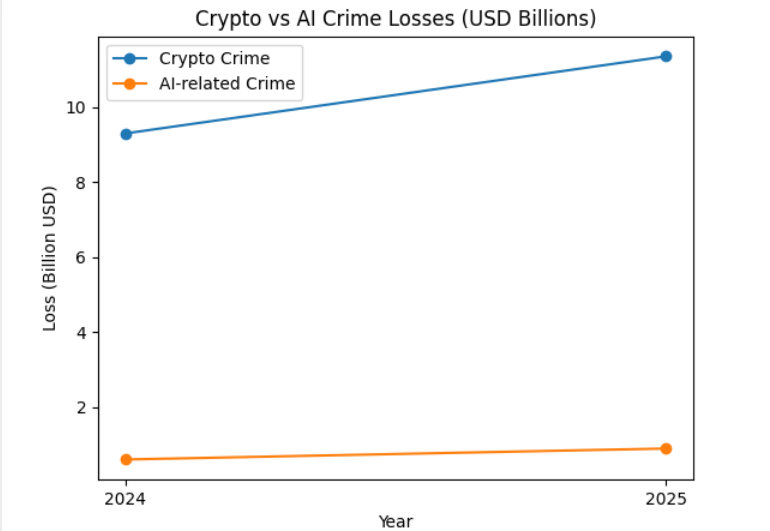
This chart illustrates the rapid growth in both crypto-related crime and AI-driven fraud, highlighting how both vectors are expanding simultaneously.
8. Strategic Implications for Investors and Builders
For readers seeking new crypto opportunities and revenue streams, this data is not merely a warning—it is a strategic signal.
Security as a Revenue Layer
Platforms that integrate advanced fraud detection, identity verification, and transaction monitoring can differentiate themselves in the market. Security is no longer a cost center—it is a value proposition.
Trust Infrastructure as a Business Model
There is growing demand for:
- On-chain identity verification
- Decentralized reputation systems
- Compliance-integrated wallets and exchanges
Projects that bridge compliance and usability will capture significant market share.
AI vs AI: The Next Battlefield
As attackers use AI, defenders must do the same. Expect rapid growth in:
- AI-driven fraud detection systems
- Behavioral analytics platforms
- Real-time risk scoring engines
9. The Future: Convergence of Finance, AI, and Crime
The convergence of cryptocurrency and AI represents both opportunity and risk. On one hand, these technologies enable:
- Faster global payments
- Decentralized financial systems
- New asset classes and investment models
On the other hand, they create an environment where trust is increasingly difficult to establish.
The future of crypto will not be defined solely by price movements or technological innovation. It will be shaped by the ability to secure systems, verify identities, and maintain trust at scale.
Conclusion
The $11.36 billion in crypto crime losses in 2025 is not just a statistic—it is a reflection of a rapidly evolving digital economy where opportunity and risk are deeply intertwined.
For investors, the message is clear: understanding risk is as important as identifying opportunity.
For builders, the mandate is even stronger: security, compliance, and trust must be embedded into the core architecture of any platform.
As AI continues to reshape both offense and defense, the winners in this new landscape will be those who can balance innovation with resilience.



