
Key Takeaways :
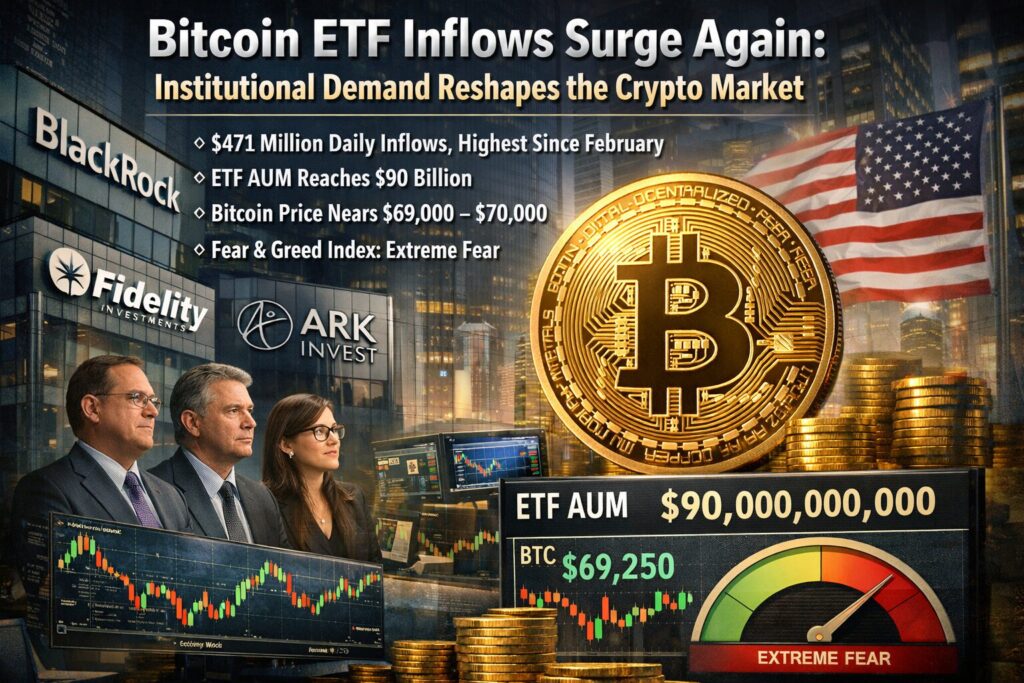
- U.S. spot Bitcoin ETFs recorded $471 million in daily inflows, the highest since late February
- Major players such as BlackRock, Fidelity, and ARK Invest are leading capital accumulation
- Total ETF assets under management (AUM) have recovered to $90 billion
- Bitcoin price fluctuates near $69,000–$70,000, showing resilience despite macro uncertainty
- Market sentiment remains cautious, with the Fear & Greed Index at “Extreme Fear”
- Institutional capital is increasingly acting as a price stabilizer and long-term driver
1. A Strong Comeback in Bitcoin ETF Inflows
The resurgence of capital inflows into U.S.-listed spot Bitcoin ETFs marks a pivotal moment for the cryptocurrency market. On April 6, total net inflows reached approximately $471 million, representing the largest single-day inflow since February 25, when the market saw $507 million enter ETF products.
This renewed inflow momentum is particularly notable given the broader macroeconomic uncertainty and the cautious sentiment prevailing across global financial markets. Traditionally, periods of fear tend to suppress risk asset investments, including cryptocurrencies. However, the latest data suggests a divergence: institutional investors are continuing to accumulate Bitcoin even as retail sentiment remains subdued.
The inflow figures demonstrate that Bitcoin ETFs are no longer just passive instruments tracking price movements—they are actively shaping market dynamics by absorbing supply and stabilizing volatility. This marks a structural evolution in how Bitcoin is traded and valued.
2. Institutional Leaders Driving the Momentum
A closer look at the inflow distribution reveals that a handful of major institutional players dominate capital allocation.
- BlackRock’s iShares Bitcoin Trust (IBIT): approximately $182 million
- Fidelity’s Wise Origin Bitcoin Fund (FBTC): approximately $147 million
- ARK Invest / 21Shares Bitcoin ETF (ARKB): approximately $119 million
For ARKB, this represents the largest daily inflow since July 2025, indicating renewed confidence among investors who previously rotated out of higher-risk crypto exposure.
What is particularly significant is the consistency of inflows across multiple funds. This suggests that demand is not concentrated in a single ETF product, but rather reflects a broader institutional thesis: Bitcoin is increasingly viewed as a legitimate portfolio asset.
3. ETF AUM Recovery and Market Structure Impact
Following three consecutive trading days of inflows in early April, total net inflows reached approximately $307 million, pushing total Bitcoin ETF assets under management back to $90 billion.
This recovery is critical for several reasons:
First, it signals that the ETF market has regained momentum after a period of stagnation. Earlier in the year, ETF flows had slowed significantly, raising concerns about whether initial enthusiasm had faded. The recent rebound suggests otherwise.
Second, growing AUM reinforces Bitcoin’s integration into traditional financial systems. ETFs serve as a bridge between crypto-native markets and institutional capital, enabling pension funds, hedge funds, and asset managers to gain exposure without directly holding digital assets.
Third, higher AUM translates into greater liquidity and depth, which reduces volatility and enhances price discovery mechanisms.
4. Price Dynamics: Stability Amid Volatility
Bitcoin’s price briefly approached the $70,000 level before retracing slightly to the $69,000 range. This price behavior reflects a market in transition.
On one hand, upward pressure from ETF inflows supports price appreciation. On the other hand, macroeconomic headwinds—including interest rate uncertainty and global liquidity tightening—limit upside momentum.
The key takeaway is that Bitcoin is no longer behaving purely as a speculative asset. Instead, it is increasingly demonstrating characteristics of a macro-sensitive asset, influenced by both institutional flows and global economic conditions.
5. Market Sentiment: Extreme Fear vs Institutional Confidence
Despite strong ETF inflows, the crypto market sentiment remains cautious. The Fear & Greed Index currently sits at 23 (“Extreme Fear”), indicating that retail investors are still hesitant.
This divergence between sentiment and capital flows is one of the most important developments in today’s crypto market.
Historically, Bitcoin rallies were driven largely by retail enthusiasm. Today, however, institutional investors are stepping in during periods of fear, effectively providing a floor for prices.
This shift suggests a maturation of the market:
- Retail investors react emotionally to price movements
- Institutional investors act strategically based on long-term allocation models
As a result, the market becomes less volatile and more resilient over time.
6. Insert Figure 1 Here – Bitcoin ETF Inflows Trend
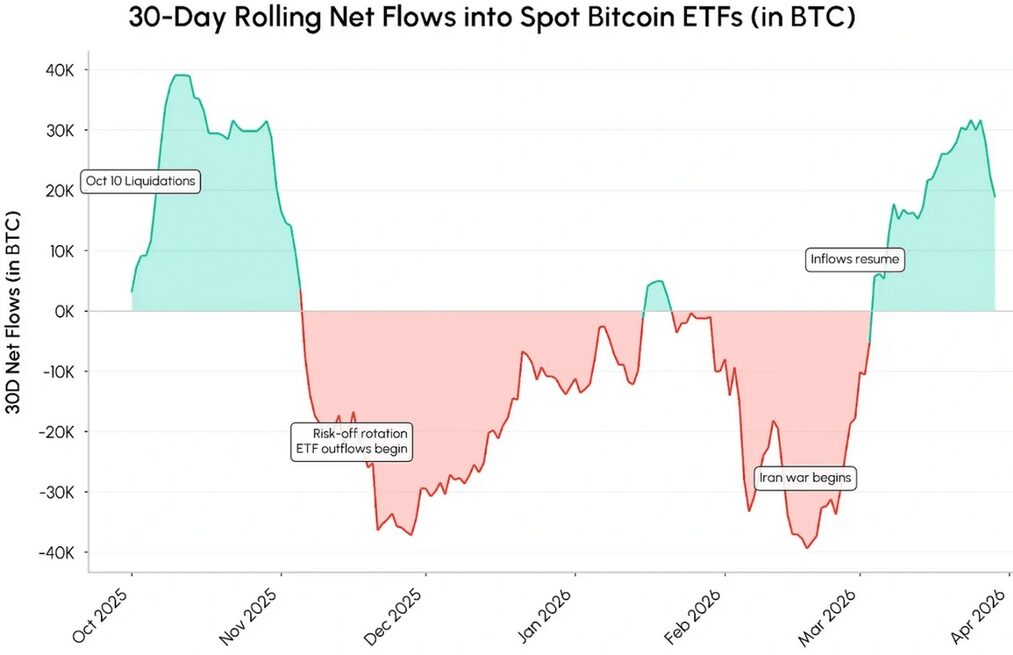
Figure 1 Description:
Daily inflows into Bitcoin spot ETFs, highlighting the spike to $471M on April 6.
7. Insert Figure 2 Here – Bitcoin Price vs ETF AUM
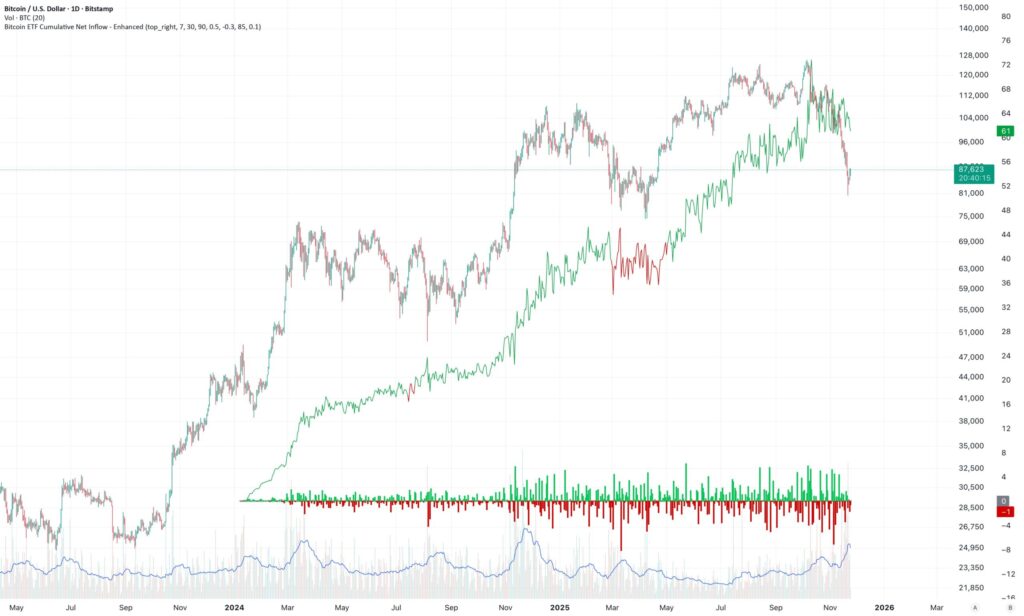
Figure 2 Description:
Correlation between Bitcoin price movements and ETF AUM growth.
8. Broader Trends: The Institutionalization of Crypto
The recent ETF inflow surge is part of a broader trend: the institutionalization of cryptocurrency markets.
Several key developments reinforce this trend:
- Increased allocation from traditional asset managers
- Integration of crypto into diversified portfolios
- Growing acceptance of Bitcoin as “digital gold”
- Expansion of custody and compliance infrastructure
These developments are transforming Bitcoin from a niche asset into a mainstream financial instrument.
Moreover, ETFs are acting as a gateway for future innovation, including:
- Multi-asset crypto ETFs
- Tokenized securities
- On-chain settlement systems integrated with traditional finance
9. Implications for Investors and Builders
For investors, the message is clear: Bitcoin is entering a new phase characterized by institutional dominance and structural stability.
For builders and entrepreneurs, this shift opens new opportunities:
- Infrastructure for institutional trading
- Compliance and regulatory technology
- Cross-border payment systems leveraging blockchain
- Hybrid CeFi–DeFi models
The convergence of traditional finance and blockchain technology is accelerating, and those positioned at the intersection stand to benefit the most.
10. Conclusion: A Structural Shift in Motion
The resurgence of Bitcoin ETF inflows is more than a short-term market event—it represents a structural transformation in the crypto ecosystem.
Even as retail sentiment remains cautious, institutional capital continues to flow into Bitcoin, reinforcing its role as a strategic asset. The recovery of ETF AUM to $90 billion underscores the growing importance of regulated investment vehicles in shaping the market.
Looking ahead, the interplay between institutional demand, macroeconomic conditions, and technological innovation will define the next phase of Bitcoin’s evolution.
For those seeking new crypto assets, revenue opportunities, and practical blockchain applications, one thing is clear:
the era of institutional crypto has truly begun.



