

Main Points :
- U.S. M2 money supply has exceeded $22.6 trillion, signaling a renewed liquidity expansion cycle
- Long-term monetary expansion has structurally reduced fiat purchasing power
- Bitcoin’s value is driven by both liquidity absorption and network growth dynamics
- The interaction of liquidity, price, and network activity forms a three-layer analytical framework
- Institutional flows, ETFs, and macro instability are accelerating Bitcoin’s role as a monetary hedge
1. Introduction: The Silent Shift in Global Liquidity
The recent expansion of the U.S. M2 money supply beyond $22.6 trillion is not merely a statistical milestone—it represents a fundamental shift in the global liquidity environment. Historically, such expansions have served as the underlying fuel for asset price inflation, particularly within risk-on markets such as equities and cryptocurrencies.
M2, which includes cash, checking deposits, savings accounts, and money market funds, is widely regarded as the most comprehensive indicator of available capital within an economy. When this pool expands, it creates excess liquidity that must find a destination—often flowing into financial assets.
Since the 2008 Global Financial Crisis, M2 has nearly tripled. In parallel, the purchasing power of the U.S. dollar has declined by approximately 38%, illustrating a clear structural relationship between monetary expansion and currency debasement.
This macroeconomic backdrop sets the stage for understanding Bitcoin—not merely as a speculative asset, but as a structural response to fiat dilution.
2. Structural Inflation and the Decline of Purchasing Power
The expansion of money supply inherently dilutes the value of existing currency units. Unlike temporary inflation caused by supply shocks, this represents structural inflation, embedded within the financial system itself.
Governments, particularly in developed economies, have increasingly relied on:
- Fiscal deficits
- Sovereign debt issuance
- Central bank liquidity injections
These mechanisms, while stabilizing short-term economic conditions, introduce long-term distortions. The result is a persistent erosion of purchasing power, forcing investors to seek alternative stores of value.
Traditionally, gold served this function. However, in the digital age, Bitcoin has emerged as a more dynamic alternative—combining scarcity with programmability.
3. Bitcoin as a Liquidity Absorber
One of the most important insights from recent data is that Bitcoin acts as a liquidity sink.
As M2 expands, excess capital seeks higher returns. Bitcoin, due to its:
- Fixed supply (21 million coins)
- Global accessibility
- High volatility and upside potential
becomes a natural destination for surplus liquidity.
This relationship explains why Bitcoin has exhibited strong long-term correlation with global liquidity cycles. Each major bull run—2013, 2017, 2021—was preceded or accompanied by significant liquidity expansion.
However, liquidity alone does not fully explain Bitcoin’s value trajectory.
4. The Second Layer: Network Growth as a Value Driver
Unlike traditional assets, Bitcoin is not just a store of value—it is a network.
This introduces a second dimension of valuation: usage and adoption.
Active addresses, transaction volume, and network participation provide insight into real demand. Notably:
- 2017 and 2021 peaks saw simultaneous spikes in both price and active addresses
- Network growth often precedes or reinforces price movements
This reflects a fundamental truth: Bitcoin’s value is not solely derived from speculation—it is reinforced by actual usage.
This dual nature—asset + network—distinguishes Bitcoin from gold and traditional financial instruments.
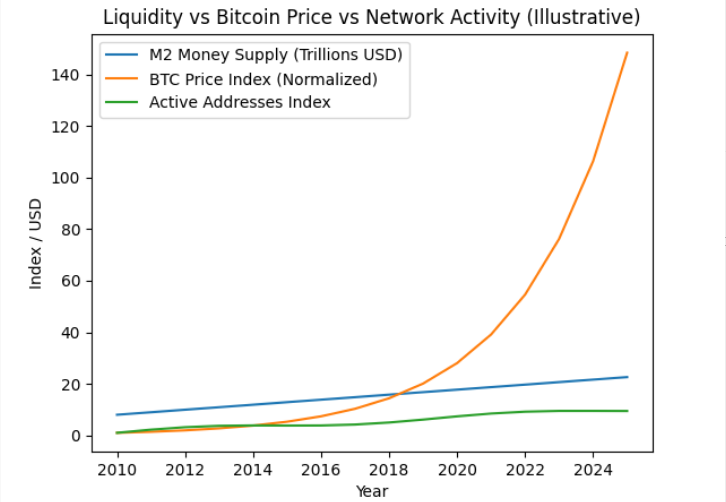
5. The Three-Layer Model: Liquidity, Price, and Network
To properly understand Bitcoin’s long-term trajectory, a three-layer analytical framework is essential:
Layer 1: Liquidity (M2)
Represents total capital available in the system.
Forms the foundation of long-term price trends.
Layer 2: Price (BTC)
Reflects market response to liquidity.
Highly sensitive to capital inflows and speculative cycles.
Layer 3: Network Activity (Active Addresses)
Represents real usage and adoption.
Determines sustainability of price movements.
This model provides a more robust framework than traditional price-only analysis, particularly for long-term investors.
6. Why Is M2 Expanding Again?
Despite nominal monetary tightening policies, liquidity continues to expand due to structural factors:
- Persistent government deficits
- Increasing Treasury issuance
- Financial system stabilization measures
- Hidden liquidity via reverse repo and shadow banking
This creates a paradox:
Tightening in theory, expansion in practice.
For markets, what matters is not policy rhetoric, but actual liquidity conditions—and those remain accommodative.
7. Risks: The Quality of Liquidity
Not all liquidity is equal.
The current expansion is heavily driven by government debt, rather than organic private sector growth. This introduces several risks:
- Reduced sustainability of liquidity-driven rallies
- Increased sensitivity to interest rate changes
- Potential for sudden policy reversals
If inflation resurges, central banks may be forced to tighten aggressively, creating downward pressure on risk assets—including Bitcoin.
8. Bitcoin’s Dual Value Proposition
Bitcoin’s strength lies in its dual structure:
1. Scarcity Hedge
With a fixed supply, Bitcoin acts as protection against currency debasement.
2. Network Growth Engine
As adoption increases, its utility and value expand organically.
This combination creates a unique asset class that bridges:
- Monetary hedge (like gold)
- Growth technology (like the internet)
9. Recent Trends: Institutionalization and ETFs
Recent developments reinforce Bitcoin’s structural importance:
- Spot Bitcoin ETFs attracting institutional capital
- Increased corporate treasury adoption
- Integration with traditional financial infrastructure
These trends suggest Bitcoin is transitioning from:
Speculative asset → Core macro asset
10. Conclusion: A New Financial Framework
The expansion of M2 is a long-term tailwind for Bitcoin—but it is not sufficient on its own.
Sustainable growth requires:
- Continued network adoption
- Real-world use cases
- Integration with financial systems
Going forward, markets must be understood through the lens of:
Liquidity + Price + Network
Bitcoin sits at the intersection of all three.
This is not merely a trend—it is the foundation of a new financial paradigm.



