
Key Takeaways :
- Twenty One Capital has become the second-largest corporate Bitcoin holder, with over $2.9 billion in BTC reserves.
- The fall of MARA highlights the risk of debt-driven Bitcoin accumulation strategies.
- A divide is emerging between sustainable treasury models and speculative leverage-based approaches.
- Analysts warn of a “death spiral” risk for firms unable to maintain valuation premiums.
- The next phase of crypto adoption will favor disciplined capital strategy and long-term conviction.
Introduction: A Shift in Bitcoin Corporate Power
Corporate Bitcoin Holdings Distribution
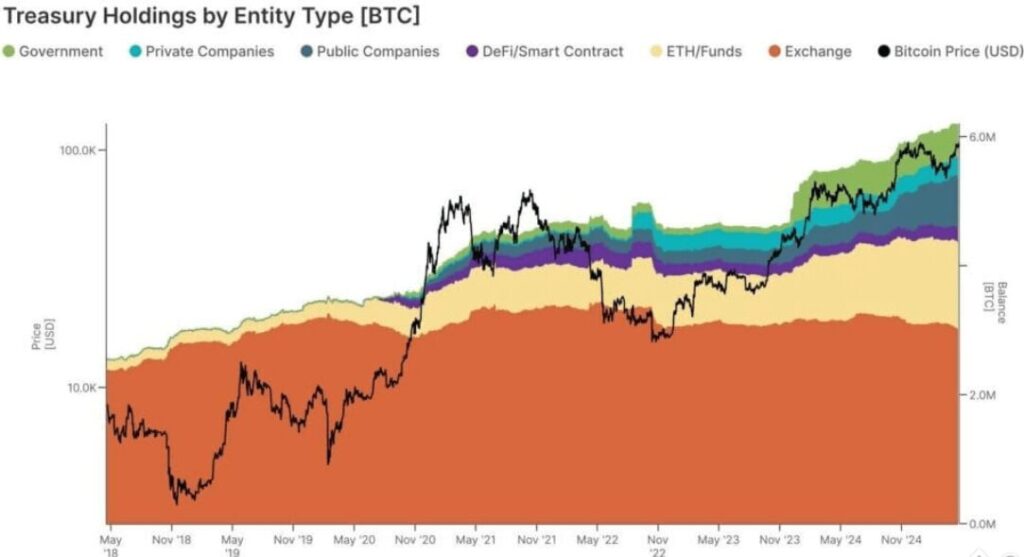
The corporate Bitcoin landscape is undergoing a structural transformation. A newly listed firm, Twenty One Capital, has rapidly ascended to become the second-largest public holder of Bitcoin. With 43,514 BTC—valued at approximately $2.9 billion, the company has positioned itself as a major force in the evolving institutional Bitcoin ecosystem.
This rise comes not merely as a story of accumulation, but as part of a broader narrative: the divergence of strategies among corporate Bitcoin holders. As some companies double down on disciplined treasury management, others are faltering under the weight of debt-driven expansion.
The Rise of Twenty One Capital
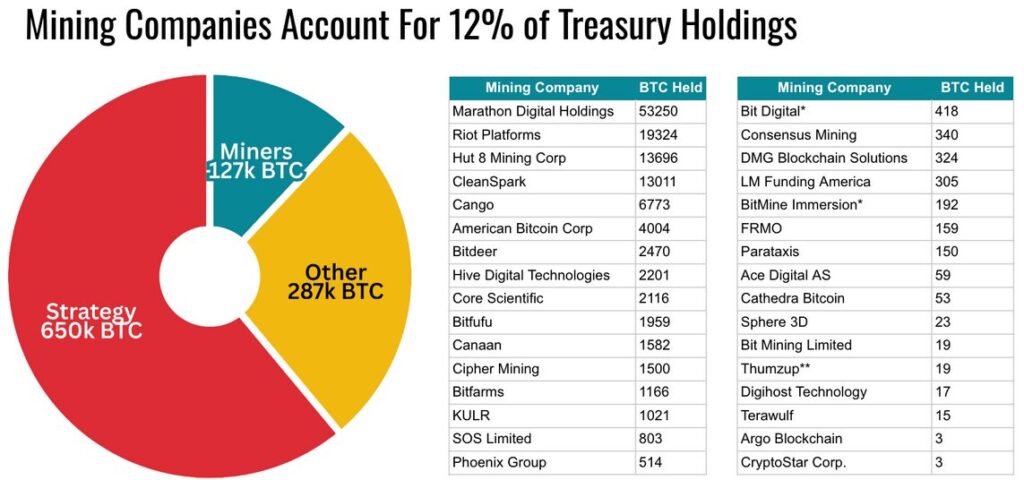
Twenty One Capital emerged through a SPAC merger with Cantor Equity Partners, allowing it to go public under the ticker XXI on the New York Stock Exchange. Despite its relatively recent listing, the company has rapidly accumulated a substantial Bitcoin reserve.
Its 43,514 BTC holdings place it just behind industry leader MicroStrategy, long known for pioneering the Bitcoin treasury strategy under Michael Saylor.
However, the rise of Twenty One Capital is not without complexity. Despite its impressive Bitcoin holdings, its stock has declined over 25% year-to-date, reflecting broader market pressures and investor skepticism toward crypto-linked equities.
The Fall of MARA: A Warning Signal
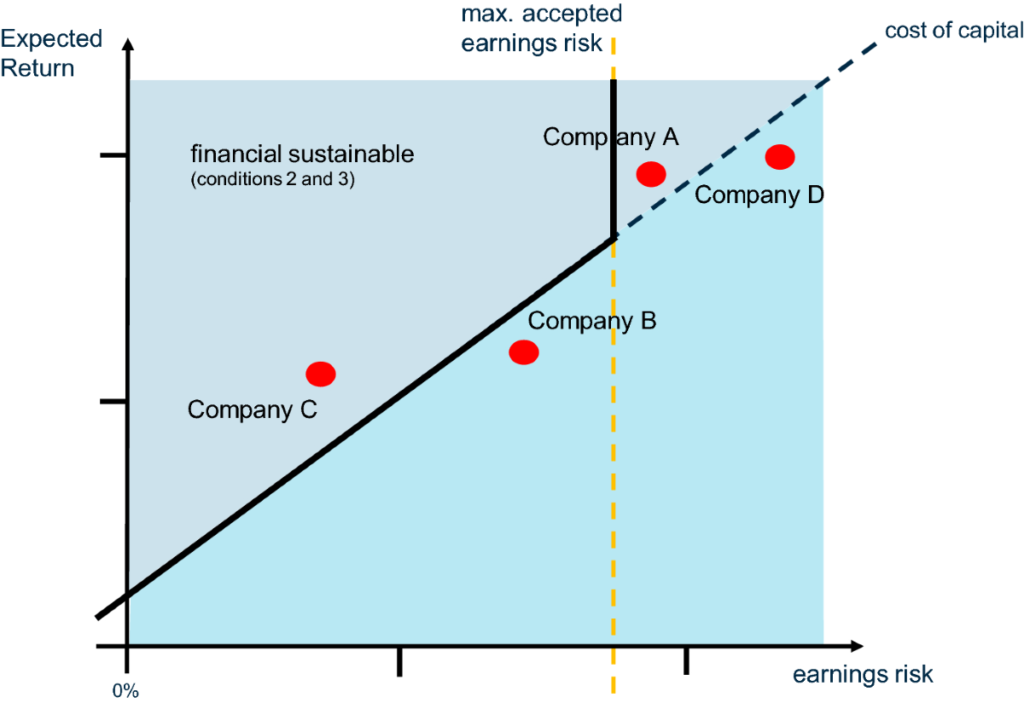
Debt vs Sustainable Strategy Comparison
The ascent of Twenty One Capital coincides with the decline of MARA Holdings, which recently sold approximately 15,133 BTC worth $1.1 billion.
This move pushed MARA down to third place among public Bitcoin holders, signaling deeper structural issues. Analysts point to a debt-heavy accumulation strategy, where borrowing was aggressively used to acquire Bitcoin during bullish periods.
When market conditions reversed, the company was forced to liquidate holdings—often at a loss—to service its debt. This scenario reflects a classic liquidity trap and validates long-standing criticisms of leveraged crypto treasury strategies.
A Strategic Divide: Debt vs Discipline
At the heart of the current shift lies a fundamental strategic divergence.
On one side is the model popularized by MicroStrategy—a system that treats Bitcoin as a long-term reserve asset and leverages capital markets infrastructure to sustain accumulation. This model relies on investor confidence, structured financing, and long-term conviction.
On the other side are companies that relied on short-term leverage, often without the institutional backing or capital market sophistication required to sustain such strategies.
According to analysts, the question now is clear:
Can mining companies or smaller treasury firms survive without the financial architecture built over years by pioneers like MicroStrategy?
The “Death Spiral” Risk in Crypto Treasury Firms
Crypto Treasury Death Spiral Model
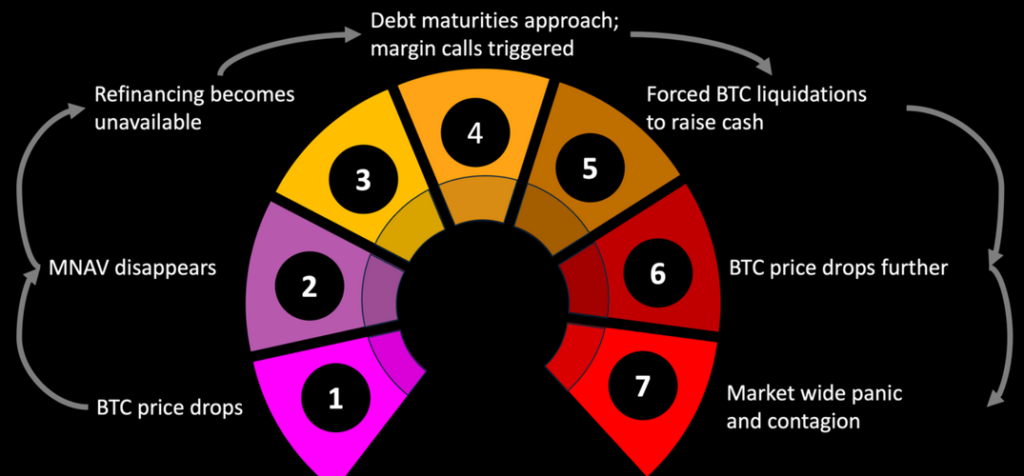
In mid-2025, venture capital firm Breed warned of a looming “death spiral” for crypto treasury companies.
This scenario unfolds when:
- A company’s stock trades at or below its net asset value (NAV).
- It loses access to cheap capital (e.g., equity issuance at a premium).
- It is forced to sell Bitcoin holdings to meet obligations.
- This selling pressure further depresses both BTC price and the company’s stock.
The result is a self-reinforcing cycle of decline—one that only a few well-capitalized and strategically disciplined firms are expected to survive.
Market Context: Bearish Pressure and Capitulation
The broader backdrop to these developments is a prolonged downturn in both crypto markets and related equities since late 2025.
This environment has triggered what some analysts describe as “capitulation” among weaker players. Companies that treated Bitcoin as a speculative asset rather than a strategic reserve are now being forced to unwind positions.
Deng Chao of HashKey Capital emphasized that firms lacking long-term conviction are unlikely to survive across multiple market cycles.
In contrast, companies with disciplined treasury management, strong balance sheets, and clear strategic intent are better positioned to endure volatility.
Where Does Japan’s Metaplanet Stand?
Another notable player in this evolving landscape is Metaplanet, which holds approximately 35,100 BTC, making it one of the largest corporate holders globally.
Japan’s regulatory clarity and growing institutional interest in Bitcoin have positioned Metaplanet as a key regional counterpart to Western treasury firms. Its strategy will be closely watched as the market continues to separate sustainable models from fragile ones.Implications for Investors and Builders
For readers seeking new crypto opportunities, the implications are profound.
1. Bitcoin Treasury Is Not a One-Size-Fits-All Strategy
The success of early adopters has led many companies to replicate the model—but without the necessary infrastructure, many are failing.
2. Capital Structure Matters More Than Holdings
Simply holding large amounts of BTC is not enough. The sustainability of that position depends on how it is financed.
3. Market Cycles Expose Weaknesses
Bull markets reward aggressive accumulation, but bear markets expose structural fragility.
4. Opportunities in Second-Order Plays
Investors may find opportunities not just in Bitcoin itself, but in companies that demonstrate resilient treasury strategies, as well as infrastructure providers supporting them.
Figure 1 (Insert after Introduction): Corporate Bitcoin Holdings Distribution
Figure 2 (Insert after MARA Section): Debt vs Sustainable Strategy Comparison
Figure 3 (Insert after Death Spiral Section): Crypto Treasury Death Spiral Model
Conclusion: A Maturing Phase for Bitcoin Treasury Strategy
The rise of Twenty One Capital marks more than just a shift in rankings—it signals the maturation of Bitcoin as a corporate treasury asset.
As the market evolves, superficial imitation is giving way to strategic differentiation. The next generation of winners will not simply be those who hold the most Bitcoin, but those who understand how to finance, manage, and sustain that exposure across cycles.
For investors, builders, and institutions alike, the message is clear:
Bitcoin is no longer just an asset—it is a test of financial discipline.