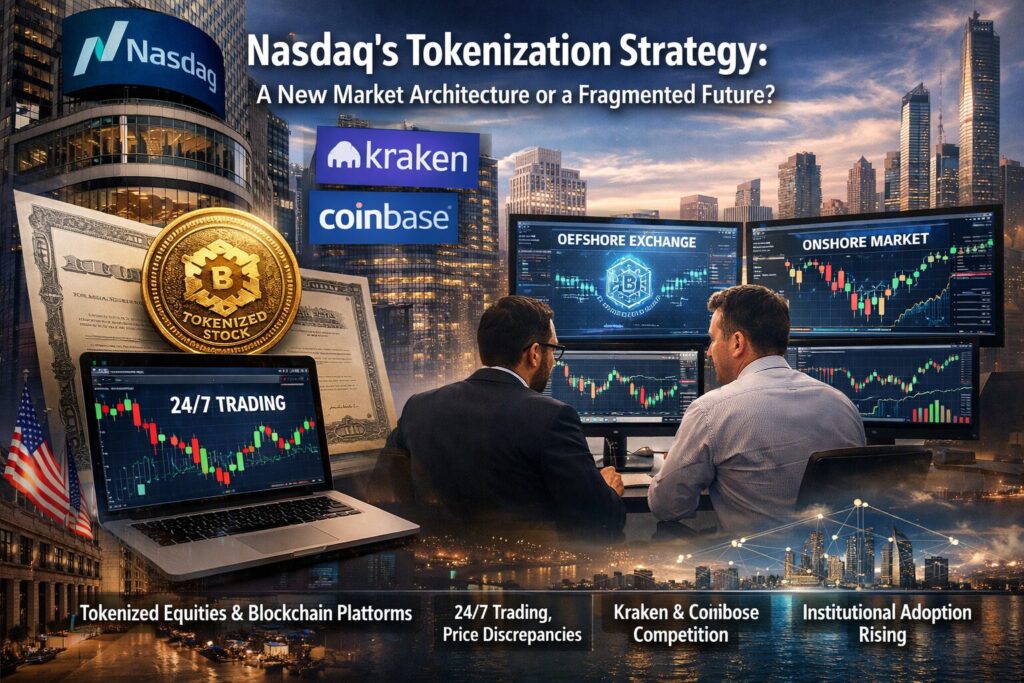
Key Points :
- Nasdaq is actively exploring tokenization across multiple fronts, including settlement, issuance, and offshore trading integration.
- The emergence of tokenized equities may split markets into regulated onshore systems and offshore blockchain-based platforms.
- Platforms like Kraken and Coinbase are accelerating competition with traditional exchanges.
- Tokenized stocks enable 24/7 trading but introduce risks such as liquidity fragmentation and price discrepancies.
- Institutional adoption is rising, signaling a structural shift in how equities may be traded globally.
1. The Rise of Tokenized Equities: A Structural Inflection Point
From Traditional Settlement to Blockchain Rails
The global financial system is approaching a structural turning point as tokenization moves from theory to execution. At the center of this transformation is Nasdaq, which is actively exploring how blockchain infrastructure can reshape equity markets.
According to recent analysis by TD Securities, Nasdaq is pursuing a multi-pronged tokenization strategy. This includes upgrading post-trade settlement systems, enabling corporations to issue tokenized shares, and supporting trading activity on offshore platforms.
These initiatives are not isolated experiments—they represent a coordinated attempt to redefine how equities are issued, traded, and settled. Traditionally, stock markets rely on centralized clearinghouses and settlement cycles (T+2 or faster). Tokenization, however, introduces near-instant settlement via blockchain, reducing counterparty risk and operational inefficiencies.
At a deeper level, this shift is not merely technological. It represents a philosophical transition from intermediated finance toward programmable ownership.
2. Dual Market Emergence: Regulated vs Offshore Systems
A Fragmented Yet Interconnected Ecosystem
One of the most significant implications of Nasdaq’s tokenization push is the potential bifurcation of markets.
On one side, we have regulated U.S. exchanges such as New York Stock Exchange, operating under strict compliance frameworks. On the other, blockchain-based offshore platforms offer tokenized representations of the same underlying assets, often outside U.S. regulatory jurisdiction.
This creates a dual-market structure:
- Onshore regulated market: Traditional equities with full investor protections
- Offshore tokenized market: Blockchain-based trading with fewer restrictions
While both markets may reference the same underlying stock, their operational mechanics—and potentially their pricing—can diverge.
For investors, this introduces a new layer of complexity. A single stock could trade simultaneously in multiple venues, each with its own liquidity profile, trading hours, and regulatory constraints.
This fragmentation resembles early foreign exchange markets, where price discovery occurred across geographically dispersed venues. However, in the case of tokenized equities, the divergence is not geographical—it is architectural.
3. The Role of Crypto Platforms in Market Evolution
From Crypto Exchanges to “Everything Exchanges”
Crypto-native platforms are playing a pivotal role in accelerating this transformation.
Kraken, for example, has launched its “xStocks” platform, enabling users to trade tokenized versions of publicly listed equities. The platform has reportedly surpassed $25 billion in cumulative trading volume, reflecting rapid adoption and strong market demand.
Similarly, Coinbase is advancing its vision of an “Everything Exchange,” where users can trade not only cryptocurrencies but also tokenized stocks and other real-world assets.
These developments signal a convergence between traditional finance (TradFi) and decentralized finance (DeFi). Crypto exchanges are no longer limited to digital assets—they are evolving into comprehensive financial marketplaces.
This trend introduces competitive pressure on traditional exchanges. If users can trade equities 24/7 on blockchain platforms, the value proposition of time-restricted legacy markets begins to erode.
4. The Promise of 24/7 Markets—and Its Hidden Risks
Liquidity, Price Discovery, and Arbitrage
One of the most compelling advantages of tokenized equities is the transition to continuous trading.
Unlike traditional stock markets, which operate within fixed hours, tokenized platforms enable trading 24 hours a day, 7 days a week. This aligns equity markets with the always-on nature of global crypto markets.
However, this innovation introduces new risks:
1. Liquidity Fragmentation
Liquidity may be split across multiple platforms, reducing depth in any single venue. This can lead to higher volatility and wider bid-ask spreads.
2. Price Discrepancies
The same stock may trade at different prices across platforms. Arbitrage opportunities will emerge, but they may not always be efficiently exploited due to regulatory and operational barriers.
3. Reduced Market Transparency
With trading dispersed across both regulated and unregulated venues, achieving a unified view of market activity becomes more difficult.
4. Regulatory Arbitrage
Offshore platforms may operate with fewer compliance requirements, potentially attracting volume away from regulated exchanges.
These risks highlight a fundamental tension: while tokenization increases accessibility and efficiency, it may also undermine the coherence of market structure.
5. Institutional Momentum and Strategic Partnerships
Wall Street Moves Toward Tokenization
Traditional financial institutions are not standing still. The New York Stock Exchange is exploring tokenized securities through partnerships with Securitize, aiming to support extended and potentially continuous trading.
This reflects a broader institutional trend. Rather than resisting blockchain, major players are integrating it into their infrastructure.
The implications are profound:
- Settlement cycles could shrink to near-zero
- Ownership could become programmable and fractionalized
- Global access to equities could expand dramatically
Tokenization also opens the door to new financial products, such as composable securities that interact with DeFi protocols.
For emerging markets and fintech companies, this represents an opportunity to leapfrog traditional infrastructure.
6. Strategic Implications for Investors and Builders
Where the Opportunity Lies
For investors seeking new crypto assets and revenue streams, tokenized equities represent a hybrid frontier—combining the stability of traditional assets with the flexibility of blockchain.
Key opportunities include:
- Arbitrage strategies across fragmented markets
- Yield generation through DeFi integrations
- Access to global equities without traditional brokerage constraints
For builders and operators (especially those in EMI/VASP environments), tokenization introduces new design considerations:
- Custody models: How to securely hold tokenized securities
- Compliance frameworks: Aligning with both securities law and crypto regulations
- Liquidity routing: Connecting to multiple trading venues
This aligns closely with the emerging “two-extremes model” of finance: asset-backed representation versus autonomous trust systems. Tokenized equities sit at the intersection of these paradigms.
Dual Market Structure – Traditional vs Tokenized Equity Markets
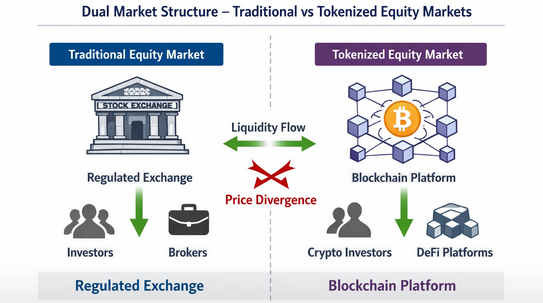
(Visual diagram showing parallel systems: regulated exchange vs blockchain platform, with arrows indicating liquidity flow and price divergence)
Growth of Tokenized Equity Trading Volume (USD)
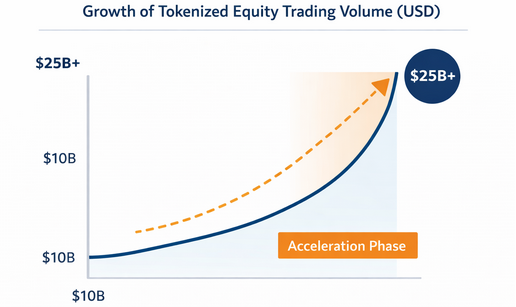
(Line chart illustrating growth trajectory from ~$10B to $25B+, highlighting acceleration phase)
24/7 Trading Cycle vs Traditional Market Hours
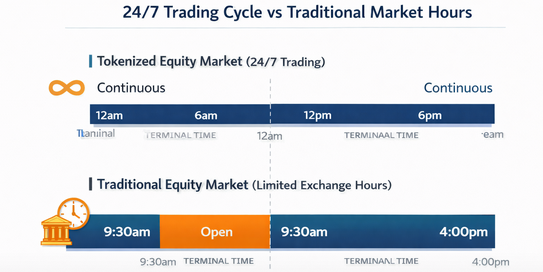
(Comparative timeline chart showing continuous trading vs limited exchange hours)
7. Conclusion: Evolution or Fragmentation?
The tokenization of equities is no longer a speculative concept—it is an unfolding reality.
Nasdaq’s strategic initiatives, combined with the rapid expansion of crypto platforms like Kraken and Coinbase, suggest that the future of equity markets will be hybrid, global, and increasingly decentralized.
However, this evolution comes with trade-offs.
While tokenization promises efficiency, accessibility, and innovation, it also introduces fragmentation, regulatory challenges, and new forms of market risk.
The key question is not whether tokenization will reshape markets—it already is. The real question is whether this transformation will lead to a more unified global system or a permanently divided financial landscape.