
Main Points :
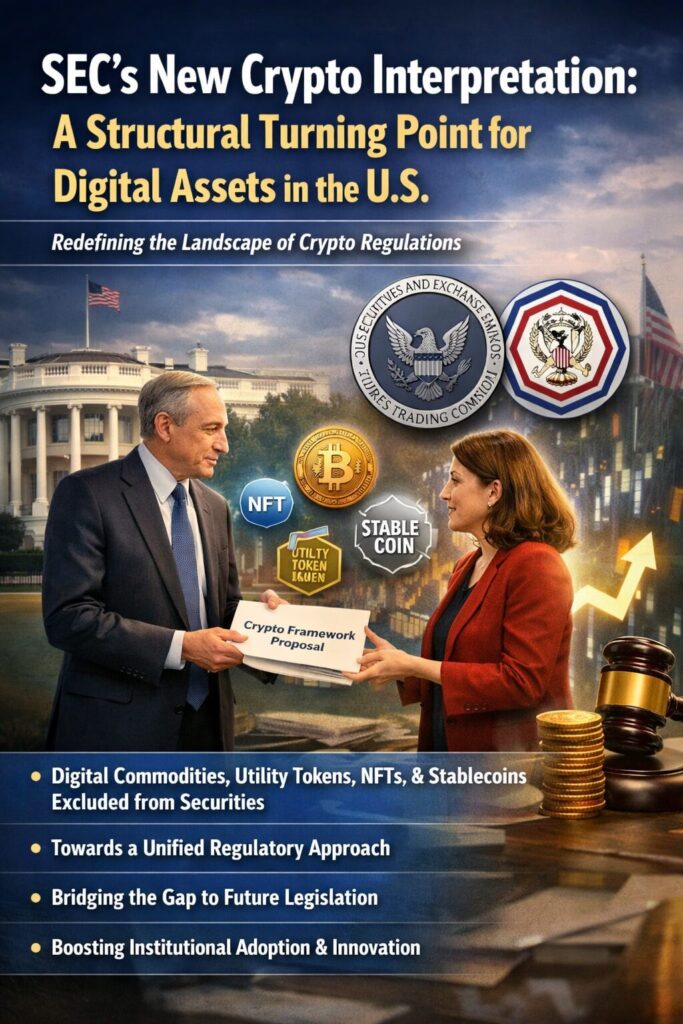
- The U.S. SEC has submitted a new interpretative framework to the White House, potentially redefining which crypto assets are considered securities.
- Four major categories—digital commodities, utility tokens, NFTs, and stablecoins—may be excluded from securities classification.
- This move signals a shift from enforcement-driven regulation toward structured taxonomy.
- The proposal could act as a bridge until full crypto market structure legislation (e.g., CLARITY Act) is passed.
- Coordination between the SEC and CFTC suggests a more unified regulatory approach.
- Institutional adoption and innovation may accelerate if regulatory clarity improves.
1. A Regulatory Inflection Point: SEC Moves Toward Clarity
The U.S. Securities and Exchange Commission (SEC) has taken a potentially transformative step in cryptocurrency regulation by submitting a new interpretative framework to the White House Office of Management and Budget (OMB). This proposal, now under official review, could fundamentally reshape how digital assets are classified under U.S. federal law.
For years, the crypto industry has operated under regulatory ambiguity, often relying on enforcement actions rather than clear rules. The SEC’s approach has historically been criticized for applying the “Howey Test” inconsistently, leading to uncertainty for developers, exchanges, and institutional investors alike.
However, this latest move suggests a shift in strategy. Instead of relying solely on case-by-case enforcement, the SEC is attempting to establish a structured taxonomy—one that defines which digital assets fall outside the definition of securities.
This is not merely a technical adjustment. It represents a philosophical shift in how regulators view blockchain-based assets: from speculative instruments requiring strict oversight to a broader ecosystem of functional, utility-driven technologies.
2. The Four Categories: Redefining What Is NOT a Security
At the core of the SEC’s proposal is a classification system that identifies four types of digital assets that should not be treated as securities:
2.1 Digital Commodities
These include assets like Bitcoin, which function primarily as stores of value or mediums of exchange rather than investment contracts. By explicitly excluding such assets from securities classification, the SEC aligns more closely with the Commodity Futures Trading Commission (CFTC), which has long treated Bitcoin as a commodity.
2.2 Digital Tools (Utility Tokens)
Utility tokens that provide access to services or platforms may also fall outside securities regulation—provided they are not marketed primarily as investment vehicles. This distinction is critical for Web3 developers building decentralized applications (dApps).
2.3 Digital Collectibles (NFTs)
Non-fungible tokens (NFTs), particularly those representing art, gaming assets, or collectibles, are categorized separately. While speculative NFT projects may still face scrutiny, the general classification acknowledges their non-investment nature.
2.4 Stablecoins
Perhaps the most strategically important category, stablecoins are proposed to be excluded from securities classification. Given their role in payments, remittances, and DeFi infrastructure, this could unlock significant institutional adoption.
3. Bridging the Gap: Toward Comprehensive Legislation
The SEC’s proposal is not intended to be the final word on crypto regulation. Instead, it serves as an interim framework—a “bridge”—until Congress passes comprehensive legislation.
One such legislative effort is the CLARITY Act, which aims to define market structure and regulatory responsibilities more clearly. However, progress has been slow due to political disagreements and industry concerns.
Recent reports suggest that the White House and lawmakers have reached a tentative agreement on stablecoin yield regulation. This development could revive stalled legislative efforts and accelerate the passage of broader crypto laws.
4. Coordination with the CFTC: A Unified Regulatory Front
Another critical aspect of this development is the increasing coordination between the SEC and the CFTC. Earlier this month, the two agencies signed a Memorandum of Understanding (MOU), signaling a move toward regulatory alignment.
Historically, jurisdictional conflicts between these agencies have created confusion. By working together, they can provide clearer guidance on whether an asset falls under securities law or commodities regulation.
This alignment is particularly important for hybrid assets and emerging financial instruments that blur the lines between traditional categories.
5. Market Impact: What This Means for Investors and Builders
5.1 Institutional Capital Inflows
Regulatory clarity is one of the biggest barriers to institutional adoption. If the SEC’s framework is finalized, large financial institutions may feel more confident entering the market.
5.2 Innovation Acceleration
Developers will benefit from clearer guidelines, reducing legal risks associated with token issuance and platform design. This could lead to a new wave of innovation in DeFi, gaming, and enterprise blockchain solutions.
5.3 Competitive Positioning
The U.S. has been at risk of losing its leadership in crypto innovation to jurisdictions with clearer regulations, such as Singapore and the UAE. This move could help restore competitiveness.
Evolution of U.S. Crypto Regulation (2017–2026)
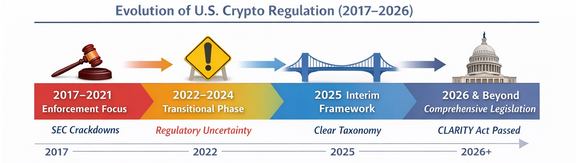
A timeline showing enforcement-heavy regulation transitioning into structured taxonomy.
6. Global Context: Aligning with International Trends
Globally, regulators are moving toward clearer frameworks:
- The EU has implemented MiCA (Markets in Crypto-Assets Regulation)
- Japan has established clear stablecoin and exchange rules
- Hong Kong is positioning itself as a crypto hub
The SEC’s proposal aligns the U.S. with these trends, signaling a maturation of the global crypto regulatory environment.
Global Crypto Regulation Comparison
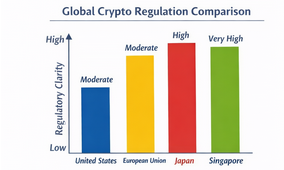
Bar chart comparing regulatory clarity levels across regions (U.S., EU, Japan, Singapore).
7. Strategic Opportunities: Where the Money Flows Next
From an investment perspective, this regulatory shift highlights several key opportunities:
7.1 Stablecoin Infrastructure
With stablecoins potentially classified outside securities law, payment systems, remittance platforms, and DeFi protocols could see massive growth.
7.2 Utility Token Ecosystems
Projects with real-world use cases—such as decentralized storage, identity, and computing—may attract renewed attention.
7.3 NFT Evolution
Beyond art, NFTs in gaming, real estate, and intellectual property could gain legitimacy.
Capital Allocation Trends in Crypto (2023–2026)
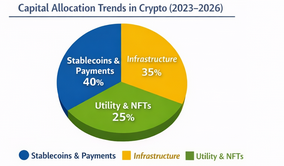
Pie chart showing increasing allocation toward stablecoins, infrastructure, and utility tokens.
8. Risks and Uncertainties
Despite the positive outlook, several risks remain:
- The proposal is still under review and may be modified
- Political dynamics could delay legislative progress
- Enforcement actions may continue in parallel
- Market interpretation of the rules may vary
9. Conclusion: A Structural Shift Toward Maturity
The SEC’s submission of a new interpretative framework marks a pivotal moment in the evolution of cryptocurrency regulation in the United States.
By defining what is not a security, the agency is taking a crucial step toward clarity—one that could unlock institutional capital, accelerate innovation, and strengthen the U.S. position in the global crypto economy.
However, this is only the beginning. The true impact will depend on how this framework integrates with future legislation and how consistently it is applied in practice.
For investors, builders, and policymakers alike, the message is clear: the era of regulatory ambiguity is gradually giving way to structured, predictable frameworks.
And in that transition lies the next major wave of opportunity.