Key Points :
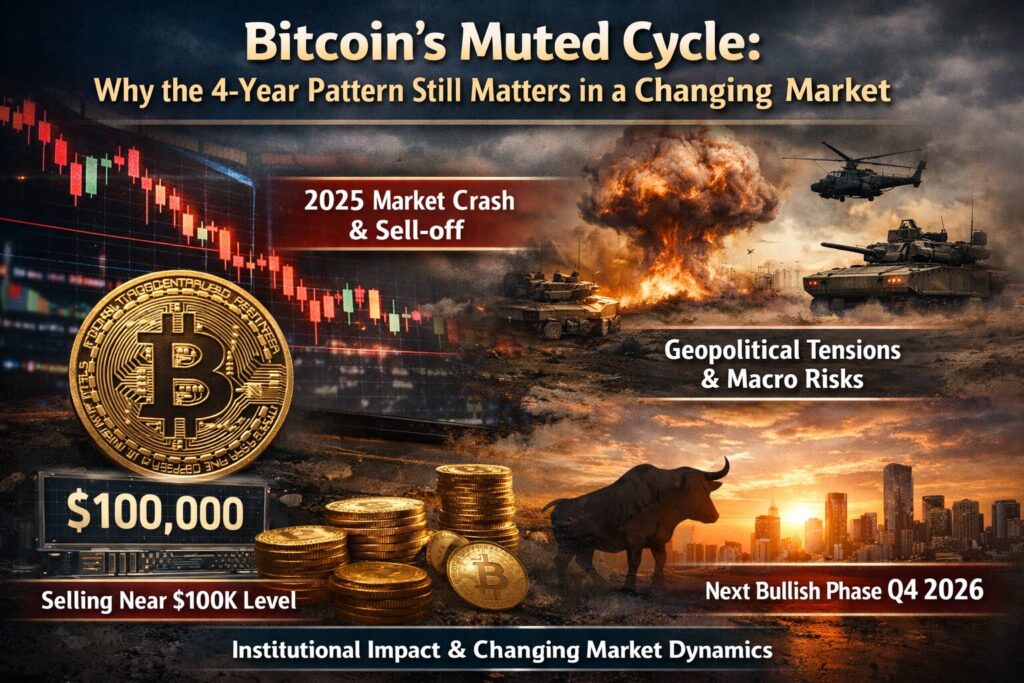
- Bitcoin’s traditional 4-year cycle remains intact but is increasingly “muted” by institutional participation.
- The 2025 crash disrupted consensus expectations and reinforced contrarian market behavior.
- Long-term holders selling near the $100,000 psychological level contributed to downside pressure.
- Macroeconomic and geopolitical risks (e.g., Middle East tensions) are influencing BTC more than before.
- A new bullish phase is expected in Q4 2026, aligning with cycle theory but under new dynamics.
1. The Persistence of the Bitcoin 4-Year Cycle
Anthony Scaramucci, managing partner at SkyBridge Capital, has reaffirmed that Bitcoin remains within its historically observed four-year cycle, despite growing skepticism among market participants. While institutional capital and the emergence of spot Bitcoin ETFs have introduced new dynamics into the market, these factors have not invalidated the underlying cyclical structure. Instead, they have dampened volatility, creating what Scaramucci describes as a “muted” cycle.
The concept of the four-year cycle is rooted in Bitcoin’s halving events, which reduce the supply of new BTC entering the market approximately every four years. Historically, these halvings have been followed by bull markets, as reduced supply meets growing demand. However, unlike previous cycles dominated by retail investors, the current environment includes institutional actors who bring more structured capital flows and risk management strategies.
Scaramucci emphasizes that belief itself plays a powerful role in sustaining the cycle. Large holders, often referred to as “whales” or early adopters (“OGs”), continue to operate under the assumption that the cycle holds true. This collective belief creates a self-fulfilling prophecy, reinforcing cyclical behavior even as market conditions evolve.
2. The Collapse of Consensus: Lessons from the 2025 Crash
Entering 2025, a strong consensus had formed among investors that Bitcoin would reach $150,000, driven by pro-crypto political narratives and increasing regulatory clarity in the United States. However, this optimism was abruptly shattered by a significant market crash in October 2025, which saw Bitcoin fall from approximately $126,000 to as low as $60,000.
This dramatic reversal underscores a recurring theme in financial markets: when consensus becomes too strong, the market often moves in the opposite direction. Scaramucci draws parallels to early 2023, when Bitcoin began recovering from the FTX collapse at a time when investor sentiment was extremely negative.
Such contrarian movements highlight the importance of sentiment analysis in crypto markets. Periods of extreme optimism often precede corrections, while periods of apathy or pessimism may signal the early stages of recovery.
3. Insert Chart Here: Bitcoin Cycle Trend
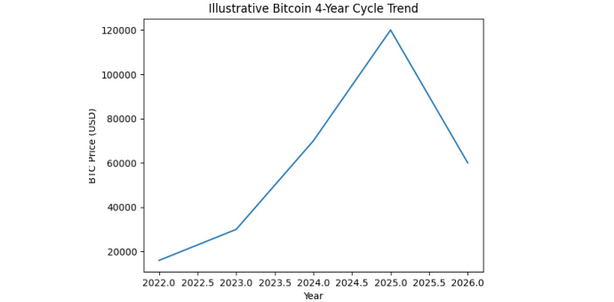
This chart illustrates a simplified representation of Bitcoin’s cyclical behavior, highlighting peaks and corrections across multiple years.
4. Long-Term Holders and the $100,000 Psychological Barrier
One of the key factors contributing to the recent downturn is the behavior of long-term holders. As Bitcoin approached and surpassed the $100,000 mark, many early investors began to take profits. This psychological threshold acted as a major resistance level, triggering widespread selling.
Unlike previous cycles where retail investors dominated, the current market includes sophisticated participants who actively manage portfolios and rebalance positions. Profit-taking at key levels is therefore more systematic and impactful.
This shift suggests that future bull runs may encounter stronger resistance at major psychological price levels, as institutional and long-term holders adopt disciplined exit strategies.
5. Macro and Geopolitical Pressures on Bitcoin
Bitcoin is increasingly behaving like a macro-sensitive asset, influenced by global economic conditions and geopolitical developments. The ongoing conflict in Iran, for example, has contributed to heightened market uncertainty, affecting not only cryptocurrencies but also traditional financial markets.
The S&P 500 recently fell below its 200-day moving average for the first time in ten months, signaling broader risk-off sentiment. Bitcoin, which has shown a growing correlation with equities, has also experienced downward pressure as a result.
Some analysts warn that if this correlation persists, Bitcoin could face further declines of up to 50% during 2026. This marks a significant departure from earlier narratives that positioned Bitcoin as a hedge against traditional market risks.
6. Insert Chart Here: BTC vs S&P 500 Correlation
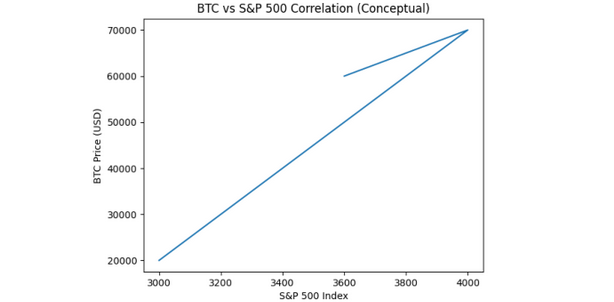
This conceptual chart shows how Bitcoin’s price movements may align with broader equity market trends.
7. Market Sentiment and Contrarian Signals
Market sentiment remains one of the most critical indicators in crypto investing. Scaramucci highlights that Bitcoin’s strongest recoveries have historically occurred during periods of low interest and widespread pessimism.
The current market environment, characterized by uncertainty and declining enthusiasm, may therefore represent a typical corrective phase rather than a structural breakdown. This perspective aligns with the idea of a “garden-variety correction,” suggesting that the market is undergoing a normal cyclical adjustment.
8. Insert Chart Here: Sentiment vs Price
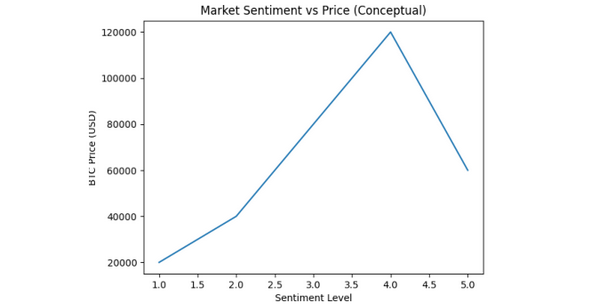
This chart demonstrates the inverse relationship between market sentiment and price turning points.
9. The Role of Institutional Capital and ETFs
One of the most significant developments in recent years is the influx of institutional capital through Bitcoin spot ETFs. These instruments have made Bitcoin more accessible to traditional investors, increasing liquidity and reducing volatility.
However, this institutional presence also introduces new complexities. Large-scale capital flows can stabilize prices but may also suppress explosive upside movements. Additionally, institutional investors often respond to macroeconomic signals, further tying Bitcoin’s performance to global financial conditions.
This dual effect—stabilization combined with increased correlation—represents a fundamental shift in Bitcoin’s market structure.
10. Outlook: Why Q4 2026 Matters
Despite current challenges, Scaramucci remains optimistic about Bitcoin’s long-term trajectory. He predicts that a new bull phase will emerge in the fourth quarter of 2026, consistent with the historical timing of post-halving rallies.
This outlook suggests that the current period should be viewed as a transitional phase rather than the end of the cycle. Investors who understand the evolving dynamics of the market may find opportunities during this period of consolidation.
Conclusion
Bitcoin’s market is undergoing a profound transformation. While the traditional four-year cycle remains relevant, it is being reshaped by institutional participation, macroeconomic influences, and changing investor behavior.
The recent downturn, rather than signaling the end of the cycle, appears to be a natural correction within a broader evolutionary process. As Bitcoin continues to mature, its price movements will likely become less volatile but more interconnected with global financial systems.
For investors, this means adapting strategies to account for both cyclical patterns and macroeconomic factors. The next bull phase may not resemble previous ones, but the underlying opportunity remains significant.