Key Takeaways :
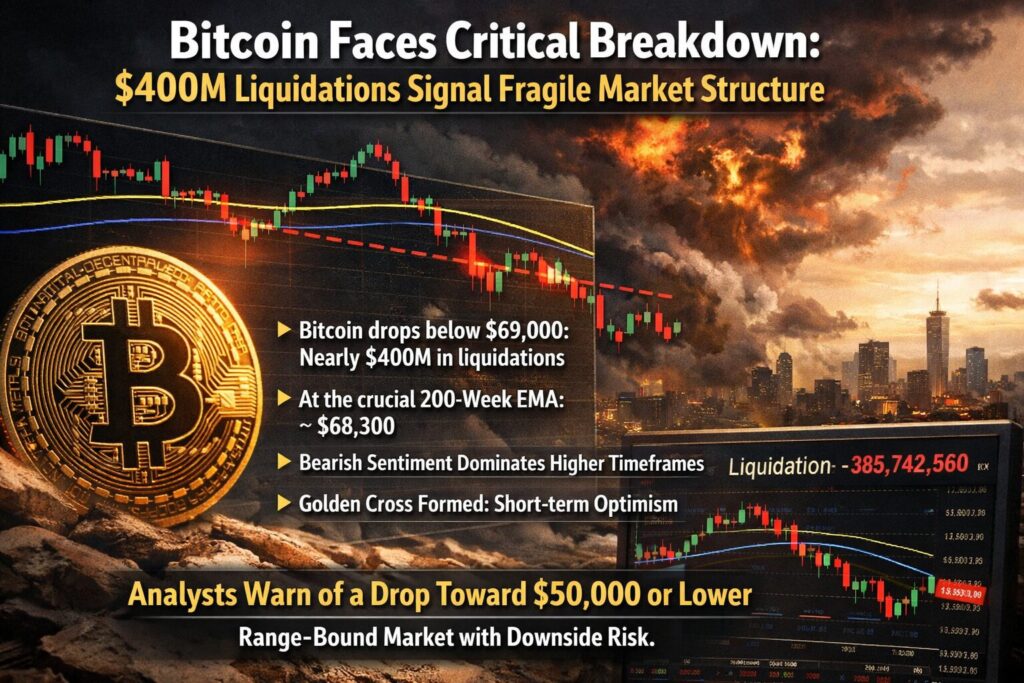
- Bitcoin dropped below $69,000, triggering nearly $400 million in liquidations
- Price is hovering around the historically critical 200-week EMA (~$68,300)
- Market sentiment remains bearish across higher timeframes
- A golden cross (21 SMA > 50 SMA) offers short-term optimism
- Analysts warn of a potential drop toward $50,000 or lower
- Current structure suggests a range-bound market with downside risk
1. Market Shock: $400 Million Liquidation Event Signals Structural Fragility
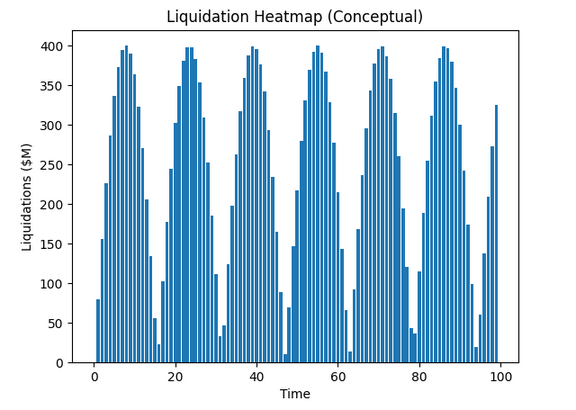
Bitcoin’s recent decline toward $68,000 has once again exposed the fragility of leveraged crypto markets. Within just 24 hours, nearly $400 million worth of positions were liquidated, with long positions accounting for approximately $300 million and short positions close to $100 million.
This liquidation imbalance highlights a critical structural issue: over-leveraged bullish positioning. Traders had been betting aggressively on upward momentum, likely influenced by previous ETF inflows and institutional narratives. However, the market’s inability to sustain higher price levels led to cascading liquidations, accelerating the downward move.
Unlike previous bull cycles where pullbacks were absorbed quickly, the current environment shows reduced liquidity depth and fragile order books, making the market more susceptible to sharp liquidation-driven volatility.
From a practical standpoint, this signals an important shift for investors and operators:
- Reliance on leverage is increasingly dangerous
- Liquidity provisioning strategies must account for sudden volatility spikes
- Risk management frameworks (hedging, delta-neutral strategies) are becoming essential rather than optional
2. The 200-Week EMA: From Strong Support to “Unreliable” Level
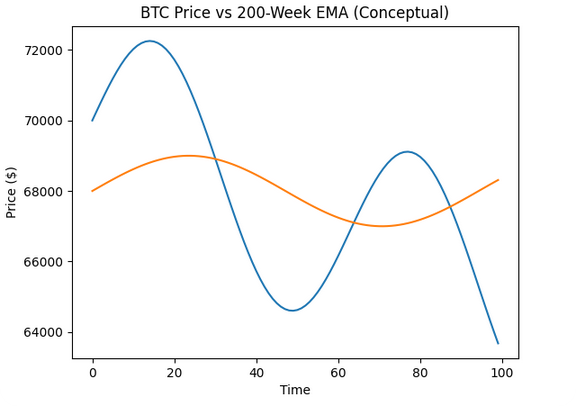
One of the most important technical developments is Bitcoin’s interaction with the 200-week Exponential Moving Average (EMA), currently around $68,300.
Historically, this level has acted as a macro-cycle support floor, marking accumulation zones during bear markets. However, in 2026, this reliability appears to be weakening.
Why This Matters:
- Previous cycles: strong bounce from 200W EMA
- Current cycle: repeated tests without strong rebound
- Indicates weak institutional absorption
Interpretation:
The weakening of this historically strong support suggests that:
- The market may still be in a distribution phase
- Institutional buyers are either waiting or allocating more cautiously
- Macro uncertainty (rates, regulation, liquidity tightening) is impacting crypto demand
3. Bearish Macro Sentiment Remains Dominant
Despite occasional bullish signals, most professional traders remain firmly bearish on higher timeframes.
Analyst Roman emphasizes:
- No bullish divergence
- No momentum exhaustion
- No structural reversal signals
He projects a possible decline toward $50,000 or below, aligning with a broader macro correction scenario.
This view is reinforced by:
- Declining trading volumes
- Weak follow-through after rallies
- Repeated rejection at resistance levels
Macro Factors Driving Bearish Sentiment:
- Tight global liquidity conditions
- High interest rates reducing speculative capital
- Institutional rotation into safer yield-bearing assets
- Regulatory uncertainty across jurisdictions
For crypto-native businesses (like wallets, exchanges, EMI/VASP operators), this environment implies:
- Lower transaction volumes
- Reduced retail participation
- Increased importance of fee optimization and cost control
4. Golden Cross: A Temporary Bullish Signal?
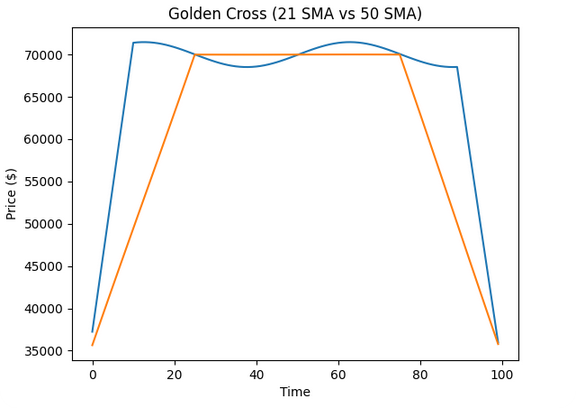
Amid the bearish backdrop, a golden cross has appeared:
- 21-day SMA crossed above 50-day SMA
This typically signals short-term bullish momentum.
However, analysts urge caution:
- Golden crosses during range markets often produce false breakouts
- Without volume confirmation, the signal lacks strength
Keith Alan (Material Indicators) notes:
“It may provide short-term upside, but the market remains range-bound.”
Key Insight:
This is not yet a trend reversal, but rather:
- A relief rally signal
- Possibly driven by short covering
5. Range-Bound Market: The Dominant Structure
Bitcoin is currently trapped in a range between ~$68,000 and ~$75,000, with no clear breakout direction.
Characteristics of Current Range:
- Low conviction moves
- Frequent false breakouts
- Liquidity-driven volatility
- Algorithmic trading dominance
This environment favors:
- Market makers
- Arbitrage strategies
- Spread-based revenue models
Rather than directional trading, range exploitation becomes the dominant strategy.
For your business model (EMI/VASP, wallet, liquidity):
- Spread optimization becomes key revenue driver
- Hedging (futures/perps) should neutralize directional risk
- Inventory management (VirtualNetBTC, ALM-style) becomes critical
6. Liquidation Dynamics: The Hidden Driver of Price Movement
One of the most important insights is that liquidations are now a primary driver of price, not fundamentals.
Liquidation Flow Breakdown:
- Long squeeze → rapid downside
- Short squeeze → sharp upside
- Both create artificial volatility
7. Broader Trend: Institutional Caution and Market Maturity
Recent external developments further support this cautious outlook:
Institutional Trends:
- ETF flows slowing compared to initial surge
- Hedge funds increasing market-neutral strategies
- More focus on yield generation (staking, lending) rather than price speculation
Market Evolution:
- From retail-driven → institutional-driven
- From narrative-driven → liquidity-driven
- From trend markets → range markets
8. Practical Implications for Crypto Operators and Investors
For readers seeking new revenue opportunities and blockchain applications, this market structure offers key lessons:
1. Directional Trading is Less Reliable
- High volatility but low trend persistence
- Increased risk of liquidation
2. Spread-Based Models Are Superior
- Market-making
- Arbitrage
- Fee-based services
3. Risk Management is Critical
- Delta-neutral hedging
- Liquidity buffer design
- Dynamic fee adjustment
4. Infrastructure Matters
- Low-latency execution
- Reliable liquidity sources
- Smart routing between exchanges
Conclusion: A Fragile Equilibrium Before the Next Major Move
Bitcoin’s drop to $68,000 and the resulting $400 million liquidation event highlight a market that is no longer driven by simple bullish narratives.
Instead, we are seeing:
- A fragile equilibrium
- Heavy reliance on derivatives
- Weak macro support
- Range-bound behavior
While short-term signals like the golden cross may provide temporary optimism, the broader structure suggests that the market is still searching for a true bottom.
A move toward $50,000 cannot be ruled out, especially if macro conditions tighten further.
However, this environment is not without opportunity.
For sophisticated participants, the current phase represents a transition:
- From speculation → strategy
- From direction → structure
- From hype → execution
Those who adapt to this new reality—by focusing on risk-neutral models, liquidity engineering, and operational efficiency—will be best positioned to capture the next wave of growth in the crypto ecosystem.