
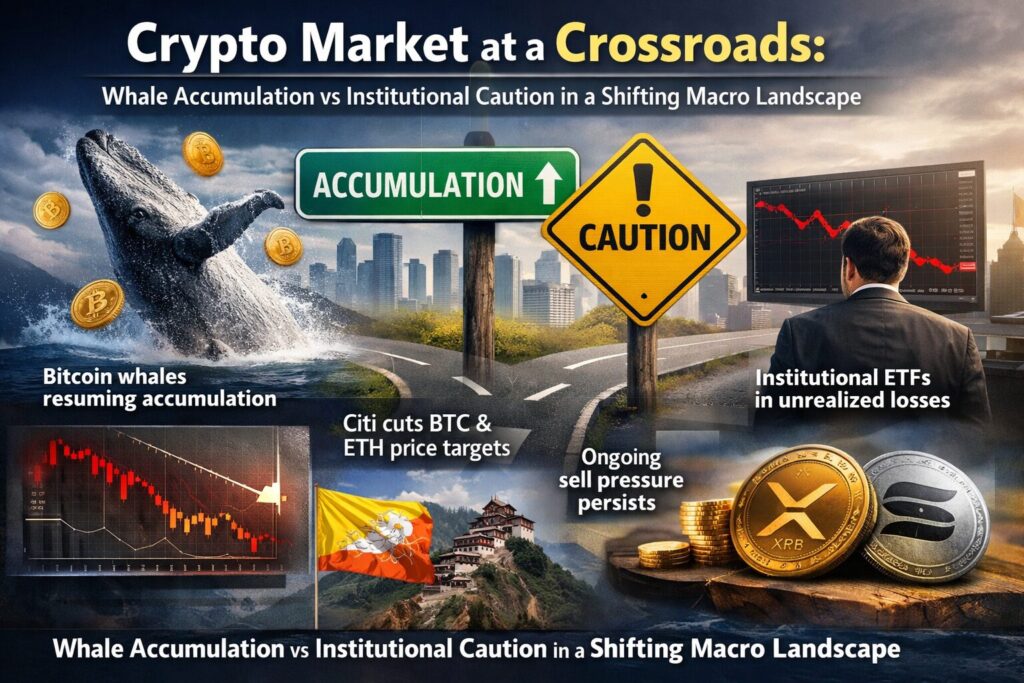
Main Points :
- Bitcoin whale wallets have resumed accumulation after two months of selling pressure
- Citi has lowered its 12-month price targets for BTC and ETH amid regulatory uncertainty
- Institutional demand via ETFs is recovering, but holders remain in unrealized loss positions
- Structural sell pressure continues despite accumulation signals
- Government-level crypto activity (e.g., Bhutan) signals long-term strategic positioning
- Altcoins like XRP and SOL show relative strength, hinting at rotation dynamics
1. Market Overview: Stability Masking Structural Tension
Over the past week, the cryptocurrency market has shown mixed yet deceptively calm behavior. Bitcoin (BTC) hovered around $70,364 (-0.2%), while Ethereum (ETH) rose to $2,150 (+3.8%). XRP and Solana (SOL) also recorded gains, reaching $1.45 (+5.0%) and $89.52 (+3.0%), respectively.
At first glance, this appears to be a typical consolidation phase. However, beneath the surface, the market is undergoing a structural transition driven by competing forces: whale accumulation, institutional caution, and macro uncertainty.
Weekly Price Performance of Major Cryptocurrencies
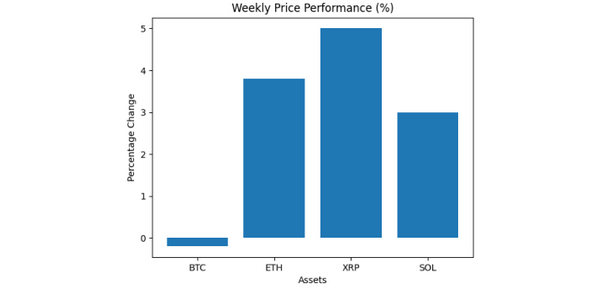
Description: Line chart showing BTC, ETH, XRP, SOL weekly % change
Purpose: Visualize divergence between BTC stagnation and altcoin strength
2. Whale Accumulation Returns: A Critical Signal
One of the most important developments comes from on-chain analytics platform Santiment. According to their data, wallets holding between 10 and 10,000 BTC—commonly referred to as “whales”—have shifted back into net accumulation after nearly two months of consistent selling.
This shift is highly significant for several reasons:
- Whale behavior often precedes major market movements
- Accumulation during price stagnation suggests long-term conviction
- It indicates a possible transition from distribution to re-accumulation phase
Historically, similar patterns have appeared near market bottoms or during early-stage bull cycles. However, unlike previous cycles, the current environment is far more complex due to institutional overlays and macroeconomic pressures.
Bitcoin Whale Wallet Accumulation Trend
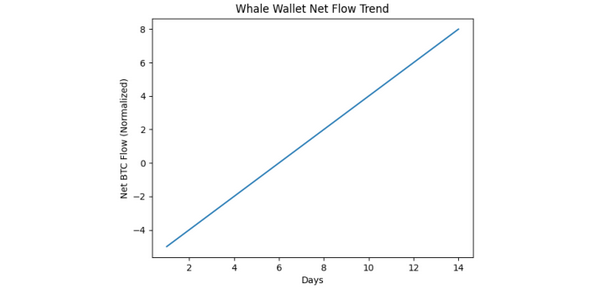
Description: Bar or area chart showing net inflow/outflow of whale wallets over time
Purpose: Highlight transition from selling to accumulation
3. Citi’s Downward Revision: Institutional Reality Check
Despite bullish signals from on-chain data, Citi has revised its 12-month price targets downward:
- Bitcoin: from $143,000 → $112,000
- Ethereum: from $4,304 → $3,175
This move reflects a more cautious institutional outlook, driven by:
- Regulatory stagnation in the U.S.
- Delayed clarity on crypto legislation
- Concerns over sustained institutional inflows
This divergence between on-chain optimism and institutional caution creates a critical tension in the market narrative.
From a strategic perspective, this suggests:
- Institutions are not exiting—but are recalibrating expectations
- Capital deployment may become more selective
- Valuation models are becoming more conservative
4. ETF Dynamics: Recovery with Hidden Weakness
Another key insight comes from CryptoQuant analysis, which revealed that spot Bitcoin ETF holders still carry an average unrealized loss of approximately $5,174.
This is a crucial structural factor:
- It creates latent sell pressure
- Investors may exit positions when breakeven is reached
- It slows upward price momentum
Even as institutional inflows begin to recover, this “overhang” of underwater positions acts as a ceiling on rapid price appreciation.
In traditional finance, this resembles a supply overhang zone, where previous buyers become future sellers.
ETF Holder Unrealized Loss Distribution
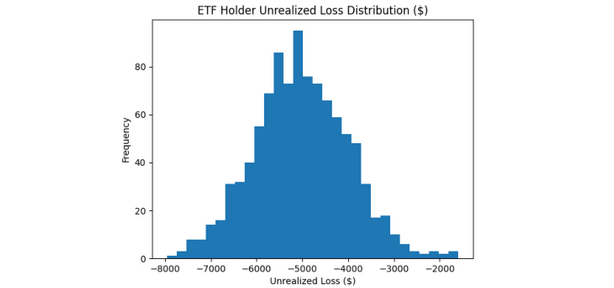
Description: Histogram showing average cost basis vs current price
Purpose: Illustrate resistance zones created by underwater investors
5. Government Activity: Bhutan’s Strategic Bitcoin Movement
One of the more underreported yet strategically important developments is the movement of 973 BTC (~$77 million) by Bhutan’s sovereign investment arm, Druk Holding & Investments (DHI).
The funds were distributed across multiple unknown wallets, which may indicate:
- Custodial restructuring
- Security diversification
- Strategic allocation or preparation for liquidity events
This highlights a broader trend: nation-state participation in crypto is evolving quietly but steadily.
Unlike retail or institutional players, sovereign entities often operate with:
- Long-term investment horizons
- Strategic geopolitical considerations
- Reduced sensitivity to short-term volatility
This adds another layer of complexity to the market structure.
6. Altcoin Strength: Early Rotation or Temporary Divergence?
While Bitcoin remains relatively flat, altcoins such as XRP and SOL have outperformed.
This raises an important question:
Are we witnessing early-stage capital rotation?
Possible explanations include:
- Traders seeking higher beta opportunities
- Market participants pricing in ecosystem-specific developments
- Reduced dominance of BTC in short-term cycles
However, caution is warranted:
- Altcoin rallies without BTC confirmation are often fragile
- Liquidity conditions remain uncertain
- Regulatory clarity impacts altcoins disproportionately
7. Broader Trends: The Institutional-Crypto Hybrid Era
Looking beyond this week, several macro trends are shaping the crypto landscape:
1. Institutional Integration Continues
Major financial institutions are not retreating—they are refining strategies.
Products like ETFs, custody services, and tokenized assets continue to expand.
2. Regulatory Uncertainty Remains a Bottleneck
The lack of clear U.S. regulation is slowing capital deployment.
3. On-Chain vs Off-Chain Narrative Split
- On-chain: bullish accumulation signals
- Off-chain: cautious institutional outlook
This divergence is likely to persist and define the next phase of the market.
Conclusion: A Market Defined by Contradiction
The current crypto market is not simply bullish or bearish—it is structurally conflicted.
On one side, we see:
- Whale accumulation
- Government-level participation
- Altcoin momentum
On the other:
- Institutional caution
- Regulatory uncertainty
- Persistent sell pressure from ETF holders
For investors and operators, this environment requires:
- Greater risk management
- Multi-layered analysis (on-chain + macro + regulatory)
- Focus on long-term positioning rather than short-term speculation
Ultimately, this phase may represent a transition toward a more mature market, where price action is no longer driven solely by retail sentiment, but by a complex interplay of institutional capital, sovereign strategy, and blockchain-native dynamics.




