
Main Points :
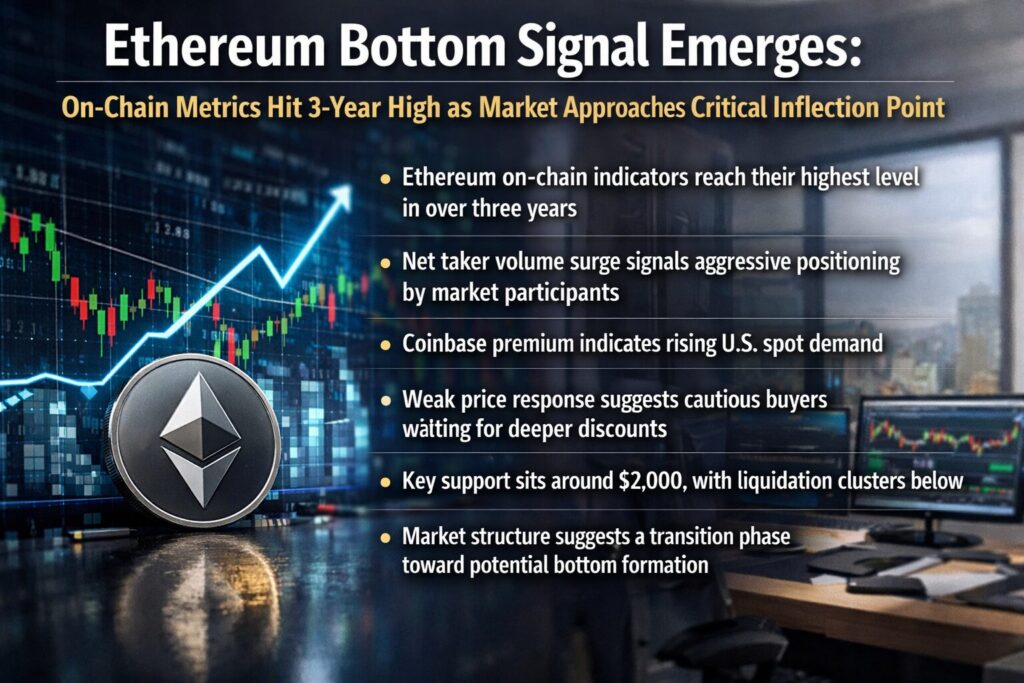
- Ethereum on-chain indicators reach their highest level in over three years
- Net taker volume surge signals aggressive positioning by market participants
- Coinbase premium indicates rising U.S. spot demand
- Weak price response suggests cautious buyers waiting for deeper discounts
- Key support sits around $2,000, with liquidation clusters below
- Market structure suggests a transition phase toward potential bottom formation
1. A Rare On-Chain Signal: Ethereum Enters a Potential Bottoming Phase
Ethereum (ETH) is once again at the center of market attention, as a series of key on-chain indicators have surged to levels not seen since the depths of the 2022 bear market. These developments suggest that ETH may be entering an early-stage bottoming phase—despite its relatively muted price action.
At the core of this narrative is a divergence between market structure and price. While ETH has struggled to establish a strong upward trend, the underlying data paints a more complex picture. Historically, such divergences have marked transitional periods where long-term investors begin accumulating positions quietly, often before price confirmation becomes visible to the broader market.
This pattern was observed in mid-2020 and mid-2022—both periods that preceded major upward movements. Today, similar signals are re-emerging, prompting analysts to reassess whether Ethereum is nearing another cyclical turning point.
[ETH Net Taker Volume Trend Graph]
2. Net Taker Volume Surge: A Signal of Aggressive Market Positioning
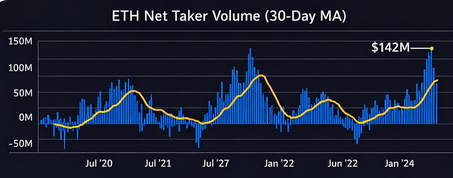
One of the most compelling indicators is Ethereum’s net taker volume (30-day moving average), which recently climbed to approximately $142 million, the highest level since July 2022.
Net taker volume measures the difference between aggressive buyers and sellers in the derivatives market. A positive reading indicates that buyers are dominating through market orders, often reflecting urgency and conviction.
Such spikes have historically occurred during transitional phases—when traders reposition themselves after prolonged downtrends. The current surge mirrors similar patterns seen during previous market bottoms, suggesting that large participants may be increasing exposure in anticipation of future upside.
However, it is important to note that aggressive buying in derivatives does not always translate into immediate price appreciation. Instead, it often precedes periods of consolidation as liquidity is absorbed.
3. Coinbase Premium: Institutional Demand from the United States
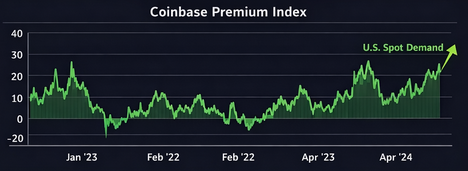
Another critical signal comes from the Coinbase Premium Index, which has remained in positive territory since late February. This metric reflects the price difference between Coinbase (primarily serving U.S. investors) and offshore exchanges.
A sustained premium indicates that U.S.-based participants—often institutional investors—are willing to pay higher prices for ETH, suggesting growing spot demand.
This trend aligns with broader developments in the crypto market, including:
- Increased institutional allocation to digital assets
- Expansion of Ethereum-based financial products
- Continued growth of staking and yield-generating mechanisms
In recent months, the narrative around Ethereum has shifted from speculative trading to infrastructure-level adoption, particularly in areas such as tokenization, decentralized finance (DeFi), and Layer-2 scaling solutions.
[Coinbase Premium Index Visualization]
4. The Missing Piece: Why Price Action Remains Weak
Despite these bullish indicators, ETH’s price has remained relatively stagnant. This apparent contradiction has led analysts to highlight a key issue: insufficient dominant buying demand.
In other words, while supply-side pressure is decreasing and some accumulation is occurring, the market lacks a strong influx of new capital willing to drive prices higher at current levels.
This behavior suggests that many investors still perceive ETH as overvalued in the short term and are waiting for clearer confirmation or lower entry points.
From a market microstructure perspective, this creates a “compression phase,” where price consolidates within a narrowing range while underlying positioning gradually shifts.
Such phases often precede significant volatility expansions—but the direction remains uncertain until a decisive breakout or breakdown occurs.
5. Critical Price Levels: The Battle Around $2,000
Ethereum’s technical structure highlights several key levels that will likely determine its short-term trajectory.
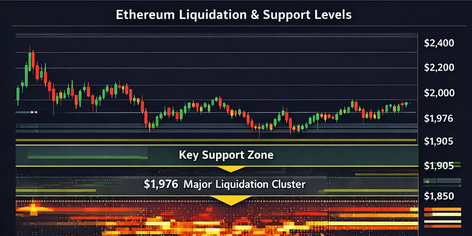
- Primary Support Zone: $2,100 – $2,000
- Major Liquidity Cluster: Around $1,905
- Liquidation Cluster: Approximately $1,976, with over $3 billion in long positions
If ETH breaks below $2,150, the market’s focus will shift toward these lower liquidity zones. A move into this region could trigger cascading liquidations, amplifying downward pressure in the short term.
[ETH Liquidation Heatmap / Support Zones]
However, this scenario is not purely bearish. Liquidation zones often act as double-edged swords:
- On one hand, they can accelerate declines through forced selling
- On the other, they can create high-demand zones where buyers step in aggressively
If buyers absorb the sell-side pressure effectively, these zones can become the foundation for a strong rebound.
A key psychological and technical level remains the $2,000 threshold. Maintaining this level on a daily closing basis would preserve the medium-term bullish structure. Conversely, a sustained breakdown could shift market sentiment toward more aggressive short positioning.
6. Broader Market Context: Ethereum’s Role in the Next Cycle
Beyond short-term price movements, Ethereum’s long-term outlook continues to be shaped by structural trends across the crypto ecosystem.
6.1 Tokenization and Real-World Assets (RWA)
Ethereum remains the leading platform for tokenizing real-world assets such as bonds, real estate, and commodities. Institutional players are increasingly exploring these use cases, which could drive sustained demand for ETH.
6.2 Layer-2 Scaling and Cost Efficiency
The rise of Layer-2 networks has significantly improved Ethereum’s scalability and reduced transaction costs. This has expanded its usability across a wide range of applications, from gaming to micropayments.
6.3 Staking and Supply Dynamics
Ethereum’s transition to proof-of-stake has fundamentally altered its supply dynamics. With a large portion of ETH locked in staking contracts, circulating supply is constrained, potentially amplifying price movements during demand surges.
7. Strategic Implications for Investors and Builders
For investors, the current environment presents both risk and opportunity:
- Accumulation during early bottoming phases has historically yielded strong returns
- However, premature positioning can expose portfolios to further downside
For builders and entrepreneurs, the implications are equally significant:
- Periods of price stagnation often coincide with accelerated infrastructure development
- Lower market hype creates a more sustainable environment for product innovation
In this sense, Ethereum’s current phase may represent not just a market transition, but an ecosystem maturation process.
Conclusion: A Market at the Edge of Transformation
Ethereum’s recent on-chain signals suggest that the market may be approaching a critical inflection point. While price action remains subdued, underlying indicators point toward a gradual shift in positioning and sentiment.
The convergence of rising net taker volume, sustained Coinbase premium, and key liquidity structures indicates that the market is entering a transitional phase—one that could precede either a significant rebound or a final capitulation event.
For those seeking new crypto assets, revenue opportunities, or practical blockchain applications, this period offers a unique window into the mechanics of market cycles. Understanding these signals is not merely about predicting price—it is about recognizing the early stages of structural change.
Whether Ethereum ultimately holds the $2,000 level or briefly dips below it, the broader trajectory appears increasingly tied to long-term adoption rather than short-term speculation.




