
Main Points :
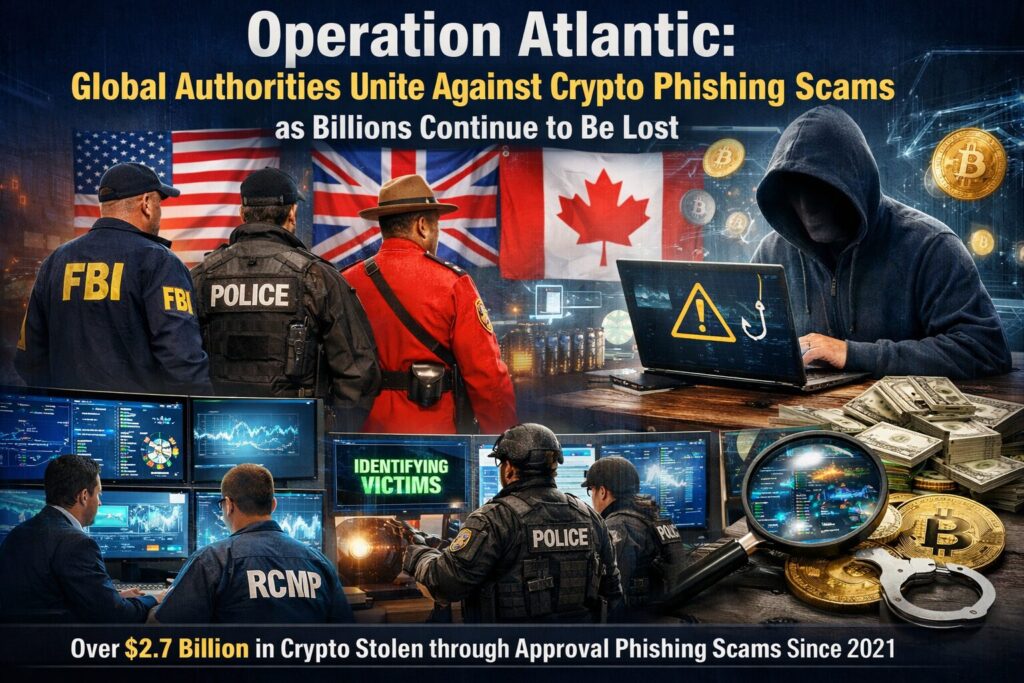
- The United States, United Kingdom, and Canada have launched Operation Atlantic, a joint investigation targeting cryptocurrency fraud.
- The operation focuses on “approval phishing” scams, a rapidly growing method that tricks users into granting token access to attackers.
- Law enforcement agencies aim to identify victims in near real time, prevent ongoing theft, and recover stolen assets.
- Blockchain analysis firms estimate that over $2.7 billion in crypto has been stolen through approval phishing schemes since 2021.
- The initiative builds on earlier investigations such as Project Atlas and Operation Spincaster, reflecting increasing global coordination.
- Rising phishing activity highlights the urgent need for better wallet security, user education, and improved blockchain monitoring tools.
Introduction: The Expanding Threat of Crypto Phishing
The rapid rise of blockchain technology and digital assets has opened the door to new financial systems, decentralized finance (DeFi), and alternative investment opportunities. However, the same technological features that make cryptocurrencies attractive—permissionless access, irreversible transactions, and decentralized control—also create fertile ground for fraud.
In response to escalating losses and increasingly sophisticated scams, law enforcement agencies across North America and Europe have launched a coordinated effort known as Operation Atlantic, aimed specifically at dismantling cryptocurrency fraud networks.
The initiative, announced jointly by authorities in the United States, the United Kingdom, and Canada, focuses primarily on a particularly dangerous form of scam known as approval phishing. These scams trick victims into signing blockchain transactions that grant attackers permission to drain assets directly from their wallets.
For crypto investors, developers, and financial institutions exploring blockchain applications, Operation Atlantic represents both a warning and a turning point: the global regulatory and enforcement environment surrounding digital assets is entering a new phase of coordinated action.
Understanding Approval Phishing: A New Generation of Crypto Fraud
How the Scam Works
Approval phishing differs from traditional phishing attacks because it exploits a core feature of smart contract systems rather than stealing passwords or private keys.
Instead of directly accessing a wallet, attackers persuade users to sign a malicious blockchain approval transaction. Once the victim signs the transaction, the attacker’s address receives permission to transfer tokens from the wallet.
The process typically follows several steps:
- The victim receives a message or advertisement promoting a fake service or investment opportunity.
- The user connects their wallet to a fraudulent website or smart contract.
- The site requests a transaction approval, often disguised as a routine authorization.
- The victim signs the transaction without fully understanding its implications.
- The attacker now has permission to transfer tokens out of the wallet.
Unlike private-key theft, this attack leaves the wallet technically “secure,” but the smart contract approval allows unlimited token withdrawals.
This subtle distinction makes approval phishing particularly dangerous because victims often do not realize what has happened until funds disappear.
Operation Atlantic: A Coordinated International Investigation
Agencies Involved
Operation Atlantic brings together a broad coalition of law enforcement and regulatory organizations, including:
- United States Secret Service
- United Kingdom National Crime Agency (NCA)
- Ontario Provincial Police
- Ontario Securities Commission (OSC)
- Royal Canadian Mounted Police (RCMP)
- London Metropolitan Police
- United States Attorney’s Office for the District of Columbia
- UK Financial Conduct Authority (FCA)
This multi-agency collaboration reflects the increasingly borderless nature of cryptocurrency crime. Fraud schemes often involve servers in one country, victims in another, and money laundering networks spread across multiple jurisdictions.
By sharing intelligence and investigative tools, authorities hope to identify scam networks faster and intervene before stolen funds disappear through crypto mixers or cross-chain bridges.
Project Atlas and the Foundation of the Operation
Operation Atlantic is built on a previous initiative known as Project Atlas, launched in 2024 by the Ontario Provincial Police and the United States Secret Service.
Project Atlas focused on identifying organized cryptocurrency fraud groups operating across North America. Investigators discovered that many scams were linked through:
- Shared phishing infrastructure
- Reused smart contracts
- Identical wallet clusters
- Similar social engineering tactics
These findings demonstrated that crypto scams are rarely isolated incidents. Instead, they often operate as large-scale criminal networks with professional infrastructure.
Operation Atlantic expands on this model by adding new jurisdictions and regulatory partners, dramatically increasing investigative reach.
The Scale of the Problem: Billions Lost to Crypto Fraud
Global Statistics
According to blockchain analytics firm Chainalysis, approval phishing scams have resulted in enormous financial losses.
Between May 2021 and July 2024, victims lost approximately:
$2.7 billion in cryptocurrency
through these schemes alone.
The victims range from small retail investors to sophisticated traders interacting with DeFi platforms.
However, the real total may be significantly higher because many victims never report their losses.
Monthly Trends in Crypto Fraud
Recent intelligence reports suggest that phishing activity has surged even as overall theft values fluctuate.
For example:
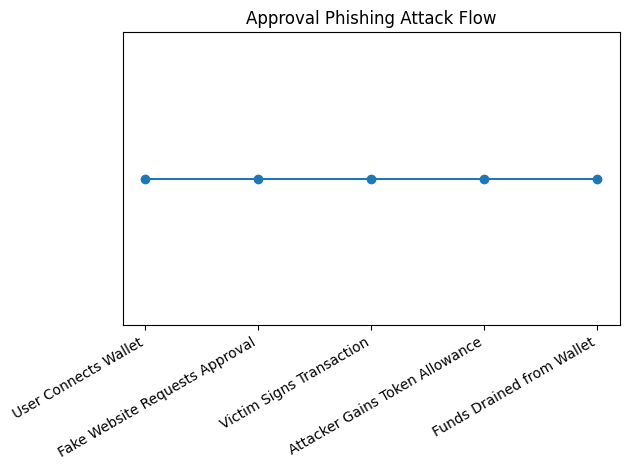
| Month | Total Crypto Stolen |
|---|---|
| January | $385 million |
| February | $49 million |
While February saw lower losses, analysts note that phishing attack attempts increased significantly during the same period.
This suggests attackers are experimenting with new techniques, including:
- AI-generated phishing websites
- Social engineering through Telegram and Discord
- Fake wallet security alerts
- Malicious browser extensions
Graph: Estimated Crypto Losses From Approval Phishing (2021–2024)
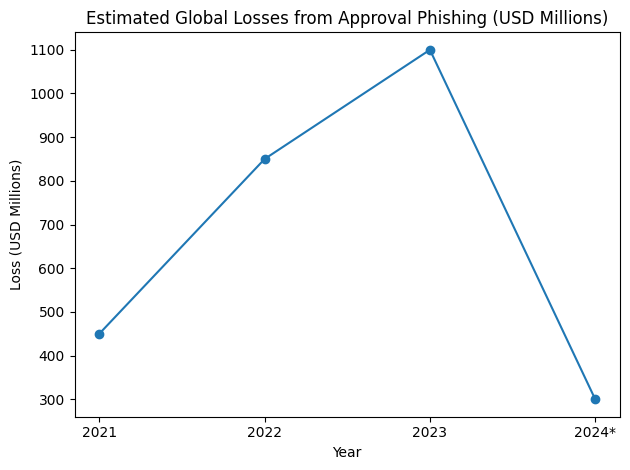
Year Estimated Loss2021 $450M2022 $850M2023 $1.1B2024* $300M+
*2024 represents partial-year data.
Why Crypto Phishing Works So Well
Several structural characteristics of blockchain technology unintentionally make phishing attacks more effective.
1. Transaction Irreversibility
Once a blockchain transaction is confirmed, it cannot be reversed by banks or regulators.
This makes stolen assets extremely difficult to recover.
2. Complex User Interfaces
Many DeFi platforms display transaction approvals in highly technical language.
Users often see confusing prompts such as:
“Grant unlimited token allowance to contract.”
Without technical expertise, users may approve dangerous permissions unknowingly.
3. Rapid Cross-Chain Laundering
Criminals frequently move stolen funds through:
- decentralized exchanges
- privacy mixers
- cross-chain bridges
Within minutes, funds may be spread across multiple blockchains.
Technology Companies Join the Fight
While law enforcement agencies lead Operation Atlantic, the private sector also plays a crucial role.
Blockchain intelligence companies now provide tools capable of:
- tracing wallet clusters
- identifying scam contracts
- tracking stolen funds across chains
- monitoring suspicious transaction patterns
Major analytics firms working with authorities include:
- Chainalysis
- TRM Labs
- Elliptic
These platforms use machine learning and blockchain graph analysis to identify criminal networks faster than ever before.
Diagram: How Approval Phishing Drains a Wallet
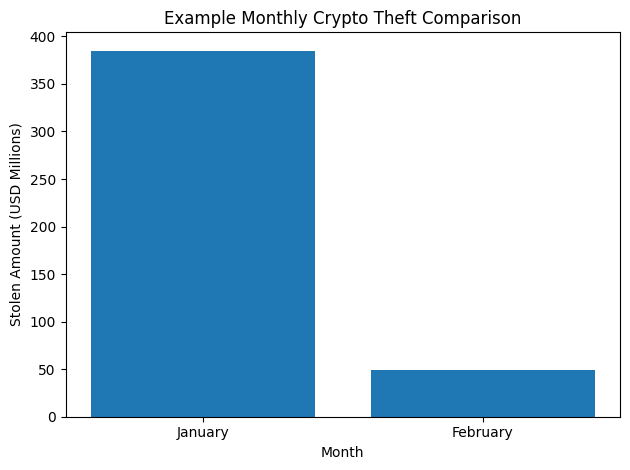
User Wallet | | connects wallet vFake Website / Smart Contract | | approval transaction signed vAttacker Wallet receives token permission | | automated withdrawals vTokens transferred out
Regulatory Pressure Is Increasing
Operation Atlantic reflects a broader shift in global policy toward cryptocurrency regulation and enforcement.
Governments are increasingly focused on:
- investor protection
- anti-money laundering compliance
- fraud prevention
In parallel, regulators are pushing for stronger controls such as:
- wallet security standards
- exchange reporting obligations
- blockchain surveillance tools
The result is an environment where crypto businesses must increasingly integrate compliance and security systems from the beginning.
What Investors and Builders Should Learn
For readers interested in new crypto assets, DeFi platforms, or blockchain business opportunities, the rise of phishing attacks carries important lessons.
1. Security Is Now a Core Investment Factor
Projects with poor wallet security, unclear transaction prompts, or weak smart-contract auditing may expose users to major risks.
2. Wallet Permission Management Matters
Users should regularly review token allowances using tools such as:
- Revoke.cash
- Etherscan token approval checker
Revoking unused permissions can prevent many attacks.
3. Institutional-Grade Monitoring Will Become Standard
Just as banks rely on fraud monitoring systems, blockchain platforms are increasingly integrating real-time transaction risk analysis.
This creates opportunities for startups building:
- on-chain compliance tools
- wallet security software
- scam detection platforms
Chart: Rising Global Coordination Against Crypto Crime
Year Major Global Operations2022 Operation Chokehold (various jurisdictions)2023 Multi-agency crypto seizure programs2024 Operation Spincaster2025+ Operation Atlantic
The Future of Crypto Enforcement
The launch of Operation Atlantic signals a new phase in the evolution of the cryptocurrency ecosystem.
For many years, crypto crime investigations were fragmented and slow due to jurisdictional barriers. Today, international cooperation is becoming the norm.
Authorities now have:
- better blockchain tracing technology
- cross-border intelligence sharing
- specialized crypto investigation teams
This does not mean crypto scams will disappear. Instead, the landscape will likely evolve into a continuous technological arms race between criminals and investigators.
Conclusion
The launch of Operation Atlantic by the United States, the United Kingdom, and Canada represents one of the most coordinated international efforts yet to combat cryptocurrency fraud.
With billions of dollars lost through approval phishing schemes over the past several years, law enforcement agencies are increasingly recognizing that crypto scams pose a serious threat not only to individual investors but also to the credibility of the digital asset industry as a whole.
For investors and entrepreneurs seeking the next wave of blockchain opportunities, the lesson is clear: security, transparency, and compliance are no longer optional features of a successful crypto ecosystem—they are fundamental requirements.
As governments strengthen enforcement and blockchain analytics tools continue to improve, the cryptocurrency industry is entering a new era in which innovation and regulation will develop side by side.
The success of Operation Atlantic may ultimately shape the future of digital asset markets, determining whether the next phase of crypto adoption can occur within a safer and more trustworthy global financial environment.



