
Main Points :
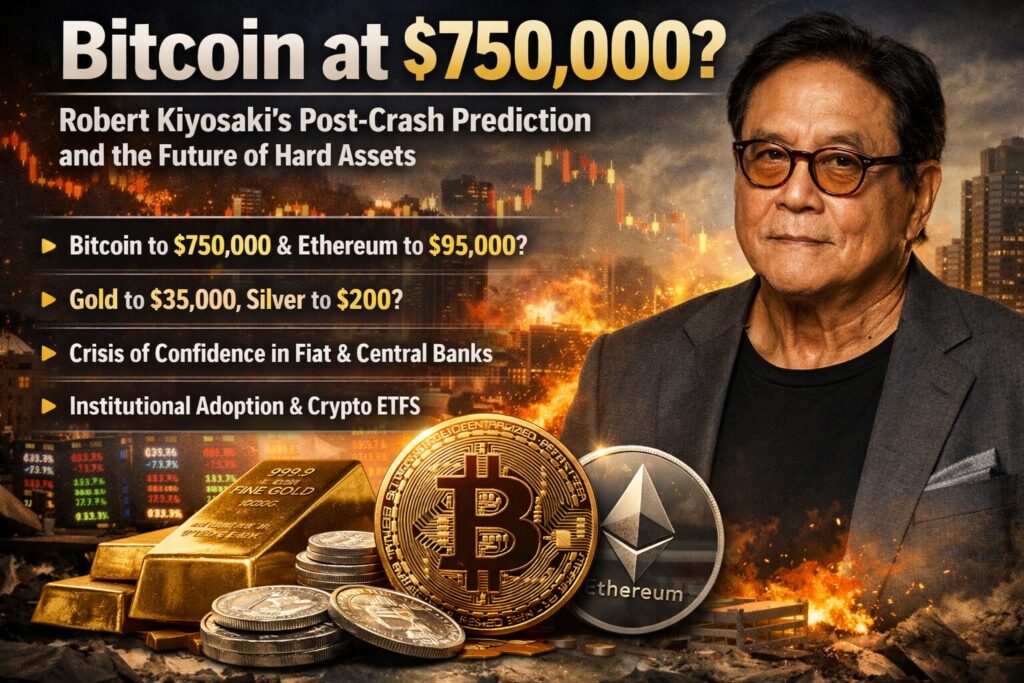
- Robert Kiyosaki predicts a major financial market crash, followed by a massive rally in hard assets.
- He forecasts Bitcoin reaching $750,000 and Ethereum $95,000 within one year after the crash.
- Gold could rise to $35,000, while silver may reach $200.
- His prediction reflects a broader narrative of declining trust in fiat systems and central banking.
- Market reactions are mixed due to past predictions that did not fully materialize.
- Recent developments—such as institutional crypto adoption, ETFs, and macroeconomic pressures—add context to the discussion.
1. Kiyosaki’s Bold Prediction: A Crash Before an Explosion in Crypto
Robert Kiyosaki, the well-known author of the Rich Dad Poor Dad series, once again stirred debate across financial and cryptocurrency markets after posting a bold prediction on social media. According to Kiyosaki, a major financial bubble is approaching collapse. While he admits he cannot pinpoint the exact trigger or timing, he insists that the real question is not whether the crash will occur but when.
Kiyosaki’s forecast goes beyond a typical market correction. He envisions a systemic financial crisis similar to or even greater than the Global Financial Crisis (GFC) of 2008. In his scenario, the crash would shake traditional markets—stocks, bonds, and fiat currencies—leading investors to flee into what he describes as “hard assets.”
Among those assets, Kiyosaki highlights Bitcoin, Ethereum, gold, and silver. His price projections are striking. Within one year after the crash, he believes Bitcoin could reach $750,000, representing roughly a tenfold increase from its recent price of around $74,000. Ethereum, in his view, could surge to $95,000. At the same time, gold could climb to $35,000 per ounce, while silver could reach $200.
Such predictions immediately caught attention across the cryptocurrency community. Some see them as extreme but plausible in a world where monetary policy continues to expand and sovereign debt levels keep rising.
2. The Hard Asset Thesis: Why Kiyosaki Favors Bitcoin
Kiyosaki has long been a vocal advocate of what he calls “hard assets.” These include commodities such as gold and silver as well as decentralized digital assets like Bitcoin.
His argument centers on a belief that fiat currencies are losing purchasing power due to inflation and excessive money printing. Central banks around the world have dramatically expanded their balance sheets over the past two decades, particularly after crises such as the 2008 financial collapse and the COVID-19 pandemic.
Bitcoin, according to Kiyosaki’s philosophy, represents a new form of digital scarcity. Unlike fiat currency, its supply is capped at 21 million coins, making it immune to monetary expansion by governments.
This scarcity narrative has become one of Bitcoin’s most powerful investment themes. Institutional investors, hedge funds, and even sovereign wealth funds have increasingly explored Bitcoin as a hedge against currency debasement.
Ethereum, while different in design, is also gaining recognition for its role as the infrastructure layer of decentralized finance (DeFi), tokenized assets, and blockchain-based applications.
3. Chart: Bitcoin Price vs Kiyosaki’s Prediction
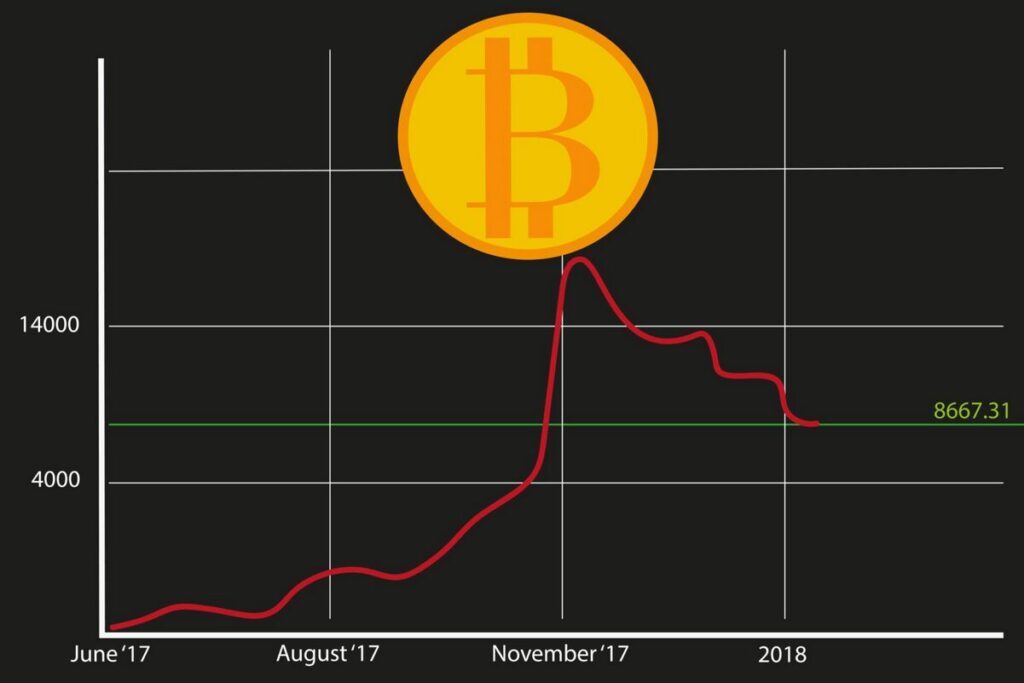
The chart above illustrates the dramatic difference between Bitcoin’s historical price trajectory and Kiyosaki’s projected target. If such a scenario were to occur, Bitcoin would enter a new phase of adoption where its market capitalization could rival that of major global asset classes.
For context, a Bitcoin price of $750,000 would imply a total market value exceeding $14 trillion, assuming most of the circulating supply remains in circulation.
4. Skepticism from the Market
Despite the enthusiasm among some Bitcoin advocates, Kiyosaki’s predictions are not universally accepted.
In fact, critics point out that the author has made several dramatic forecasts in the past that did not unfold exactly as predicted. For example, he warned of a massive market crash in August 2025, yet the expected collapse did not materialize during that period.
This history has led many analysts to treat his statements with caution. Financial commentators argue that macroeconomic predictions—especially those involving precise price targets—are inherently uncertain.
Market participants therefore tend to view such predictions more as philosophical perspectives on financial systems rather than strict investment forecasts.
Still, even skeptics acknowledge that Kiyosaki’s views resonate with a broader shift in investor psychology: growing distrust of traditional financial institutions.
5. Chart: Global Money Supply Expansio
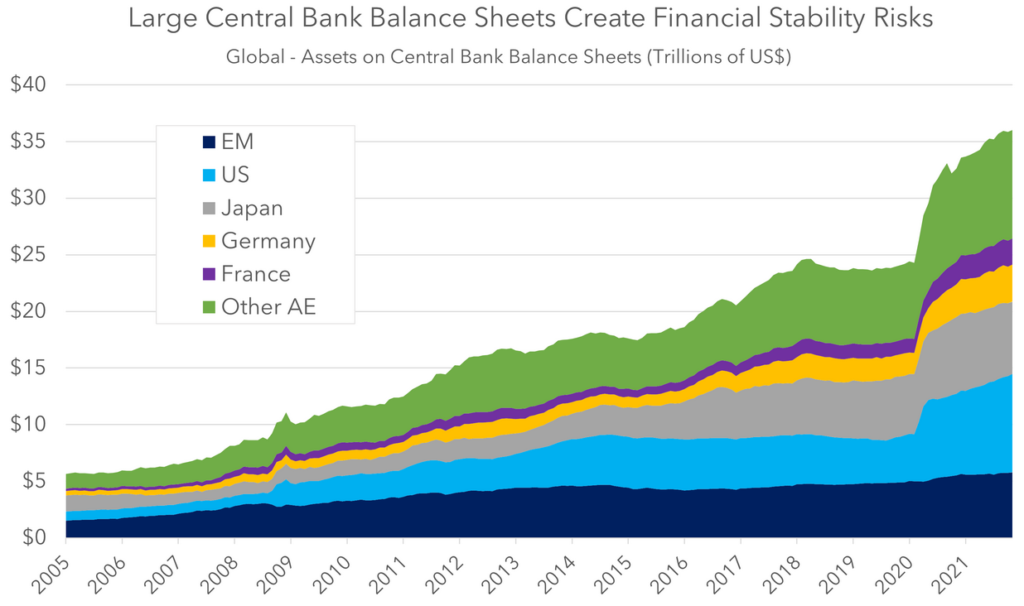
The expansion of global money supply has been one of the key drivers behind interest in alternative assets. Since the early 2000s, central bank balance sheets have grown dramatically.
Many Bitcoin supporters argue that this environment makes scarce assets increasingly attractive.
6. Institutional Adoption: The Structural Shift in Crypto Markets
Beyond individual predictions, the cryptocurrency landscape has changed significantly over the past few years.
Several structural developments are reshaping the market:
1. Bitcoin ETFs
The approval of Bitcoin exchange-traded funds in multiple jurisdictions has opened the door for institutional investors who previously lacked access to crypto markets.
2. Corporate Treasury Adoption
Major companies have begun holding Bitcoin as part of their treasury reserves, viewing it as a potential hedge against inflation.
3. Tokenization of Real-World Assets
Blockchain technology is increasingly used to tokenize real-world assets such as bonds, commodities, and real estate.
4. Stablecoins and Payment Infrastructure
Stablecoins have become a critical component of global crypto liquidity and cross-border payments.
These developments suggest that the crypto ecosystem is evolving from a speculative niche market into a broader financial infrastructure.
7. Chart: Growth of Institutional Crypto Adoption
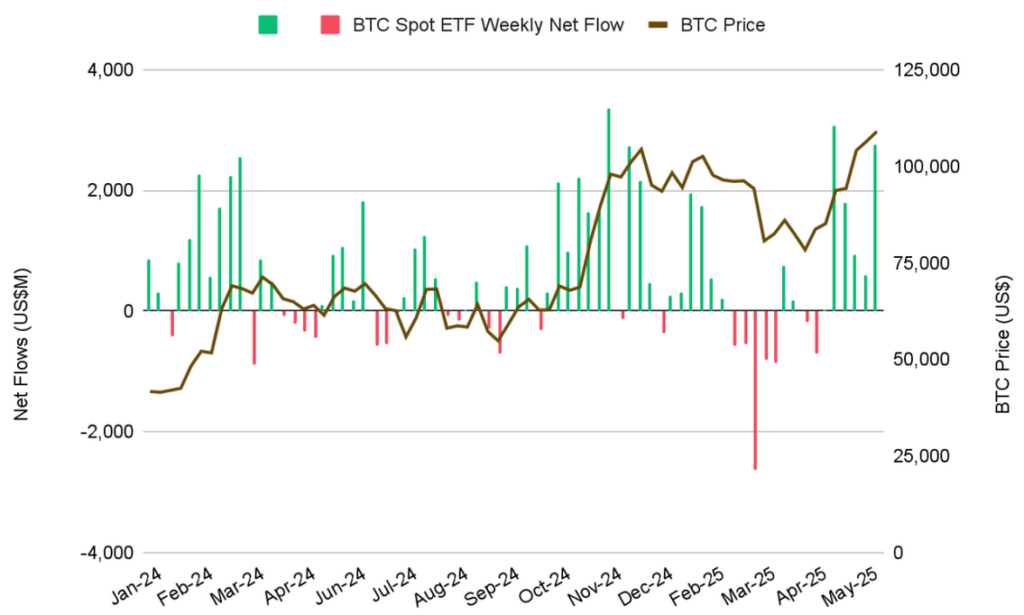
The increasing presence of institutional investors could significantly influence future price dynamics.
Large asset managers entering the market introduce deeper liquidity but also connect crypto more closely to global macroeconomic cycles.
8. The Broader Macro Context
Kiyosaki’s predictions also reflect a larger narrative unfolding across global markets.
Several macroeconomic trends are shaping the debate:
- Rising sovereign debt levels worldwide
- Persistent inflation in major economies
- Geopolitical tensions affecting trade and supply chains
- Increasing digitization of financial infrastructure
In such an environment, digital assets may serve multiple roles simultaneously:
- speculative investments
- technological infrastructure
- monetary alternatives
Bitcoin’s narrative has gradually shifted from a niche experiment into a potential macro asset class.
9. Practical Implications for Investors and Builders
For readers interested in discovering new crypto opportunities or practical blockchain applications, the key takeaway is not necessarily the exact price prediction.
Instead, the deeper lesson lies in the direction of financial innovation.
Several sectors within the blockchain ecosystem are currently attracting significant attention:
- decentralized finance platforms
- cross-border payment systems
- tokenized real-world assets
- decentralized identity solutions
- blockchain infrastructure and scaling networks
These sectors represent areas where blockchain technology may create new revenue models and economic opportunities.
Conclusion: Prediction or Provocation?
Robert Kiyosaki’s prediction of Bitcoin reaching $750,000 within a year after a financial crash may appear extreme. However, it reflects a broader shift in how investors perceive the global financial system.
His thesis is rooted in a belief that traditional monetary structures are fragile and that scarce assets—both physical and digital—will gain value as trust in fiat currencies erodes.
Whether or not his exact forecast becomes reality, the underlying forces driving interest in Bitcoin and other blockchain technologies continue to strengthen.
Institutional adoption, financial innovation, and macroeconomic uncertainty are converging to reshape the global financial landscape.
For investors, entrepreneurs, and developers exploring the next wave of digital assets, the question may not simply be whether Bitcoin can reach $750,000.
The more relevant question might be this:
How will the financial system evolve as decentralized technologies increasingly intersect with global markets?



