
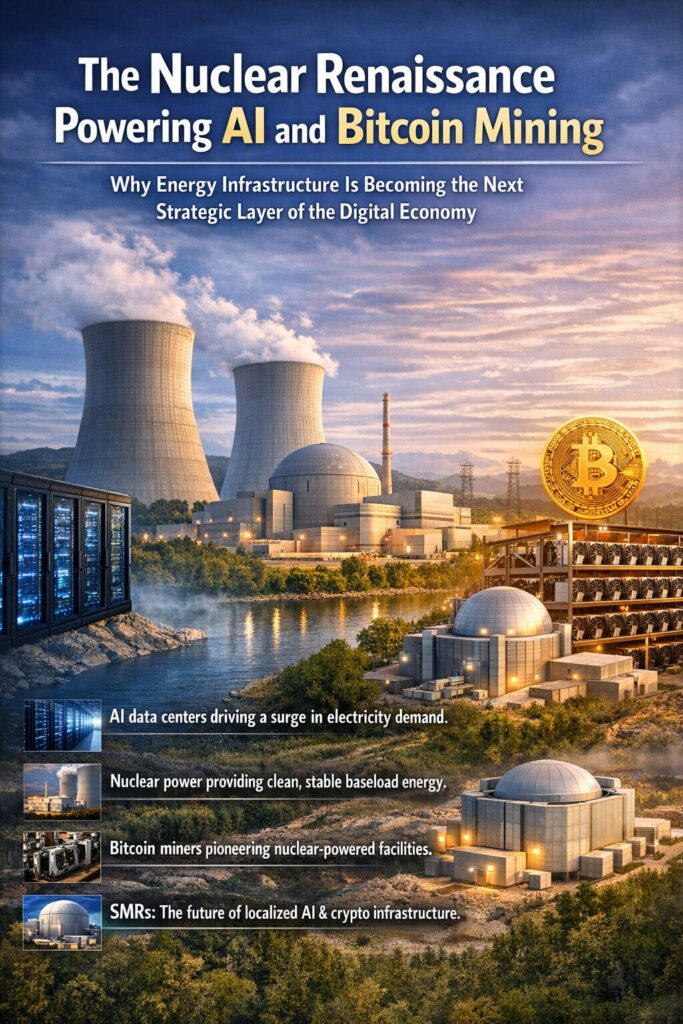
Main Points :
- AI data centers are triggering a massive new wave of electricity demand, forcing governments and tech companies to rethink long-term power supply.
- Nuclear energy is returning as a strategic solution because it provides stable, carbon-free baseload power required for AI and high-performance computing.
- Bitcoin miners were early adopters of nuclear-powered computing, positioning facilities near nuclear plants years before the AI boom.
- Sustainable energy now powers more than half of Bitcoin mining, with nuclear energy rapidly increasing its share.
- Small Modular Reactors (SMRs) may become the backbone of future AI and crypto infrastructure, allowing localized clean power generation near data centers and mining operations.
Introduction
The Unexpected Convergence of AI, Nuclear Power, and Bitcoin
Artificial intelligence is transforming the global economy, but the technology comes with a hidden cost: enormous energy consumption.
Training large AI models, operating hyperscale data centers, and running high-performance computing clusters require staggering amounts of electricity. As companies such as Microsoft, Amazon, and Meta Platforms rapidly expand AI infrastructure, the demand for stable, continuous electricity is reaching unprecedented levels.
This demand is forcing a surprising shift in energy strategy. After decades of stagnation, nuclear power is gaining renewed attention in the United States, driven largely by the energy needs of AI.
Interestingly, the cryptocurrency industry anticipated this trend long before AI became mainstream. Bitcoin mining companies had already begun locating their facilities near large power plants—including nuclear facilities—years earlier in order to secure stable and inexpensive electricity.
Today, these two industries—AI and crypto—are converging around the same fundamental challenge: how to secure large-scale, carbon-free energy for computing.
The AI Energy Shock
Why Data Centers Are Reshaping the Global Power Market
AI is quickly becoming one of the most energy-intensive sectors of the digital economy.
A single advanced AI training cluster can require tens of megawatts of electricity. Hyperscale data centers—massive facilities containing thousands of GPUs—can consume as much power as entire cities.
Industry estimates suggest that global data-center electricity consumption could double or even triple by the early 2030s.
For large technology companies, this presents three key challenges:
- Reliability – AI workloads cannot tolerate interruptions.
- Scale – Future models require exponentially larger compute resources.
- Carbon reduction – Tech companies face pressure to meet net-zero targets.
Traditionally, companies offset emissions by purchasing Renewable Energy Certificates (RECs). However, this accounting method does not guarantee that the electricity used in real time is carbon-free.
As a result, hyperscale companies are now shifting toward 24/7 carbon-free energy procurement, meaning they must secure continuous clean power rather than simply offset emissions.
This requirement is pushing nuclear power back into the spotlight.
The Return of Nuclear Energy
Why the United States May Be Entering a “Nuclear Renaissance”
For decades, nuclear power was widely viewed as a declining industry in the United States. Construction costs, regulatory hurdles, and public concerns slowed the development of new reactors.
However, the rise of AI is changing the equation.
Energy industry analysts now believe the United States may be entering what some call a “nuclear renaissance.”
Nuclear energy offers several advantages that make it attractive for large computing operations:
- Stable baseload power (runs 24/7)
- Carbon-free electricity
- High energy density
- Long-term predictable output
Unlike solar or wind power, nuclear plants produce electricity continuously regardless of weather conditions.
This reliability is particularly valuable for AI infrastructure and high-performance computing.
Major technology companies are increasingly signing long-term power purchase agreements (PPAs) with utilities to secure nuclear energy.
Some companies are even considering direct investments in nuclear facilities in order to guarantee long-term electricity supply for their computing operations.
Bitcoin Miners Were Early to Recognize the Opportunity
Crypto Infrastructure Positioned Near Nuclear Plants
While AI companies are only now beginning to embrace nuclear power, Bitcoin miners recognized its advantages much earlier.
Mining operations require enormous amounts of electricity. Profitability depends heavily on securing low-cost power.
As a result, miners actively search for locations with:
- Cheap electricity
- Stable supply
- Large-scale generation capacity
Nuclear power plants meet all of these criteria.
One notable example is the Bitcoin mining company TeraWulf.
In 2021, TeraWulf partnered with Talen Energy to develop the Nautilus Cryptomine facility adjacent to the Susquehanna Nuclear Power Plant in Pennsylvania.
This mining facility was designed to draw electricity directly from the nuclear plant, creating a highly efficient and stable energy supply for mining operations.
At the time, the strategy seemed unconventional. But today it looks increasingly prescient.
Bitcoin miners effectively acted as early pioneers of nuclear-powered computing infrastructure.
Nuclear Power in Bitcoin Mining
A Growing Share of the Network’s Energy Mix
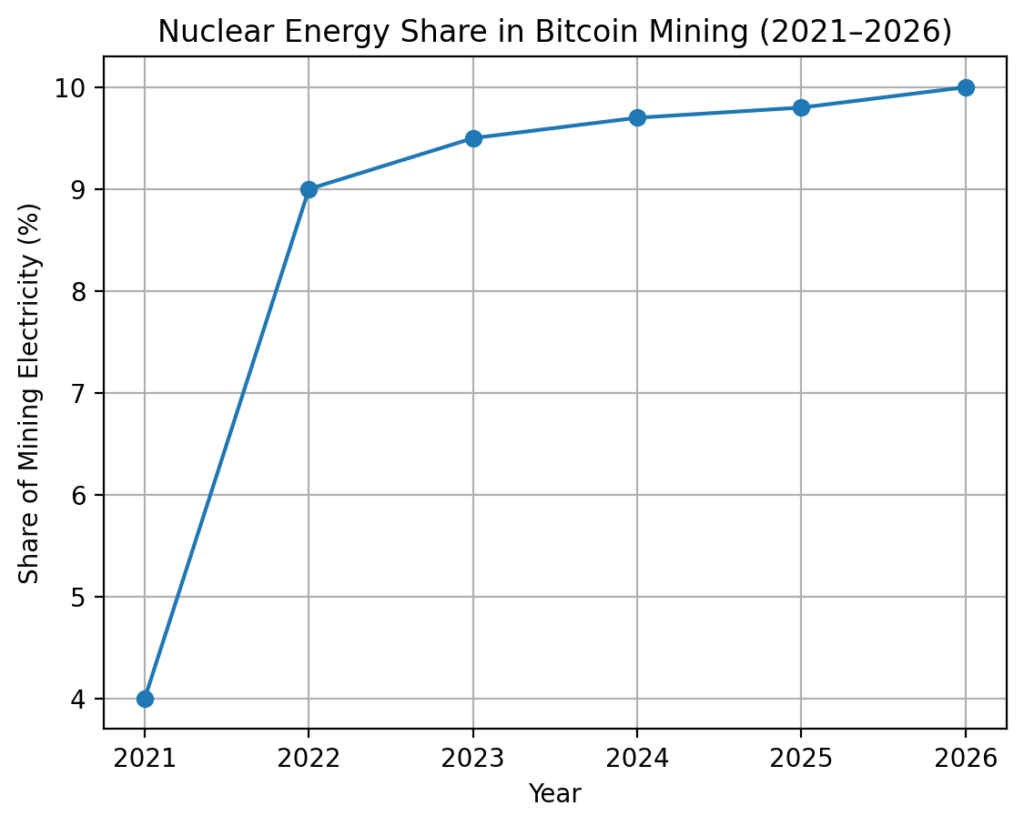
Data from the Cambridge Centre for Alternative Finance reveals that nuclear energy has steadily increased its role in Bitcoin mining.
According to research from the center:
- 2021: Nuclear accounted for about 4% of Bitcoin mining energy.
- 2022: The share increased to approximately 9%.
- Today: Nuclear power approaches 10% of total mining electricity.
Meanwhile, when combined with other sustainable sources—including hydroelectric, wind, and solar—more than 52.4% of Bitcoin mining energy now comes from sustainable sources.
This shift contradicts the common narrative that Bitcoin mining relies primarily on fossil fuels.
Instead, the industry is increasingly migrating toward regions with abundant clean energy.
Suggested Image:
A line graph showing the growth of nuclear energy usage in Bitcoin mining from 2021 to 2026.
“Nuclear Energy Share in Bitcoin Mining (2021-2026)”
Small Modular Reactors
The Technology That Could Transform AI and Crypto Infrastructure
Perhaps the most significant development in the intersection of energy and computing is the emergence of Small Modular Reactors (SMRs).
SMRs are a new generation of nuclear reactors that differ from traditional plants in several ways:
- Smaller physical footprint
- Lower construction costs
- Shorter build times
- Flexible deployment near energy demand
Unlike conventional nuclear plants, SMRs can potentially be installed close to industrial facilities such as:
- Data centers
- AI supercomputing clusters
- Bitcoin mining farms
This proximity reduces transmission losses and improves energy efficiency.
Technology companies are already exploring this model.
For example, Google has signed agreements to explore SMR development to power future computing infrastructure.
If successful, the same model could easily extend to large-scale crypto mining operations.
In effect, the future of computing may involve purpose-built nuclear reactors dedicated to digital infrastructure.
Suggested Image:
Diagram showing:
SMR Reactor → Local Power Grid → AI Data Center + Bitcoin Mining Facility
“Localized Energy Architecture for AI and Crypto Computing”

Strategic Implications for the Crypto Industry
Energy Access May Become the Ultimate Competitive Advantage
As computing demand explodes, the most valuable resource in the digital economy may no longer be chips or algorithms—it may be electricity.
For Bitcoin miners and crypto infrastructure providers, this creates a new strategic landscape.
Companies with direct access to large-scale energy sources will gain several advantages:
- Lower operational costs
- Stable long-term mining profitability
- Reduced environmental criticism
- Potential integration with AI compute markets
Some mining companies are already exploring hybrid business models where mining infrastructure is also used for AI computing workloads during periods of low mining profitability.
This convergence could reshape the economics of both industries.
Mining facilities may evolve into multi-purpose computing campuses capable of supporting:
- AI training
- cloud computing
- blockchain validation
- high-performance computing
The Future: Nuclear-Powered Digital Economies
Looking forward, the relationship between energy infrastructure and digital technology is likely to deepen.
Several trends are becoming increasingly clear:
- AI will dramatically increase electricity demand worldwide.
- Nuclear power may become the preferred solution for carbon-free baseload energy.
- Bitcoin miners are already integrated into this emerging energy ecosystem.
- Small Modular Reactors could decentralize nuclear energy production.
In this environment, the boundary between energy companies and technology companies may begin to blur.
We may eventually see new types of companies emerge—energy-compute infrastructure providers—that operate both power generation and computing facilities.
Conclusion
Why Energy Infrastructure May Become the Next Crypto Investment Frontier
The renewed interest in nuclear power is not merely an energy story—it is a technological and economic transformation.
Artificial intelligence, hyperscale computing, and cryptocurrency mining are all converging around the same foundational requirement: massive, reliable electricity.
Bitcoin miners, once criticized for their energy consumption, may ultimately prove to be early innovators in building the energy infrastructure required for the digital economy.
As nuclear energy expands and SMR technology matures, new opportunities may emerge at the intersection of energy, blockchain, and high-performance computing.
For investors and entrepreneurs searching for the next major frontier in crypto and blockchain applications, the energy layer of the digital economy may become one of the most important arenas to watch.
The future of computing may not only depend on better algorithms or faster chips—but on who controls the power plants that run them.



