Main Points :
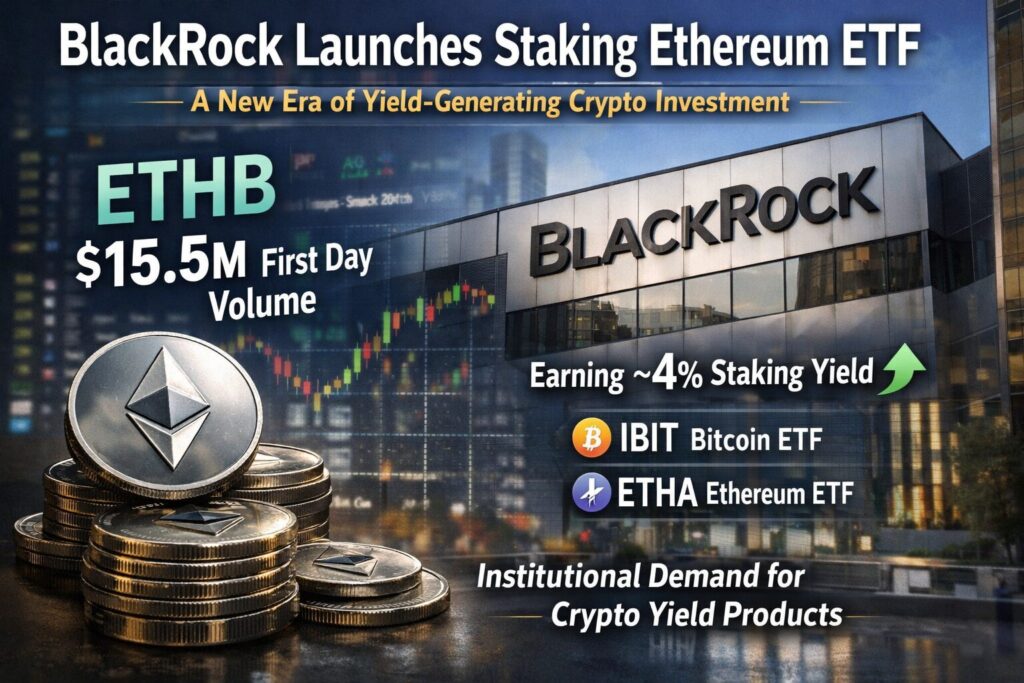
- BlackRock’s staking-enabled Ethereum ETF (ETHB) recorded approximately $15.5 million in trading volume on its first day.
- The ETF allows investors to gain exposure to Ethereum while earning staking yield, estimated around 4% annually.
- ETHB’s debut was strong, though smaller than earlier Solana staking ETFs, which saw larger opening volumes.
- The product expands BlackRock’s rapidly growing crypto ETF ecosystem, which already includes the massive Bitcoin ETF IBIT and Ethereum ETF ETHA.
- The launch highlights a growing institutional trend toward yield-generating crypto investment products.
Introduction: Institutional Crypto Enters the Yield Era
The cryptocurrency investment landscape has undergone a dramatic transformation over the past few years. What began as a speculative asset class dominated by retail traders has steadily matured into a structured financial market attracting some of the world’s largest asset managers. Among those institutions, BlackRock, the largest asset manager in the world, has played a particularly significant role.
The launch of BlackRock’s staking-enabled Ethereum ETF, the iShares Staked Ethereum Trust (ETHB) marks a major step in the evolution of crypto investment products. Unlike traditional crypto ETFs that simply track the price of a digital asset, this new product integrates staking rewards, enabling investors to earn passive yield from the Ethereum network.
On its first trading day, ETHB recorded approximately $15.5 million in trading volume, a performance that analysts described as “very strong” for a newly launched ETF. Although the figure fell short of similar staking-focused Solana ETF launches in 2025, it nevertheless represents an important milestone in the integration of blockchain-based yield mechanisms into traditional financial markets.
For investors searching for new crypto assets, new income opportunities, and practical blockchain applications, this development signals a shift toward a more sophisticated and yield-oriented digital asset economy.
BlackRock’s ETHB ETF: A Hybrid of Traditional Finance and Blockchain Yield
The newly launched iShares Staked Ethereum Trust (ETHB) represents a hybrid financial product designed to bridge traditional capital markets and decentralized blockchain infrastructure.
According to market data from Nasdaq, the ETF traded 592,804 shares on its first day, resulting in a total trading volume of approximately $15.5 million.
The ETF invests primarily in Ethereum while allocating a portion of its holdings to staking operations, allowing the fund to earn validator rewards from the Ethereum network.
ETHB Asset Structure
- 80% Staked Ethereum
- 20% Liquid Ethereum
This structure enables the ETF to maintain sufficient liquidity while still capturing the economic benefits of staking.
At launch, the fund reported net assets of approximately $106.7 million. Custody of the Ethereum assets is handled by Coinbase, one of the largest regulated crypto custodians in the United States.
Staking Yield Distribution
The staking rewards generated by the Ethereum network are expected to be distributed to investors monthly, with validators operated by:
- Figment
- Galaxy Digital
- Attestant (a Bitwise subsidiary)
These validator operators help secure the Ethereum blockchain while generating yield for staked assets.
Typical Ethereum staking yields currently average around 4% annually, though actual returns may fluctuate depending on network conditions and validator performance.
Institutional Demand for Yield-Generating Crypto Products
The launch of ETHB reflects a broader shift in institutional crypto investment strategy. Early crypto ETFs primarily focused on providing price exposure to Bitcoin or Ethereum, but investors increasingly seek yield-producing digital assets.
Traditional finance has long relied on income-generating instruments such as:
- Bonds
- Dividend stocks
- Covered-call strategies
Crypto markets are now beginning to develop similar mechanisms.
BlackRock itself has explored additional yield strategies, including a proposed Bitcoin Premium Income ETF, which would generate returns by selling covered call options on Bitcoin futures.
This approach mirrors strategies commonly used in equity income funds, demonstrating how traditional asset management techniques are gradually merging with digital asset markets.
Comparison with Solana Staking ETFs
While ETHB’s first-day performance was strong, it was still smaller than the launch of several Solana staking ETFs introduced in 2025.
For example:
| ETF | First-Day Volume |
|---|---|
| Bitwise Solana Staking ETF (BSOL) | $55.4 million |
| REX-Osprey SOL + Staking ETF (SSK) | $33.7 million |
| BlackRock ETHB | $15.5 million |
There are several possible explanations for this difference.
First, Solana staking yields have historically been higher than Ethereum’s. In some periods, Solana validators have generated yields exceeding 6-7%, which may attract yield-seeking investors.
Second, the Solana ecosystem experienced strong speculative momentum in 2025 due to:
- AI-related blockchain projects
- High-speed decentralized finance (DeFi) platforms
- Growing meme-coin trading activity
Nevertheless, Ethereum remains the dominant smart-contract platform, and institutional investors often view it as a more stable long-term infrastructure layer.
BlackRock’s Expanding Crypto ETF Ecosystem
ETHB is only the latest addition to BlackRock’s growing digital asset product lineup.
The firm previously launched two major ETFs:
- iShares Bitcoin Trust (IBIT)
- iShares Ethereum Trust (ETHA)
Since their launches in 2024, these products have attracted massive inflows.
| ETF | Net Inflows |
|---|---|
| IBIT | $62.8 billion |
| ETHA | $11.9 billion |
These inflows demonstrate the enormous demand from institutional investors for regulated crypto investment vehicles.
The success of these products has also helped normalize crypto within traditional portfolio management frameworks.
Many financial advisors now view Bitcoin and Ethereum as alternative assets comparable to commodities such as gold.
Fee Structure and Competitive Positioning
ETHB carries a sponsor fee of 0.25%, which is consistent with many other crypto ETFs.
However, BlackRock is offering a temporary fee reduction for the first year.
Under this promotional structure:
- Fees are reduced to 0.12%
- Applies to the first $2.5 billion in assets
This aggressive pricing strategy reflects intense competition among ETF issuers seeking to dominate the emerging crypto investment market.
Lower fees could make ETHB attractive for both:
- Institutional investors
- Long-term retail investors seeking passive income
Visualizing the Ethereum Staking ETF Model
Below is a conceptual diagram showing how staking ETFs function within the Ethereum ecosystem.
[Ethereum Staking ETF Structure]
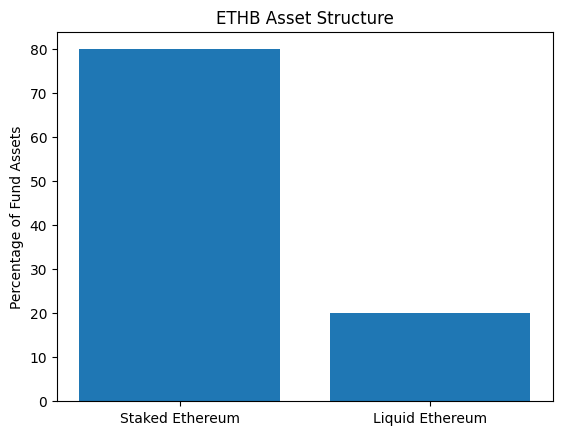
Image description:
ETF investors → ETF fund → Ethereum staking validators → staking rewards → monthly distribution to investors.
Visualizing Institutional Crypto ETF Growth
Another chart helps illustrate the rapid growth of institutional crypto ETFs.
[Institutional Crypto ETF Inflows 2024-2026]
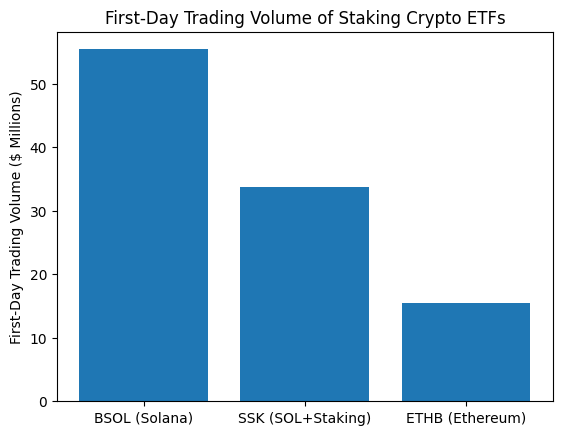
Image description:
Bar chart comparing cumulative inflows into IBIT, ETHA, and newer staking ETFs.
The Broader Trend: Crypto as a Yield Asset Class
The introduction of staking ETFs reflects a broader transformation in how investors view cryptocurrencies.
Early crypto investing was largely based on price speculation. Today, however, blockchain networks are increasingly viewed as productive digital infrastructure capable of generating economic returns.
Examples include:
- Ethereum staking yields
- DeFi lending protocols
- Tokenized real-world assets (RWA)
- Blockchain-based payment networks
Institutional investors are particularly interested in these mechanisms because they resemble traditional financial instruments.
For example:
| Traditional Finance | Crypto Equivalent |
|---|---|
| Bonds | Staking rewards |
| Dividend stocks | Protocol fee revenue |
| Covered calls | Option-based crypto funds |
This convergence between traditional finance and decentralized infrastructure is likely to accelerate in the coming years.
Why This Matters for Crypto Investors
For investors searching for the next opportunity in digital assets, the launch of ETHB highlights several important trends.
1. Institutional Capital Is Still Entering Crypto
Despite market volatility, institutional participation continues to expand.
Large asset managers such as BlackRock, Fidelity, and Franklin Templeton are actively building crypto investment products.
2. Yield Is Becoming a Key Investment Narrative
The future of crypto investing may increasingly revolve around income generation, not just price appreciation.
3. Ethereum Remains a Core Infrastructure Layer
Even as new blockchains emerge, Ethereum continues to dominate areas such as:
- decentralized finance (DeFi)
- tokenized assets
- stablecoin settlement
Conclusion: A Turning Point for Crypto Financial Products
BlackRock’s staking-enabled Ethereum ETF represents more than just another crypto investment product. It marks a turning point in the financialization of blockchain infrastructure.
By combining Ethereum staking rewards with the familiar structure of ETFs, the product creates a bridge between decentralized networks and traditional capital markets.
Although its first-day trading volume of $15.5 million did not surpass competing Solana-based products, analysts still consider the launch a strong success.
More importantly, ETHB signals a future in which cryptocurrencies are no longer viewed merely as speculative assets but as yield-producing financial infrastructure.
As institutional capital continues to flow into the sector, investors can expect to see an expanding range of products that blend blockchain technology with traditional portfolio management strategies.
For those searching for the next crypto opportunity, the rise of staking-based investment vehicles may represent one of the most important trends of the coming decade.