Main Points :
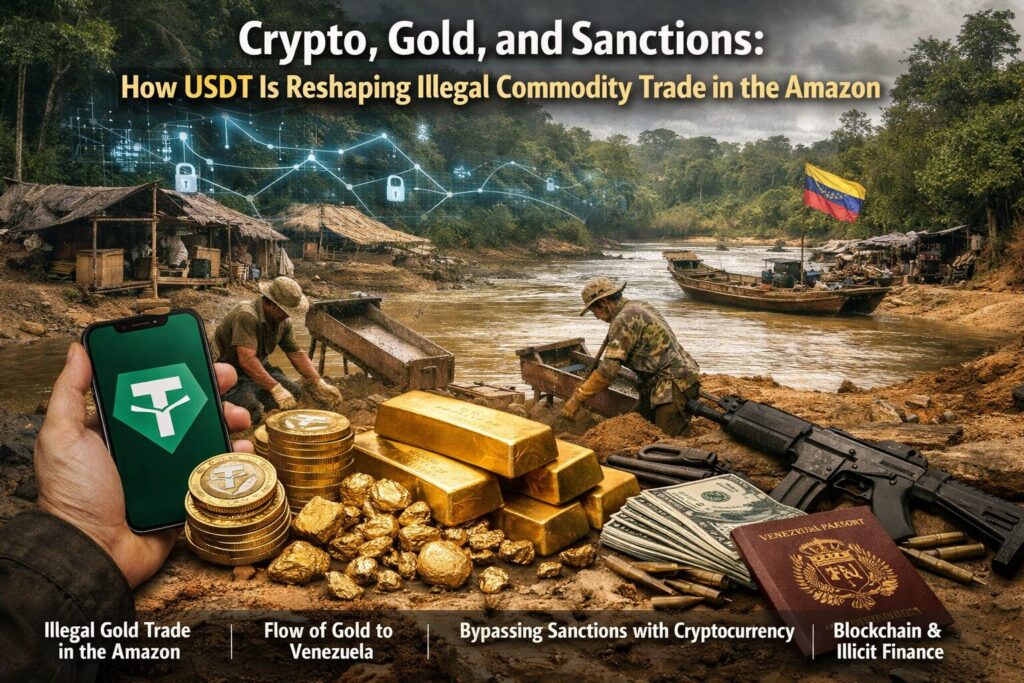
- USDT is reportedly being used as a payment method in illegal gold trade networks in the Amazon region.
- The flow of gold has shifted toward Venezuela as the country seeks alternative economic lifelines.
- Cryptocurrencies may be helping bypass financial sanctions and traditional banking oversight.
- Rising global gold prices are increasing incentives for illegal mining and smuggling.
- Blockchain technology is becoming a double-edged sword: enabling financial inclusion but also facilitating new forms of illicit finance.
Introduction: The Convergence of Commodities and Cryptocurrency
The global cryptocurrency ecosystem has increasingly intersected with traditional commodity markets. In recent years, blockchain-based assets have become tools not only for innovation and financial inclusion but also for facilitating complex global trade networks that sometimes operate outside legal frameworks.
A recent policy brief published in March 2026 by the Global Initiative Against Transnational Organized Crime (GI-TOC) highlights a striking example of this convergence: the use of the stablecoin USDT (Tether) as a settlement mechanism in illegal gold trading across the Amazon region, particularly involving Venezuela.
This development illustrates a broader transformation in global trade and finance. While cryptocurrencies have enabled efficient cross-border payments, the same properties — speed, pseudonymity, and global accessibility — can also make them attractive tools for illicit activities.
For investors, blockchain developers, and policy analysts alike, the emerging relationship between digital assets and commodity supply chains presents both opportunities and challenges.
The Emergence of USDT in Illegal Gold Trade
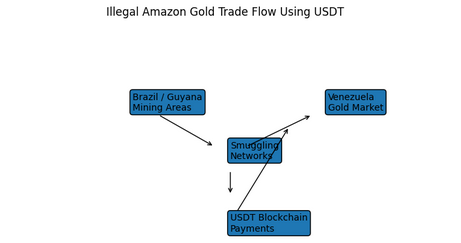
According to the GI-TOC report titled “Changing Flows of Gold in the Amazon (March 2026 Edition)”, some gold transactions within the Amazon basin — particularly those moving from Guyana and Brazil into Venezuela — are now being settled using the stablecoin USDT.
USDT is a dollar-pegged stablecoin issued by Tether and widely used in global cryptocurrency markets for liquidity and settlement. Its stability relative to the US dollar makes it particularly useful for international transactions where participants wish to avoid volatile assets such as Bitcoin.
In traditional commodity markets, payments often rely on banks, wire transfers, or physical cash. However, illegal mining networks and smuggling operations face significant barriers when using traditional financial systems due to anti-money-laundering controls and international sanctions.
Cryptocurrencies provide a workaround.
By using USDT on blockchain networks, traders can settle large payments quickly and across borders without interacting with regulated banking channels. For criminal networks involved in illegal mining and smuggling, this capability dramatically reduces operational friction.
Venezuela’s Gold Economy and Sanctions Pressure
To understand why gold smuggling has intensified in Venezuela, it is necessary to examine the country’s economic context.
Venezuela has faced severe economic sanctions from the United States and other Western governments in recent years. These sanctions have restricted access to international financial markets and reduced the country’s ability to monetize its oil resources — historically its primary source of national income.
As oil revenues declined, gold mining emerged as a critical alternative revenue source.
Illegal and semi-legal mining activities have proliferated in the Orinoco Mining Arc, a region rich in gold deposits but plagued by environmental destruction, criminal networks, and armed groups.
According to multiple international studies, the Venezuelan gold industry involves a complex network of actors:
- government officials
- military units
- local criminal organizations
- multinational trafficking groups
Gold extracted in these areas is often smuggled through neighboring countries such as Brazil and Guyana before eventually reaching international markets.
The GI-TOC report suggests that cryptocurrencies — particularly USDT — are increasingly used within these networks to facilitate payments between miners, smugglers, and brokers.
Rising Gold Prices Fuel Illegal Mining
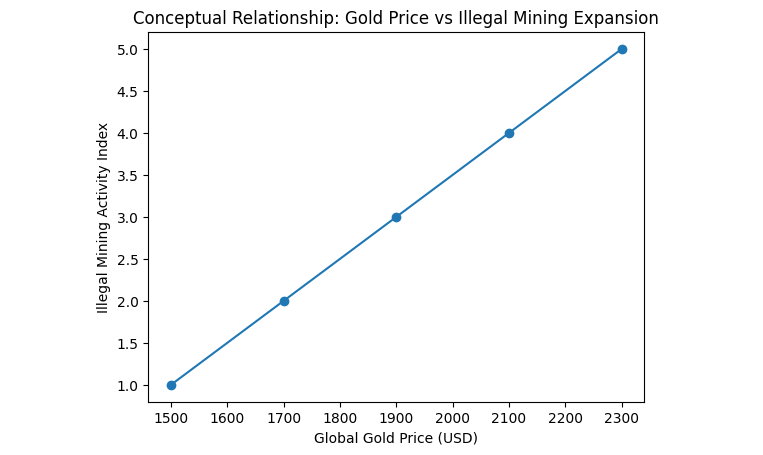
Another factor driving illegal gold activity is the rising global price of gold.
Gold prices have surged in recent years due to geopolitical uncertainty, inflation concerns, and central bank accumulation.
When gold prices rise, illegal mining becomes more profitable.
This creates powerful incentives for organized crime groups to expand extraction operations in remote regions such as the Amazon rainforest.
The consequences extend beyond financial crime.
Illegal mining operations often lead to:
- deforestation
- mercury contamination of rivers
- exploitation of indigenous communities
- violence linked to criminal gangs
In many cases, gold produced through illegal mining eventually enters legitimate supply chains after being laundered through intermediaries.
Cryptocurrency-based payments may accelerate this process by enabling faster and less traceable transactions.
Cryptocurrency and Sanctions Evasion
One of the key concerns highlighted by GI-TOC is the potential role of cryptocurrency in sanctions evasion.
Sanctions typically rely on restricting access to global banking infrastructure, particularly the US-dollar-based financial system.
However, cryptocurrencies operate outside traditional banking rails.
This means individuals or organizations facing sanctions can still transact internationally by using blockchain-based assets.
Stablecoins such as USDT are particularly attractive for this purpose because they maintain a stable value linked to the US dollar.
In practice, a gold buyer in Venezuela could transfer USDT directly to a seller in Guyana or Brazil using a digital wallet. The transaction can occur in minutes and without the involvement of banks.
While blockchain transactions are publicly recorded, identifying the real-world actors behind wallets often requires advanced analytics tools.
Blockchain Transparency: A Hidden Advantage
Despite concerns about criminal use, blockchain technology also provides an unexpected advantage: traceability.
Unlike cash transactions, blockchain payments leave permanent records on public ledgers.
Specialized blockchain analysis firms can use these records to track illicit financial flows.
Over the past few years, governments and law enforcement agencies have increasingly relied on blockchain analytics tools to detect money laundering and sanction evasion.
This means cryptocurrencies are not inherently anonymous — they are pseudonymous.
When wallet addresses become linked to individuals or organizations, entire networks of transactions can be analyzed.
For regulators and investigators, this creates new opportunities to monitor illicit trade networks.
Broader Trends in Crypto-Enabled Commodity Trade
The case of USDT in Amazon gold trading reflects a broader trend across global markets.
Cryptocurrencies are increasingly being used in commodity transactions, including:
- energy trading
- mineral exports
- cross-border agricultural trade
In emerging markets where banking infrastructure is weak or heavily regulated, digital assets provide an alternative settlement layer.
At the same time, stablecoins are becoming essential financial tools in many developing economies.
According to industry estimates, hundreds of millions of people now use stablecoins for payments and savings, particularly in regions experiencing currency instability.
For legitimate users, stablecoins can protect purchasing power and enable faster remittances.
However, the same features that make stablecoins attractive for legal use also make them useful for criminal networks.
The Future: Regulation, Technology, and Market Evolution
As cryptocurrencies continue to integrate with global trade, governments and international organizations are likely to increase scrutiny.
Regulators may focus on several areas:
- monitoring stablecoin transactions
- strengthening anti-money-laundering frameworks
- improving blockchain analytics capabilities
- regulating digital asset exchanges and on-ramps
At the same time, blockchain developers are working on technologies that enhance transparency while preserving privacy.
These include identity-linked wallets, decentralized compliance protocols, and transaction monitoring tools.
The intersection of commodities, cryptocurrencies, and geopolitics is likely to become an increasingly important area of global finance.
Conclusion
The reported use of USDT in illegal gold trading across the Amazon region highlights a complex reality.
Cryptocurrencies are transforming global finance in ways that extend far beyond digital investment markets.
They are increasingly embedded in real-world economic systems — including commodity trade, cross-border commerce, and even illicit networks.
For investors and blockchain innovators, this evolution underscores the growing importance of digital assets as global financial infrastructure.
At the same time, it emphasizes the need for responsible development, effective regulation, and advanced analytical tools to ensure that the benefits of blockchain technology are not overshadowed by its misuse.
As the digital and physical economies continue to merge, the role of cryptocurrencies in global trade will likely expand — shaping the future of both legitimate commerce and financial crime prevention.