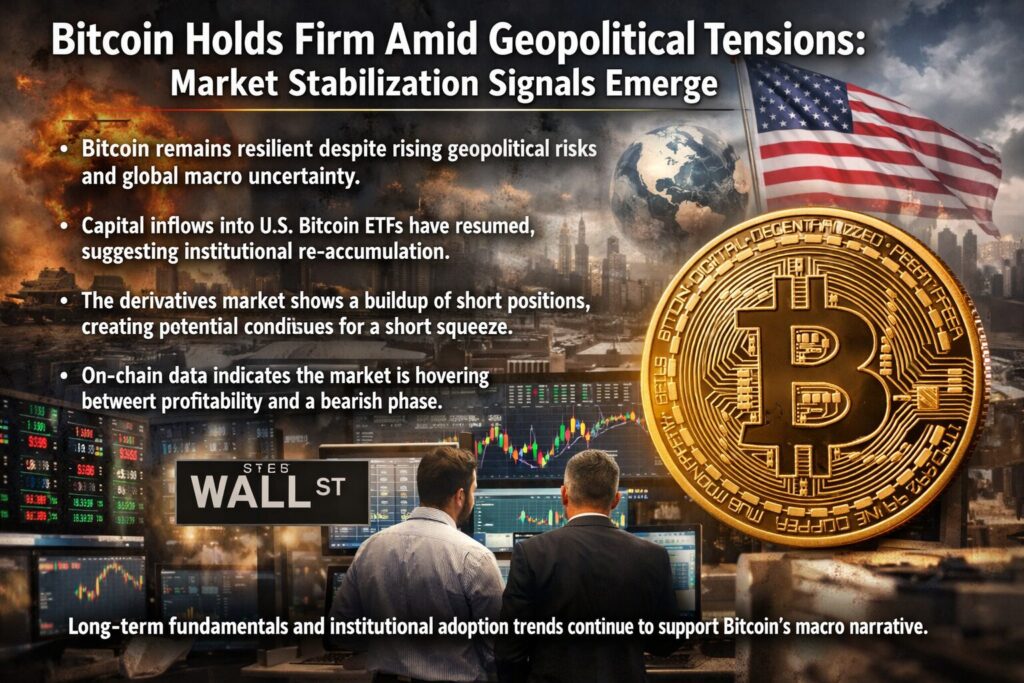
Main Points :
- Bitcoin remains resilient despite rising geopolitical risks and global macro uncertainty.
- Capital inflows into U.S. Bitcoin ETFs have resumed, suggesting institutional re-accumulation.
- The derivatives market shows a buildup of short positions, creating potential conditions for a short squeeze.
- On-chain data indicates the market is hovering between profitability and a bearish phase.
- Long-term fundamentals and institutional adoption trends continue to support Bitcoin’s macro narrative.
Bitcoin’s Resilience in a Turbulent Global Environment
In an increasingly volatile global environment marked by geopolitical tensions, shifting monetary policy expectations, and uncertainty across traditional financial markets, Bitcoin continues to demonstrate notable resilience. According to the latest weekly report released by blockchain analytics firm Glassnode, the flagship cryptocurrency appears to be entering a phase of relative stabilization despite persistent macroeconomic headwinds.
Over the past several months, global investors have been closely watching developments such as conflicts in multiple regions, interest-rate policy uncertainty from major central banks, and tightening liquidity conditions in financial markets. Historically, such macro pressures have weighed heavily on risk assets including cryptocurrencies. However, recent on-chain indicators suggest that Bitcoin may be transitioning into a more stable market structure.
Glassnode’s analysis points out that while the broader market sentiment remains cautious, a number of underlying metrics indicate that the worst phase of the recent correction may already be behind us. Bitcoin’s ability to maintain its trading range and avoid deeper capitulation has become one of the most important signals for market participants seeking clues about the next phase of the cycle.
For investors looking for emerging opportunities in digital assets or exploring blockchain’s real-world financial applications, these developments offer valuable insight into how Bitcoin behaves under macroeconomic stress.
Bitcoin Trading Range Reflects Market Uncertainty
One of the key observations highlighted in the Glassnode report is the relatively narrow price range in which Bitcoin has been trading for more than a month. The asset has fluctuated between approximately $62,800 and $72,600, repeatedly failing to break above resistance levels while also finding consistent support on dips.
This range-bound behavior reflects a market that is neither fully bullish nor deeply bearish. Instead, it represents a transitional phase where investors are reassessing risk exposure and waiting for clearer macro signals.
Glassnode notes that Bitcoin’s current price sits between two critical cost-basis metrics:
- Average acquisition price for all holders: approximately $54,000
- Average cost basis for actively traded coins: approximately $78,000
These two levels provide insight into the psychological and structural dynamics currently shaping the market.
The lower level near $54,000 represents the average cost for the entire supply of Bitcoin held across the network. As long as the market price remains above this level, the majority of holders remain in profit, reducing the probability of large-scale panic selling.
Conversely, the $78,000 level represents the cost basis of coins that have recently changed hands more actively. Because the current market price is significantly below this level, many recent buyers remain underwater, creating potential selling pressure whenever prices attempt to rise.
This tension between profitable long-term holders and recently underwater investors is one of the defining characteristics of the current market phase.
Bitcoin Market Cost Basis Structure
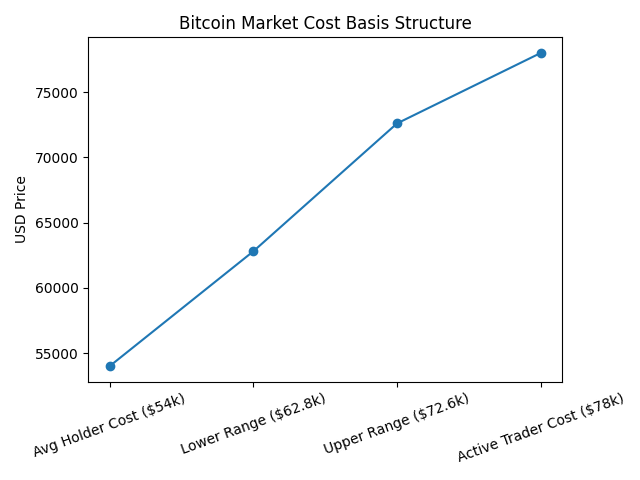
The following diagram illustrates the relationship between the overall holder cost basis, active investor cost basis, and the current trading range.
Persistent Losses Among Recent Buyers
Another important takeaway from the Glassnode report is that many investors who purchased Bitcoin during recent rallies are currently facing unrealized losses. These participants—often referred to as “short-term holders”—have historically played a key role in shaping market volatility.
When prices fall below the acquisition cost of these investors, they often become more sensitive to market movements. Even small rallies can trigger selling as they attempt to exit positions and recover capital.
This dynamic has been observed in multiple past crypto market cycles. During previous bearish periods, large numbers of short-term holders capitulated before the market ultimately found a sustainable bottom.
According to Glassnode’s on-chain data, this pattern appears to be repeating in the current cycle. Many of the coins purchased during the most recent rally remain in loss territory, meaning selling pressure could continue in the short term.
However, this situation also has a silver lining. When weaker hands exit the market and coins migrate toward longer-term holders with higher conviction, the market structure typically becomes more stable.
This process, often referred to as “supply redistribution,” has historically preceded the early stages of new bull markets.
Institutional Demand Returns Through Bitcoin ETFs
While some indicators remain cautious, the report also highlights a potentially significant positive development: capital inflows into U.S. Bitcoin spot ETFs have resumed after several weeks of outflows.
Since the approval of spot Bitcoin ETFs in the United States, institutional investors have gained a more accessible pathway to gain exposure to the cryptocurrency without directly holding the asset.
These investment vehicles have become a crucial bridge between traditional finance and the digital asset ecosystem.
The recent return of ETF inflows suggests that institutional investors may be using the current price consolidation as an opportunity to accumulate Bitcoin at discounted levels.
Historically, periods of institutional accumulation during market corrections have often preceded major upward price movements.
Large financial institutions tend to operate with longer time horizons and deeper capital reserves compared with retail investors. As a result, their buying activity can provide a stabilizing effect during periods of market uncertainty.
Some analysts view the resumption of ETF inflows as one of the most important signals indicating that the market may be nearing the end of its correction phase.
Institutional Bitcoin ETF Flow Trend
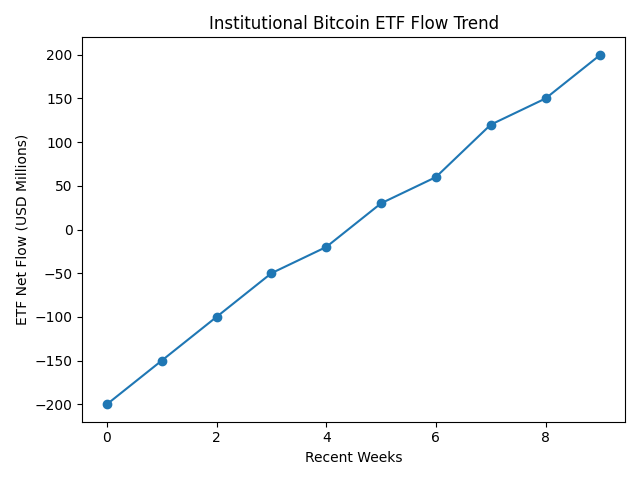
This chart illustrates the trend of capital inflows and outflows from U.S. Bitcoin ETFs.
Futures Market Short Positions Raise Volatility Risk
While institutional inflows provide bullish signals, activity in the derivatives market paints a more complex picture.
Glassnode reports that short positions in Bitcoin futures markets have been steadily increasing. Traders betting on further price declines have built significant positions, reflecting lingering bearish sentiment.
At first glance, this may appear negative for the market. However, a large buildup of short positions can also create the conditions for a powerful upward move.
If Bitcoin’s price begins to rise unexpectedly, traders holding short positions may be forced to close their positions by buying back Bitcoin in the market. This process is known as a short squeeze.
Short squeezes can trigger rapid price spikes because multiple traders attempt to exit their positions simultaneously, creating sudden buying pressure.
Crypto markets have experienced numerous short squeeze events in the past, often leading to dramatic price surges within short periods.
Therefore, the current derivatives positioning suggests that volatility—both upward and downward—could increase in the coming weeks.
Bitcoin’s Emerging Role as Digital Gold
Beyond short-term trading dynamics, Bitcoin’s macro narrative continues to evolve. Several major financial institutions have recently emphasized Bitcoin’s potential role as a hedge against geopolitical instability.
For example, analysts at JPMorgan have highlighted the growing perception of Bitcoin as a form of “digital gold.”
The argument is based on several characteristics that Bitcoin shares with traditional safe-haven assets:
- Limited supply
- Global accessibility
- Resistance to censorship
- Independence from centralized monetary systems
During periods of geopolitical tension, investors often seek assets that are not directly tied to the economic policies of any single nation.
Gold has historically fulfilled this role. However, Bitcoin’s digital nature allows it to move across borders instantly and operate outside traditional financial infrastructure.
This makes it particularly attractive in an era where capital controls, sanctions, and cross-border payment restrictions are becoming more common.
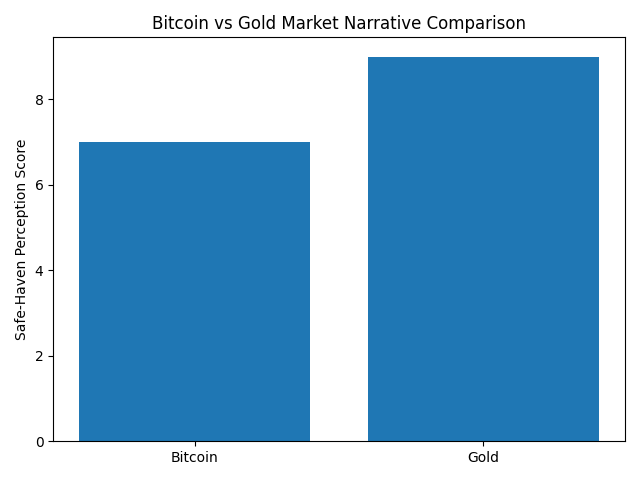
While Bitcoin has not yet achieved the same level of stability as gold, its growing adoption among institutional investors suggests that its role as a macro hedge may continue to strengthen.
Bitcoin vs Gold Market Narrative
Broader Crypto Market Implications
Bitcoin’s stabilization also has implications for the broader cryptocurrency ecosystem.
Historically, Bitcoin has served as the primary liquidity anchor for the entire crypto market. When Bitcoin stabilizes after a correction, capital often begins rotating into alternative digital assets.
This process can lead to new investment opportunities in emerging blockchain sectors such as:
- decentralized finance (DeFi)
- tokenized real-world assets
- blockchain infrastructure
- next-generation Layer-1 networks
For investors seeking the next major crypto opportunity, periods of Bitcoin consolidation often represent the early stages of broader market expansion.
In addition, the ongoing integration of blockchain technology into traditional financial systems continues to accelerate.
Major banks, asset managers, and payment companies are exploring applications such as tokenized securities, blockchain settlement networks, and stablecoin-based payment systems.
These developments reinforce the long-term investment thesis that the crypto industry is transitioning from a speculative frontier into a foundational layer of global financial infrastructure.
Conclusion: Signs of Stabilization but Not Yet a Full Bull Market
Glassnode’s latest report suggests that Bitcoin may be entering a period of stabilization after months of market turbulence. The cryptocurrency has maintained a relatively narrow trading range despite geopolitical uncertainty and macroeconomic pressures.
Key indicators—including renewed ETF inflows, supply redistribution among investors, and growing institutional interest—suggest that the market may be gradually recovering.
However, several risks remain.
Short-term holders continue to hold underwater positions, and the buildup of bearish bets in derivatives markets could lead to increased volatility.
For now, Bitcoin appears to be navigating a delicate balance between bearish pressure and emerging bullish momentum.
If institutional accumulation continues and macro conditions stabilize, the foundation for a stronger recovery could begin forming in the months ahead.
For investors exploring new crypto opportunities, this transitional phase may represent a critical moment—one where the next cycle’s leaders begin quietly positioning themselves before the broader market recognizes the shift.