
Main Points :
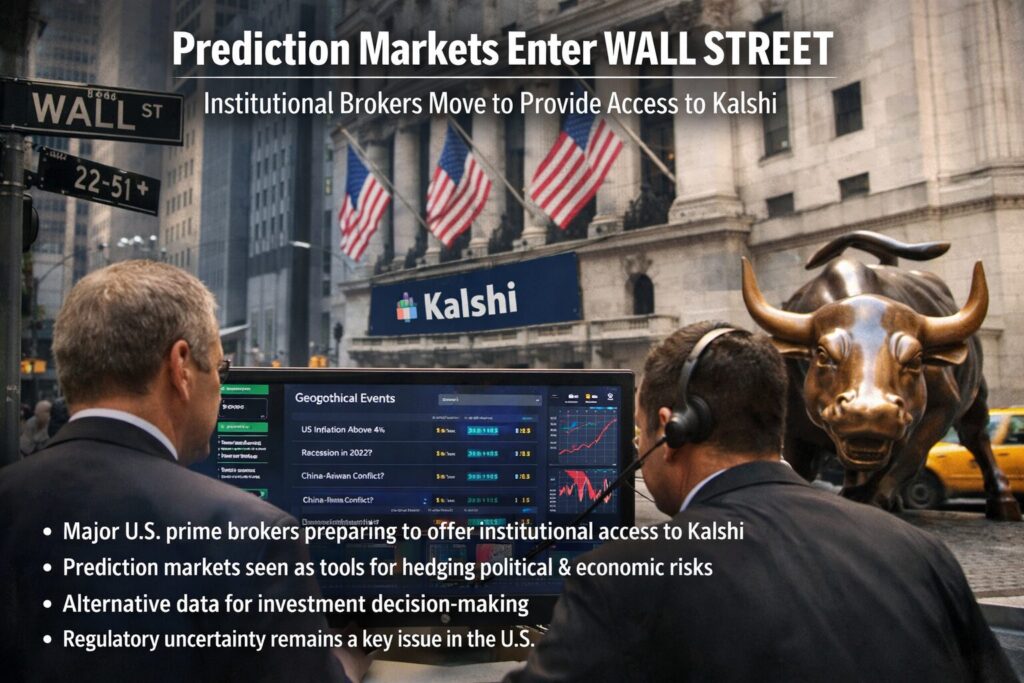
- Major U.S. prime brokers are preparing to provide institutional trading access to the regulated prediction market platform Kalshi.
- Institutional investors increasingly view prediction markets as tools for hedging geopolitical and macroeconomic risks.
- Prediction market data may serve as a new form of alternative data for investment decision-making.
- Regulatory uncertainty remains significant, particularly in the United States where CFTC and state regulators debate legal boundaries.
- The entrance of brokerage infrastructure may determine whether prediction markets become a mainstream financial asset class.
Introduction
Prediction markets—platforms where participants trade contracts based on the probability of future events—have long existed at the fringes of finance. For decades they were viewed primarily as academic experiments or entertainment platforms for retail traders speculating on elections, sports outcomes, or global events.
However, a new phase of institutionalization appears to be emerging.
Recent reports indicate that several major prime brokers, including Clear Street and Marex Group, are preparing to offer institutional clients access to the U.S. prediction market platform Kalshi. If successful, this development could mark the first major integration of prediction markets into the infrastructure of institutional finance.
For investors searching for new sources of alpha, risk hedging tools, and innovative data signals, prediction markets represent an intriguing frontier. At the same time, regulatory debates and legal uncertainty continue to shape the sector’s future.
This article explores how prediction markets are evolving, why institutions are becoming interested, how blockchain-based systems are influencing the industry, and what the next phase of development could mean for crypto investors and financial innovators.
Institutional Access to Kalshi Accelerates
According to reporting by Bloomberg, U.S. prime brokers are accelerating efforts to connect institutional trading desks to Kalshi, the only federally regulated prediction market platform in the United States.
Kalshi operates as a CFTC-regulated exchange, allowing traders to buy and sell contracts tied to real-world events. Each contract typically settles at $1 or $0, depending on whether a specific event occurs.
Examples include contracts such as:
- Will the U.S. inflation rate exceed a certain threshold?
- Will the Federal Reserve raise interest rates this month?
- Will a particular geopolitical event occur?
Clear Street, a brokerage firm specializing in hedge fund infrastructure, plans to begin clearing the first institutional trades on Kalshi later this month. Meanwhile, London-based Marex Group has announced plans to provide access within the coming months.
The significance of this development lies not merely in access to the platform itself, but in the institutional infrastructure surrounding it. Prime brokers provide clearing, risk management, margining, and settlement services—essential components required by professional trading firms.
Once these services are in place, hedge funds and asset managers can participate in prediction markets using the same operational frameworks they use for futures, options, and other derivatives.
Prediction Markets as a New Hedging Instrument
One of the primary reasons institutional investors are exploring prediction markets is their potential as hedging instruments against geopolitical and macroeconomic risks.
Traditional financial markets offer hedging tools for interest rates, currencies, and commodities. However, many events that influence markets—such as elections, wars, regulatory decisions, or policy announcements—are difficult to hedge directly.
Prediction markets allow investors to create positions tied to the probability of such events occurring.
For example, a hedge fund heavily exposed to defense stocks might purchase contracts predicting increased geopolitical conflict. If tensions escalate and defense stocks rise, the hedge may partially offset risks associated with market volatility.
Similarly, investors concerned about inflation might buy contracts tied to inflation outcomes or central bank decisions.
Unlike traditional derivatives, prediction market contracts often represent binary outcomes, making them simple yet powerful tools for expressing views on future events.
This capability is increasingly attractive in a world where macro events—from elections to trade wars—can reshape markets overnight.
Alternative Data for Investment Decision-Making
Beyond hedging, institutional investors are increasingly viewing prediction markets as a source of alternative data.
Financial markets today rely heavily on data analysis. Hedge funds collect massive datasets—from satellite imagery to credit card transactions—in order to detect economic trends before they become widely known.
Prediction markets offer a unique form of crowd-sourced intelligence.
Each contract price reflects the collective probability assigned by traders to a specific event. When aggregated across thousands of participants, these probabilities can serve as real-time forecasts of political or economic developments.
Academic research has repeatedly shown that prediction markets often outperform traditional forecasting methods.
For example:
- Election prediction markets frequently outperform polling averages.
- Market-based forecasts of economic indicators often rival professional economist surveys.
Institutional investors are increasingly exploring ways to integrate these signals into quantitative trading strategies.
For crypto investors and blockchain developers, this trend highlights a growing opportunity: building data-driven financial products around decentralized prediction markets.
The Regulatory Gray Zone
Despite growing institutional interest, prediction markets remain surrounded by legal uncertainty.
In the United States, the Commodity Futures Trading Commission (CFTC) oversees regulated prediction markets like Kalshi. However, disputes continue over whether certain event contracts should be classified as derivatives or illegal gambling.
Election-related contracts have been particularly controversial.
Some regulators argue that allowing traders to bet on political outcomes could undermine democratic processes or encourage manipulation. Others argue that prediction markets improve transparency and provide valuable forecasting data.
The debate has intensified as decentralized platforms such as Polymarket gain popularity. These blockchain-based markets allow users worldwide to trade predictions on events ranging from elections to geopolitical conflicts.
Because many decentralized platforms operate outside U.S. jurisdiction, regulators face challenges enforcing traditional financial laws.
This regulatory tension has led to proposals from lawmakers seeking to ban certain types of prediction market trading—particularly contracts tied to wars, terrorism, or individual deaths.
Chart: Growth of Prediction Market Trading Volume
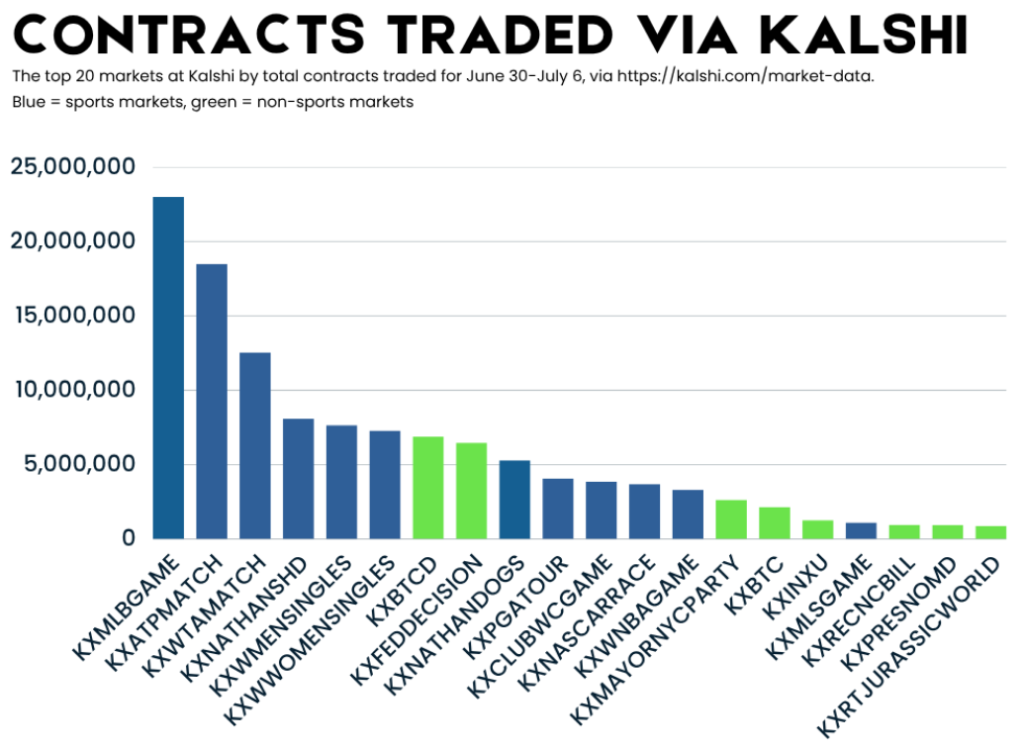
The global prediction market sector has grown rapidly in recent years. Platforms like Kalshi, Polymarket, and Augur have collectively processed billions of dollars in trading volume.
While still small compared to traditional derivatives markets, the sector’s growth trajectory has attracted attention from institutional investors.
Blockchain and the Rise of Decentralized Prediction Markets
While Kalshi represents the regulated institutional side of prediction markets, the blockchain ecosystem has simultaneously built decentralized alternatives.
Platforms such as:
- Polymarket
- Augur
- Gnosis / Omen
allow users to trade predictions without centralized intermediaries.
These systems rely on smart contracts and decentralized oracle networks to resolve event outcomes.
For crypto investors, decentralized prediction markets represent a convergence of several key innovations:
- Decentralized finance (DeFi)
- Oracle networks
- Tokenized incentives
- On-chain governance
Some analysts believe prediction markets could become one of the most powerful applications of blockchain technology.
In theory, decentralized markets can aggregate global knowledge and produce highly accurate forecasts across politics, finance, science, and technology.
Diagram: Structure of a Prediction Market
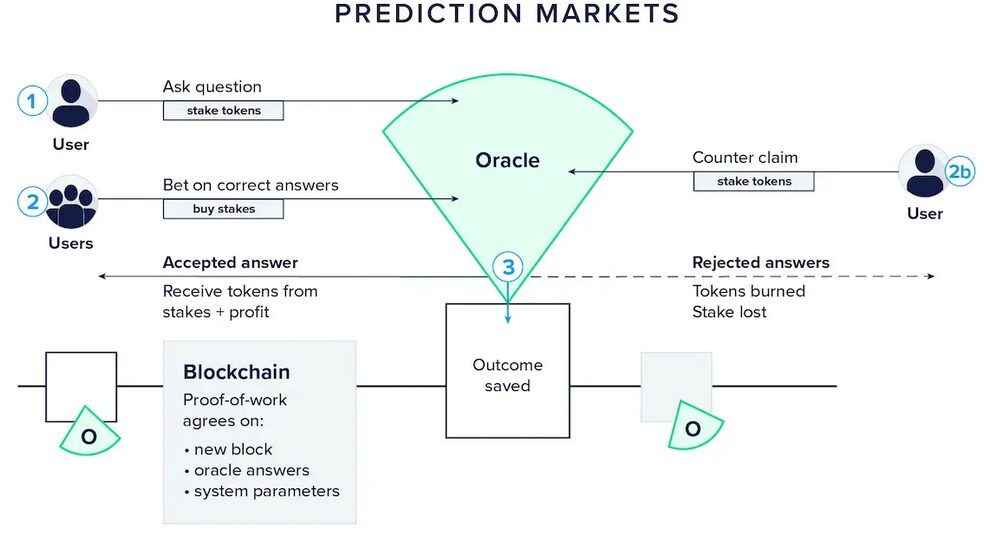
A typical prediction market involves four main components:
- Event Definition – A clear yes/no question is defined.
- Market Trading – Participants buy or sell contracts reflecting their probability estimates.
- Price Discovery – Market prices adjust based on new information.
- Settlement – When the event occurs, contracts settle at $1 or $0.
This structure makes prediction markets function similarly to derivatives markets, but with a focus on real-world event probabilities.
Why Wall Street Is Paying Attention
The interest from prime brokers signals that Wall Street increasingly sees prediction markets as a legitimate financial tool.
Several factors are driving this shift:
1. Rising Geopolitical Volatility
Global conflicts, elections, and policy shifts have become major market drivers.
2. Data-Driven Investment Strategies
Quantitative funds are constantly searching for new predictive datasets.
3. Market Efficiency
Prediction markets aggregate dispersed information rapidly.
4. Technology Infrastructure
Blockchain and fintech platforms are making prediction markets easier to access.
As these factors converge, prediction markets may evolve into a new class of financial derivatives.
Opportunities for Crypto Investors and Builders
For readers interested in discovering new crypto opportunities, the rise of prediction markets offers several potential avenues:
1. Infrastructure Tokens
Platforms providing oracles, liquidity, or settlement layers could benefit from prediction market growth.
2. Data Analytics
Startups may build trading signals derived from prediction market probabilities.
3. Cross-Market Hedging
Crypto traders may use prediction markets to hedge macro risks affecting digital asset prices.
4. Tokenized Event Markets
Future platforms may tokenize prediction contracts and integrate them with DeFi lending or derivatives.
In many ways, prediction markets represent a natural extension of blockchain’s core philosophy: decentralized truth discovery through market mechanisms.
Risks and Challenges
Despite the excitement, several risks remain.
Regulatory Intervention
Governments may restrict certain event markets, especially those tied to sensitive geopolitical events.
Insider Information
Prediction markets could theoretically be exploited by participants with privileged information.
Liquidity Constraints
Compared to traditional derivatives markets, prediction markets still have limited liquidity.
Ethical Concerns
Some critics argue that betting on wars or disasters raises moral questions.
These challenges will likely shape how prediction markets evolve over the coming decade.
Conclusion: A New Financial Frontier
Prediction markets are transitioning from niche experiments to a potential pillar of modern finance.
The decision by prime brokers to connect institutional traders to Kalshi represents a major step toward integrating these markets into the global financial system.
If institutional participation grows, prediction markets could transform how investors hedge risk, forecast economic events, and analyze geopolitical developments.
At the same time, the rise of decentralized prediction markets suggests that blockchain technology may play a central role in the sector’s long-term evolution.
For crypto investors and financial innovators, this convergence of institutional finance, data analytics, and decentralized technology may open an entirely new category of markets—one where information itself becomes a tradable asset.
The next few years will determine whether prediction markets remain a specialized tool or become a core component of global financial infrastructure.



