
Main Points :
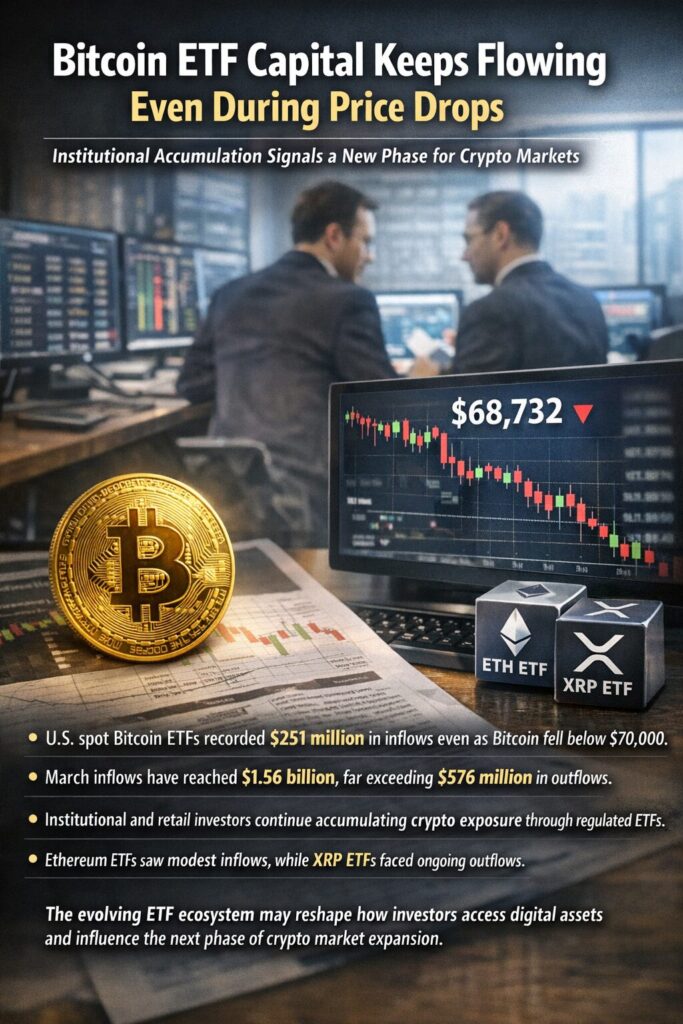
- U.S. spot Bitcoin ETFs recorded $251 million in inflows even as Bitcoin fell below $70,000.
- March inflows have reached $1.56 billion, far exceeding $576 million in outflows.
- Institutional and retail investors continue accumulating crypto exposure through regulated ETFs.
- Ethereum ETFs recorded modest inflows, while XRP ETFs experienced continued outflows, though at a slower pace.
- The evolving ETF ecosystem may reshape how investors access digital assets and influence the next phase of crypto market expansion.
1. Bitcoin ETF Inflows Continue Despite Market Volatility
One of the most notable developments in the cryptocurrency market recently has been the continued inflow of capital into U.S. spot Bitcoin exchange-traded funds (ETFs), even during periods of price weakness.
According to market data from SoSoValue, U.S. spot Bitcoin ETFs recorded approximately $251 million in net inflows on Tuesday, following $167 million in inflows the previous day. These figures highlight a persistent demand for Bitcoin exposure through regulated financial products.
This trend is particularly significant because it occurred while Bitcoin’s price temporarily dipped below $70,000, reaching a low of approximately $69,400 before stabilizing around $69,810.
Historically, such price declines often trigger panic selling among retail traders. However, the ETF flow data suggests a different narrative unfolding in the current market cycle: investors are increasingly treating price dips as buying opportunities rather than warning signals.
Cumulative Inflows into U.S. Spot Bitcoin ETFs (March)
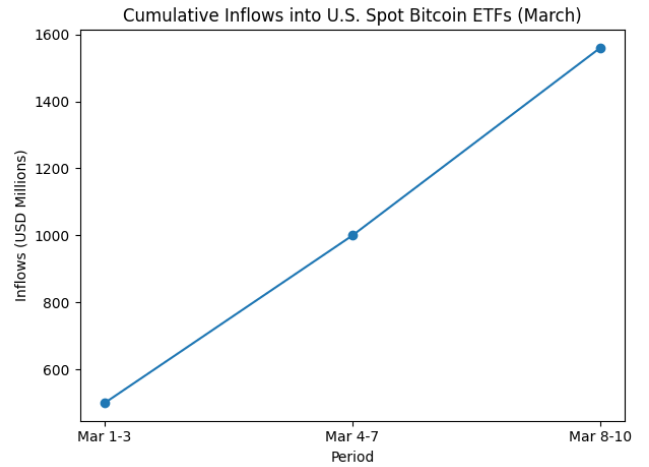
The chart above illustrates the steady accumulation of capital into Bitcoin ETFs throughout March, reflecting sustained institutional and retail demand.
Overall, March has recorded $1.56 billion in ETF inflows, compared with $576 million in outflows, indicating strong net positive demand.
This imbalance between inflows and outflows reinforces the argument that Bitcoin ETFs have become a primary gateway for capital entering the cryptocurrency market.
2. Bitcoin Price Dips Are Now Viewed as Buying Opportunities
The relationship between Bitcoin price movements and ETF inflows is becoming an increasingly important indicator of market sentiment.
Traditionally, crypto markets have been highly momentum-driven, meaning price declines often trigger cascading sell-offs. However, ETF flows suggest that a structural shift may be underway.
Even as Bitcoin dipped below the psychological $70,000 level, investors continued allocating capital to Bitcoin ETFs.
Bitcoin Price Dip vs ETF Inflow Activity
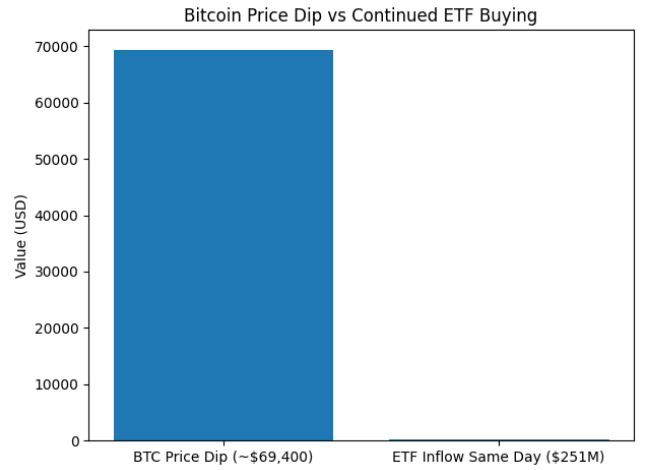
This dynamic indicates a maturing market structure where large investors are taking a longer-term view.
Several factors may explain this behavior:
Institutional portfolio allocation
Many institutional investors are incorporating Bitcoin exposure as part of diversified portfolios rather than speculative trades.
ETF accessibility
Spot ETFs allow investors to gain exposure to Bitcoin without directly managing private keys or navigating cryptocurrency exchanges.
Macro narrative
Bitcoin is increasingly being framed as a digital store of value, often compared with gold as a hedge against monetary instability.
Together, these elements suggest that Bitcoin’s price volatility may now serve as an entry point for strategic accumulation rather than a signal to exit positions.
3. Ethereum and Altcoin ETFs Show Mixed Signals
While Bitcoin ETFs continue attracting strong inflows, the picture for other cryptocurrency ETFs is more nuanced.
Ethereum ETFs recorded a modest $12.6 million in inflows, indicating continued but cautious interest among investors.
However, funds tracking other altcoins have shown more mixed performance.
For example:
- Solana ETF products recorded no significant inflows during the period.
- XRP ETFs experienced approximately $3.9 million in outflows, marking the fourth consecutive trading day of withdrawals.
Despite this streak of outflows, analysts note that the pace of withdrawals has slowed compared with earlier in the week.
This suggests that investor sentiment toward altcoin ETFs remains cautious but not decisively negative.
4. XRP ETFs and the Role of Retail Investors
Bloomberg ETF analyst James Seyffart noted in a recent social media analysis that XRP ETF flows remain relatively stable despite price volatility.
Over the past 30 days, XRP has declined roughly 5%, trading around $1.38.
Yet XRP ETFs have accumulated approximately $1.4 billion in total inflows since launch, indicating persistent interest from investors.
One of the more surprising revelations is the identity of major institutional holders.
Major Institutional Holders of XRP ETFs
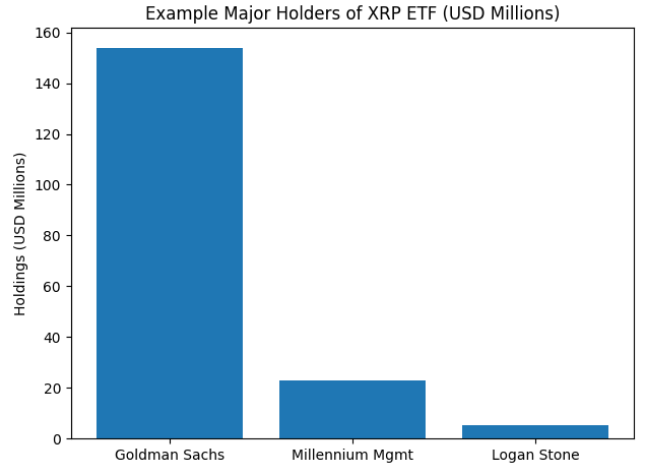
According to regulatory filings as of December 31:
- Goldman Sachs holds approximately $154 million worth of XRP ETFs
- Millennium Management holds $23 million
- Logan Stone Capital holds $5.3 million
The involvement of large financial institutions suggests that XRP ETFs have attracted at least some level of institutional interest.
However, the composition of investors differs significantly from other crypto ETFs.
5. Institutional vs Retail Participation in Crypto ETFs
A deeper analysis of regulatory filings reveals important differences in investor composition across crypto ETFs.
Institutional holdings are often disclosed through 13F filings, which provide insights into the investment activity of large asset managers.
Institutional Ownership Share Across Crypto ETFs
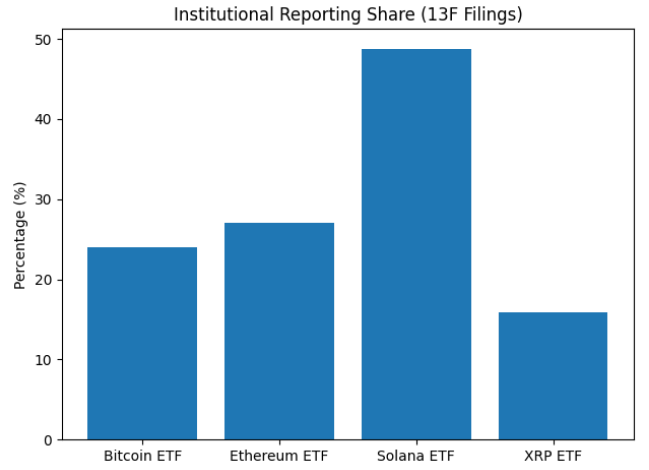
Data suggests the following proportions of ETF assets reported in institutional filings:
- Solana ETFs: 48.8% institutional participation
- Ethereum ETFs: 27%
- Bitcoin ETFs: 24%
- XRP ETFs: 15.9%
This data indicates that XRP ETFs are heavily driven by retail demand, while Solana ETFs show stronger institutional participation.
Bitcoin and Ethereum fall somewhere in between, reflecting their roles as both speculative and strategic assets.
This differentiation highlights the evolving segmentation within the cryptocurrency investment landscape.
6. The Expanding Role of ETFs in the Crypto Economy
The rapid growth of cryptocurrency ETFs represents a significant structural change in how digital assets are accessed.
In the early years of crypto, investors had to rely on cryptocurrency exchanges, manage private wallets, and navigate complex security risks.
Today, ETFs allow exposure to digital assets through traditional brokerage accounts, dramatically lowering barriers to entry.
This transformation has several important implications:
Institutional capital flows
Large asset managers can now allocate capital to crypto within regulated frameworks.
Portfolio integration
Crypto assets are increasingly included alongside stocks, bonds, and commodities.
Market stability
Long-term investors entering through ETFs may help dampen some of the extreme volatility historically associated with crypto markets.
7. What This Means for the Future of Crypto Investment
The continued inflows into Bitcoin ETFs despite price declines signal that cryptocurrency markets may be entering a new phase.
Rather than being dominated purely by speculative trading, the market is gradually integrating into the broader financial system.
Several trends are likely to shape the next stage of this evolution:
Institutional portfolio adoption
Pension funds, hedge funds, and asset managers may increase allocations to crypto ETFs.
Expansion of ETF offerings
New ETFs tracking additional cryptocurrencies or thematic strategies could emerge.
Integration with traditional finance
Crypto assets may increasingly interact with traditional financial infrastructure, including derivatives, lending markets, and structured products.
For investors searching for new revenue opportunities or emerging blockchain applications, this transition could create both risks and opportunities.
Conclusion
The continued inflow of capital into Bitcoin ETFs—even during price declines—marks a pivotal moment in the maturation of cryptocurrency markets.
Rather than reacting to short-term volatility, investors appear to be using market dips to build positions in regulated crypto investment products.
At the same time, the ETF ecosystem is expanding beyond Bitcoin to include Ethereum, Solana, and XRP, each with distinct investor profiles.
Institutional adoption, retail demand, and regulatory frameworks are now converging to shape the next chapter of digital asset investment.
If these trends continue, ETFs may become one of the most powerful forces driving capital into the cryptocurrency ecosystem—potentially accelerating the mainstream adoption of blockchain-based financial systems.



