
Main Points :
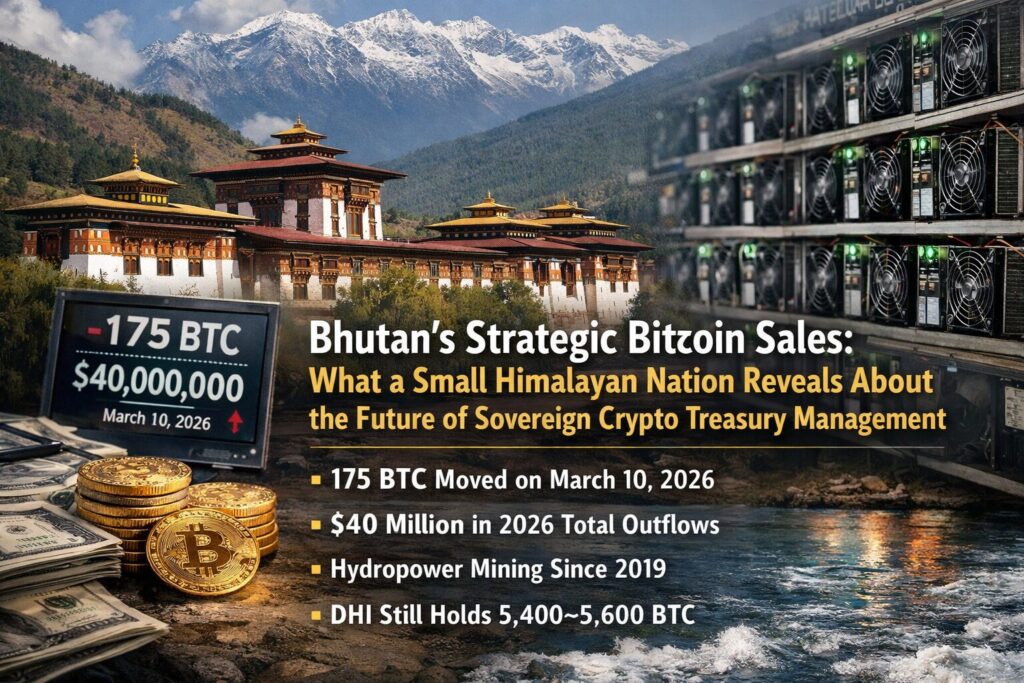
- Bhutan moved 175 BTC (~$12.1 million) from its main government wallet on March 10, 2026.
- Total Bitcoin outflows in 2026 reached roughly $40 million (converted from ¥6.7 billion).
- Bhutan accumulated Bitcoin primarily through hydropower-driven mining operations launched in 2019.
- Its sovereign wealth vehicle Druk Holding & Investments (DHI) still holds roughly 5,400–5,600 BTC.
- Rising mining costs after the 2024 Bitcoin halving have reduced production and encouraged partial liquidation.
- Bhutan’s approach reflects a broader trend: nation-states increasingly treating Bitcoin as a treasury asset, similar to gold or foreign reserves.
The Rise of Sovereign Bitcoin Strategies
In early March 2026, blockchain analytics firm Arkham Intelligence reported that the Kingdom of Bhutan transferred 175 BTC—worth roughly $12.1 million at a Bitcoin price near $68,879—from a government-controlled address. The move brought Bhutan’s total Bitcoin outflows for 2026 to approximately $40 million.
While the transaction itself might appear modest compared to institutional trades, it highlights something much larger: the emergence of sovereign crypto treasury management.
Bhutan, a small Himalayan kingdom better known for its Gross National Happiness index, has quietly become one of the world’s most intriguing national Bitcoin players. Unlike countries that purchased Bitcoin directly, Bhutan accumulated most of its holdings through state-supported mining operations powered by hydropower.
For investors searching for new digital asset opportunities—or builders interested in real-world blockchain deployment—Bhutan’s strategy offers a powerful case study.
Bhutan’s Bitcoin Mining Program
Bhutan’s involvement with Bitcoin began around 2019, when the government recognized an opportunity: the country possesses abundant renewable hydropower resources, often producing electricity surplus during certain seasons.
Instead of exporting all excess energy, Bhutan began using part of it for large-scale Bitcoin mining operations.
The program was managed through Druk Holding & Investments (DHI), Bhutan’s sovereign investment arm.
Key Characteristics of Bhutan’s Mining Model
- Hydropower-driven mining
Mining farms are powered by renewable electricity generated from Bhutan’s rivers. - State-level investment vehicle
Mining operations are coordinated through DHI, which manages national strategic assets. - Low operational costs (initially)
Cheap electricity made Bhutan one of the most cost-efficient mining jurisdictions. - Strategic accumulation of BTC
Instead of immediately selling mined Bitcoin, Bhutan accumulated reserves.
At its peak, Bhutan reportedly held more than 13,000 BTC.
This accumulation strategy effectively transformed the country into a sovereign Bitcoin miner, a model rarely seen in global finance.
Chart Insert Location
Bhutan Bitcoin Holdings Over Time
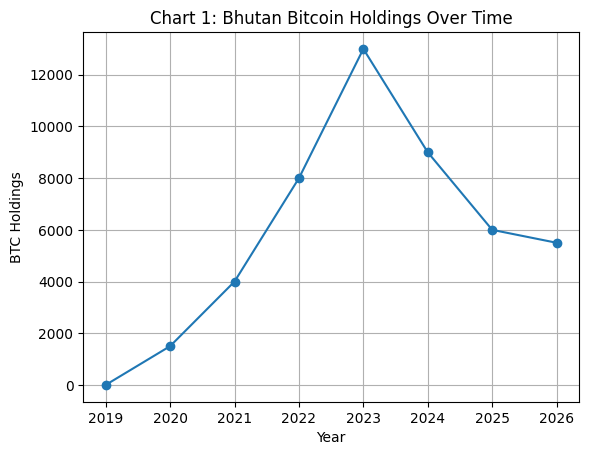
Description: Line graph showing estimated holdings from 2019 to 2026.
Suggested values:
| Year | Estimated BTC Holdings |
|---|---|
| 2019 | 0 |
| 2020 | 1,500 |
| 2021 | 4,000 |
| 2022 | 8,000 |
| 2023 | 13,000 (peak) |
| 2024 | 9,000 |
| 2025 | 6,000 |
| 2026 | 5,500 |
Why Bhutan Is Selling Bitcoin
Despite its early accumulation success, Bhutan’s Bitcoin strategy has recently shifted toward gradual liquidation.
The primary catalyst was the 2024 Bitcoin halving, which reduced mining rewards from 6.25 BTC to 3.125 BTC per block.
For mining operations worldwide, this effectively doubled production costs overnight.
Bhutan was not immune to these changes.
Although its energy costs remain relatively low, the halving dramatically reduced mining output. As a result, Bhutan began adjusting its strategy:
- selling portions of reserves
- maintaining liquidity
- managing national treasury exposure
Arkham data suggests that Bhutan conducted multiple transfers during 2026, including a previous sale of roughly $7 million in BTC to QCP Capital, a Singapore-based institutional crypto market maker.
This suggests Bhutan is actively engaging with institutional liquidity providers, not merely dumping assets onto exchanges.
Sovereign Asset Management: Bitcoin as a Treasury Instrument
Bhutan’s actions reflect a broader shift: Bitcoin is increasingly treated like a sovereign reserve asset.
Historically, governments managed reserves through:
- Gold
- U.S. Treasury bonds
- Foreign currencies
Today, Bitcoin is gradually joining that list.
Bhutan’s approach mirrors the logic of sovereign wealth funds:
- accumulate during favorable production periods
- sell during high-price environments
- rebalance national exposure
This resembles commodity-based fiscal strategies used by oil-producing nations.
In that sense, Bhutan’s Bitcoin reserves function similarly to Norway’s oil revenues or Saudi Arabia’s petroleum reserves.
A Contrast: Corporate Bitcoin Accumulation
Interestingly, Bhutan’s selling activity contrasts sharply with corporate accumulation trends.
During the same period, Strategy Inc. (formerly MicroStrategy) reportedly purchased an additional 17,994 BTC, bringing its total holdings to approximately 738,000 BTC.
This divergence illustrates two different approaches to Bitcoin:
| Entity Type | Strategy |
|---|---|
| Nation States | Strategic selling for treasury management |
| Corporations | Long-term accumulation |
While companies often seek balance sheet appreciation, governments must consider:
- fiscal budgets
- economic stability
- liquidity requirements
Bhutan’s partial selling therefore reflects responsible treasury management rather than loss of conviction.
Chart Insert Location
Bitcoin Holdings Comparison
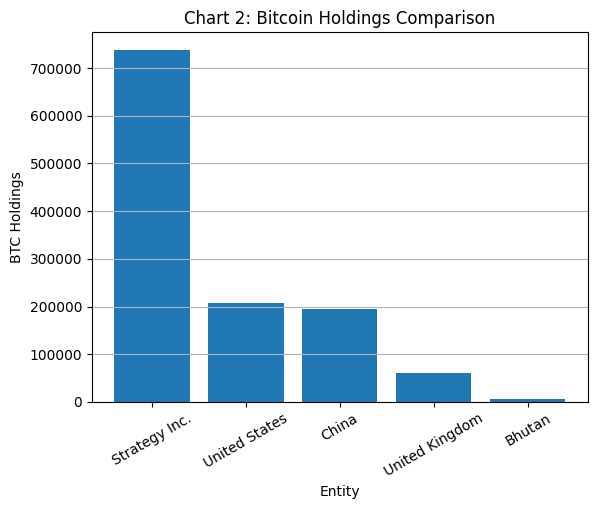
| Entity | BTC Holdings |
|---|---|
| Strategy Inc. | 738,000 BTC |
| United States (est.) | ~207,000 BTC |
| China (est.) | ~194,000 BTC |
| United Kingdom | ~61,000 BTC |
| Bhutan | ~5,500 BTC |
This chart highlights Bhutan’s position as the 7th-largest national Bitcoin holder.
Mining Economics After the Halving
To understand Bhutan’s selling activity, it is essential to analyze mining economics.
The 2024 halving dramatically reshaped the industry.
Before Halving
- Block reward: 6.25 BTC
- Typical mining cost: $20,000–$35,000 per BTC
After Halving
- Block reward: 3.125 BTC
- Effective cost per BTC doubled
For smaller operations—or countries with limited scaling capacity—this significantly reduced profitability.
Bhutan reportedly mined approximately 8,200 BTC annually in 2023, but production dropped sharply after the halving.
Consequently, Bhutan shifted from aggressive accumulation to balanced treasury management.
The Future of Sovereign Bitcoin Mining
Bhutan’s experiment could inspire other nations, particularly those with abundant renewable energy.
Potential candidates include:
- Paraguay (hydropower from Itaipu Dam)
- Iceland (geothermal energy)
- Norway (hydroelectric capacity)
- Kazakhstan (previous mining hub)
The model is attractive for several reasons:
- Monetizing excess energy
- Diversifying national reserves
- Participating in the digital asset economy
In developing economies, Bitcoin mining could become a new form of digital natural resource extraction.
Instead of exporting raw electricity, countries can export Bitcoin produced domestically.
Diagram Insert Location
Sovereign Bitcoin Mining Model
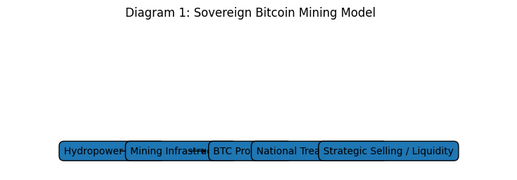
Flow:
Hydropower → Mining Infrastructure → BTC Production → Treasury Reserve → Strategic Selling
Implications for Crypto Investors
For investors searching for the next opportunity in digital assets, Bhutan’s activity provides several important signals.
1. Governments are entering the crypto economy
State-level participation validates Bitcoin’s role as a global macro asset.
2. Mining can be a strategic industry
Energy-rich countries may increasingly treat Bitcoin mining as national infrastructure.
3. Sovereign treasury strategies may stabilize markets
Gradual selling—like Bhutan’s—can add predictable liquidity to markets.
4. Institutional liquidity networks are expanding
Transactions involving firms like QCP Capital indicate deepening connections between governments and crypto trading desks.
Conclusion
Bhutan’s recent transfer of 175 BTC is more than just another on-chain transaction—it represents the evolving role of Bitcoin within sovereign financial strategy.
Since launching its mining program in 2019, Bhutan transformed surplus hydropower into digital assets, accumulating over 13,000 BTC at its peak. Today, with holdings around 5,500 BTC, the nation continues to manage its reserves through measured sales.
The shift reflects changes in mining economics after the 2024 halving, as well as the realities of national treasury management.
For the broader crypto industry, Bhutan offers a glimpse into the future:
A world where nation-states mine, hold, and strategically deploy Bitcoin as part of their economic toolkit.
As more governments explore digital assets—whether through mining, reserves, or blockchain infrastructure—the line between sovereign finance and decentralized networks will continue to blur.
And in that evolving landscape, Bhutan may be remembered as one of the earliest pioneers.


