
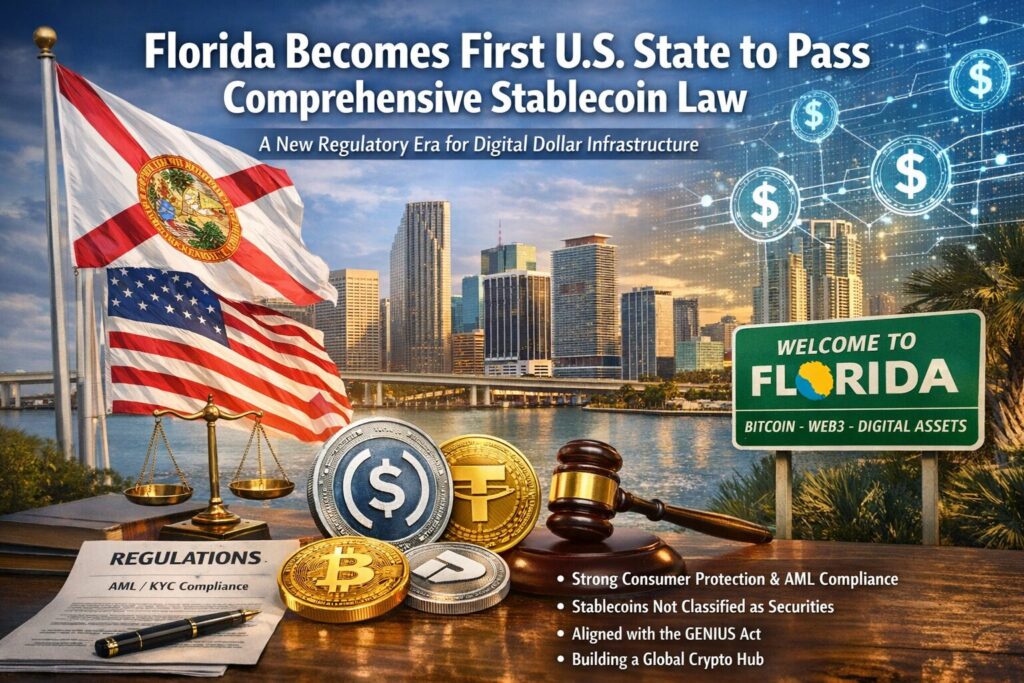
Main Points :
- Florida becomes the first U.S. state to pass a comprehensive stablecoin regulatory framework.
- The law requires consumer protection and AML compliance for stablecoin issuers.
- Interest payments to stablecoin holders are prohibited, aligning with federal policy.
- Qualified payment stablecoins are explicitly not treated as securities.
- The framework aligns with the federal GENIUS Act, signaling a coordinated regulatory environment.
- Florida aims to become a global hub for Bitcoin, Web3, and digital asset companies.
1. A Historic Step: Florida Passes the First State-Level Stablecoin Law
Florida has taken a historic step in the evolution of cryptocurrency regulation in the United States. In early March 2026, the Florida State Legislature passed what is widely recognized as the first comprehensive state-level regulatory framework specifically targeting stablecoins.
The legislation was announced publicly by Samuel Armes, founder of the Florida Blockchain Business Association. According to Armes, both chambers of the Florida legislature approved the bill—commonly referred to as HB 175 and related legislation—establishing a regulatory framework for stablecoin issuance and use within the state.
The bill now awaits the signature of Florida Governor Ron DeSantis, which is expected within 30 days. Once signed, Florida will officially become the first state in the U.S. to create a detailed legal framework for stablecoins.
Armes described the event as a “historic achievement,” emphasizing that Florida intends to remain a global leader in Bitcoin and blockchain innovation.
This development reflects a broader trend in the United States: while federal regulation of digital assets continues to evolve slowly, individual states are increasingly stepping forward to establish clear operational rules for crypto businesses.
For entrepreneurs, investors, and blockchain developers, the Florida initiative signals something extremely important: regulatory clarity is finally emerging around stablecoins.
2. What the Florida Stablecoin Framework Actually Regulates
The Florida stablecoin bill focuses on a category called “qualified payment stablecoins.”
These are digital assets designed primarily for payments and pegged to fiat currency—typically the U.S. dollar.
The law establishes several key regulatory requirements:
Consumer Protection Requirements
Stablecoin issuers must ensure that:
- Reserves are maintained to support the value of issued tokens.
- Redemption mechanisms are clearly defined.
- Consumer disclosures are transparent and standardized.
This is designed to prevent the types of failures seen in previous stablecoin collapses such as algorithmic models that lacked sufficient backing.
Anti-Money Laundering (AML) Compliance
Issuers must comply with AML regulations similar to those applied to financial institutions. This includes:
- Transaction monitoring
- Know-Your-Customer (KYC) procedures
- Suspicious activity reporting
For readers interested in real-world blockchain infrastructure, this is a critical development. Stablecoins are increasingly becoming the settlement layer for digital payments, remittances, and decentralized finance (DeFi).
Regulatory clarity allows companies to build compliant infrastructure without legal uncertainty.
3. Stablecoins Will Not Be Treated as Securities
One of the most important aspects of the Florida legislation is its clarification regarding securities law.
Under the new framework:
Qualified payment stablecoins are not classified as securities.
This clarification directly addresses one of the biggest concerns facing crypto companies in the United States.
For years, companies have struggled with the question of whether certain digital assets might be treated as securities under federal law. By clearly separating payment stablecoins from investment tokens, Florida provides a legal foundation for payment-focused blockchain innovation.
This distinction could have major implications for:
- Payment networks
- Fintech companies
- Cross-border remittance platforms
- Merchant payment infrastructure
For example, a regulated payment stablecoin could be integrated into payment rails similar to traditional digital wallets—without the compliance burden associated with securities markets.
4. Interest Payments on Stablecoins Are Prohibited
Another major element of the Florida bill is the prohibition of interest-bearing stablecoins.
Stablecoin issuers are not allowed to pay interest to holders.
This provision aligns with the federal GENIUS Act, a recent U.S. law that sets standards for stablecoin issuers at the national level.
The reasoning behind this rule is rooted in financial stability.
If stablecoin issuers offered interest yields, the tokens could begin to function like unregulated bank deposits, potentially creating systemic risks.
By prohibiting interest payments, regulators aim to ensure that stablecoins remain:
- Payment tools
- Settlement assets
- Liquidity instruments
rather than speculative savings products.
This approach mirrors regulatory frameworks in several other jurisdictions, including the European Union’s MiCA (Markets in Crypto-Assets) regulation, which similarly restricts interest-bearing stablecoins.
5. Alignment With Federal Regulation: The GENIUS Act
The Florida framework was designed to integrate with the federal GENIUS Act, which was enacted in 2025.
The GENIUS Act establishes national guidelines for:
- Stablecoin reserves
- Licensing requirements
- Federal supervision
- Consumer protections
By aligning with federal law, Florida avoids regulatory conflict and creates a layered regulatory structure:
Federal Level
→ Macro financial stability and national standards
State Level
→ Licensing and operational oversight
This dual-layer framework resembles the way traditional financial institutions are regulated in the U.S., where both federal and state regulators play roles.
For crypto businesses, this creates a predictable compliance pathway.
6. Florida’s Strategy: Becoming a Global Crypto Hub
Florida has been positioning itself as a crypto-friendly jurisdiction for several years.
The state has actively promoted:
- Bitcoin innovation
- Web3 startups
- Blockchain-based financial services
Miami in particular has emerged as one of the most visible crypto hubs in the United States, hosting large conferences such as Bitcoin events and attracting blockchain entrepreneurs.
The stablecoin legislation strengthens Florida’s position by offering something that crypto companies desperately need:
legal certainty.
For startups building stablecoin-based infrastructure—such as:
- payment networks
- remittance platforms
- decentralized finance settlement layers
- merchant payment gateways
Florida may now become an extremely attractive base of operations.
7. Why Stablecoins Are Becoming the Backbone of Crypto Finance
Stablecoins have quietly become one of the most important components of the cryptocurrency ecosystem.
Today they are used for:
- trading liquidity on crypto exchanges
- cross-border payments
- DeFi collateral
- settlement layers for tokenized assets
Global stablecoin market capitalization has grown dramatically over the past decade.
Global Stablecoin Market Growth (2018–2026)

The rapid growth is driven by the demand for programmable dollars that can move instantly across blockchain networks.
For example:
Traditional Bank Transfer
→ 1–3 days settlement
Stablecoin Transfer
→ seconds to minutes
This speed advantage is transforming sectors such as:
- remittances
- international trade
- treasury management
8. Implications for Investors and Blockchain Entrepreneurs
For readers searching for new crypto opportunities, this regulatory shift is extremely significant.
Clear stablecoin rules open the door to several emerging sectors:
Stablecoin Payment Infrastructure
Companies building payment rails for merchants and global transactions.
Tokenized Financial Products
Stablecoins used as collateral for tokenized securities and real-world assets.
Cross-Border Settlement Networks
Replacing slow correspondent banking systems.
Institutional DeFi
Banks and financial institutions using stablecoins for settlement.
As regulation matures, stablecoins may evolve into the core financial infrastructure of the blockchain economy.
9. Could Other U.S. States Follow Florida?
Florida’s legislation could serve as a template for other states.
Several states have already shown interest in crypto-friendly regulation, including:
- Texas
- Wyoming
- Arizona
Wyoming in particular has pioneered crypto banking frameworks through Special Purpose Depository Institutions (SPDIs).
However, Florida’s stablecoin framework may be the first comprehensive state law focused specifically on payment stablecoins.
If successful, it could trigger a wave of similar legislation across the country.
This competition among states could accelerate innovation in the U.S. digital asset sector.
Conclusion: Stablecoins Move Toward Mainstream Financial Infrastructure
Florida’s new stablecoin law represents a major milestone in the evolution of digital asset regulation.
By establishing clear rules for stablecoin issuers—while aligning with federal standards—the state is creating a regulatory environment that supports both consumer protection and blockchain innovation.
For crypto entrepreneurs and investors, the implications are profound.
Stablecoins are no longer just tools used on cryptocurrency exchanges. They are rapidly becoming a new financial infrastructure layer for payments, settlement, and digital commerce.
Florida’s move suggests that the future of money may increasingly be built on blockchain rails.
If other states and countries follow this model, stablecoins could soon become one of the most widely used forms of digital currency in the global economy.



