
Main Points :
- Russia’s central bank has proposed allowing banks and securities brokers to obtain cryptocurrency exchange licenses through a simple notification process rather than a complex licensing regime.
- The proposal would allow existing financial institutions to operate crypto brokerage services using their current banking or securities licenses.
- Banks’ crypto exposure would be limited to 1% of their capital, creating a controlled risk environment.
- Qualified investors would face no investment limits, while retail investors could buy up to about $3,300 per year through a single intermediary.
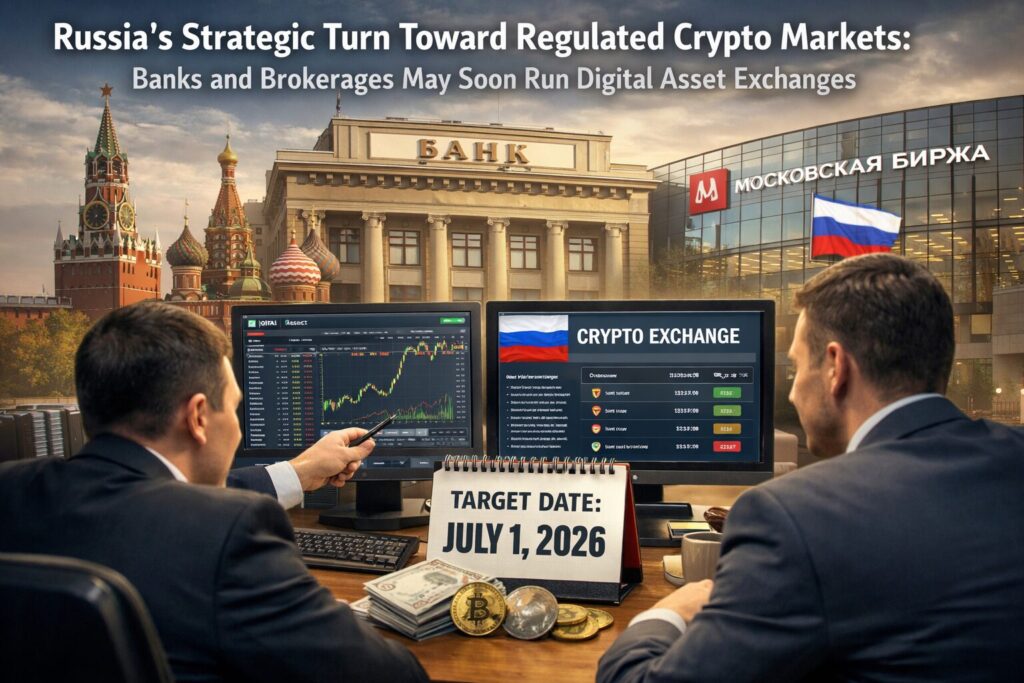
- The law is expected to be debated in Russia’s State Duma in spring 2026, with a potential implementation target of July 1, 2026.
- Moscow and Saint Petersburg stock exchanges are preparing to launch crypto trading services once regulation becomes active.
- The regulatory approach focuses on using banks’ existing AML/CFT compliance frameworks to regulate crypto markets.
Introduction: Russia’s Gradual Institutionalization of Crypto
Russia’s relationship with cryptocurrency has historically been complex and often contradictory. While authorities have repeatedly expressed concerns about financial stability, capital flight, and illicit finance, the country has simultaneously shown interest in harnessing blockchain technology and digital assets as strategic financial tools.
Now, a new proposal from the Central Bank of Russia could mark a significant shift in policy. According to reports by Interfax, Central Bank Governor Elvira Nabiullina recently suggested a regulatory framework that would allow banks and securities brokers to operate cryptocurrency exchanges through a simplified licensing process.
If implemented, the proposal could reshape Russia’s digital asset ecosystem by integrating cryptocurrency markets directly into the country’s existing financial infrastructure. Rather than building an entirely new regulatory structure, the proposal relies heavily on the compliance systems already developed by banks—particularly their anti-money laundering (AML) and counter-terrorist financing (CFT) frameworks.
For investors, developers, and institutions watching the global evolution of crypto regulation, Russia’s proposal represents more than a domestic regulatory adjustment. It signals a broader trend: governments increasingly prefer to regulate crypto through existing financial institutions rather than through standalone crypto-native entities.
Simplified Exchange Licensing for Banks and Brokers
At the core of the proposal is a remarkably streamlined licensing process.
Instead of requiring financial institutions to undergo a complex new licensing regime, banks and brokerage firms would only need to submit a notification to regulators to begin operating cryptocurrency exchange services. Their existing banking or brokerage licenses would effectively extend to digital asset brokerage.
This approach dramatically lowers the barrier for institutional participation in the crypto market.
Traditional exchanges typically undergo lengthy approval processes involving specialized licensing, capital requirements, operational audits, and compliance checks. Under Russia’s proposed system, however, established financial institutions could quickly enter the market using their existing regulatory framework.
The logic behind this strategy is straightforward: banks already possess the infrastructure needed to handle financial transactions securely, including:
- Know-Your-Customer (KYC) procedures
- Anti-Money Laundering monitoring systems
- Transaction surveillance technologies
- Compliance reporting mechanisms
Rather than reinventing regulatory oversight, the central bank intends to extend these existing controls into the crypto market.
This model mirrors regulatory developments in several other jurisdictions. For example:
- Germany allows banks to offer crypto custody services under banking licenses.
- Switzerland integrates crypto services into existing financial licenses.
- Singapore permits financial institutions to provide digital asset services through regulated frameworks.
Russia’s proposal suggests that similar integration may soon occur within its own financial system.
Controlled Risk Exposure: The 1% Capital Limit
One of the most important safeguards in the proposal is a strict risk limit.
Banks would be allowed to take on crypto exposure only up to 1% of their capital.
This limit is designed to ensure that cryptocurrency activities cannot threaten the financial stability of major banks. In practical terms, the rule would force financial institutions to treat crypto trading as a limited experimental activity rather than a major balance-sheet strategy.
Governor Nabiullina emphasized that the cap is intended as a testing phase.
Regulators plan to observe how banks manage crypto operations within this limited exposure before deciding whether to expand the allowance.
This cautious approach reflects lessons learned from previous crypto market volatility. Over the past decade, digital assets have experienced several dramatic cycles:
- Bitcoin rising from about $1,000 to over $60,000 during the 2017–2021 period
- Major exchange collapses such as FTX in 2022
- Sharp declines followed by institutional recovery in later years
By limiting exposure to 1%, Russian regulators aim to encourage innovation while protecting systemic financial stability.
Investor Segmentation: Protecting Retail Participants
Another key component of the proposal is a clear distinction between qualified investors and retail participants.
Qualified investors would be able to purchase cryptocurrencies without any investment limit. These investors typically include institutions, high-net-worth individuals, and market participants who meet certain financial or professional criteria.
Retail investors, however, would face a yearly cap.
Under the proposal, non-qualified investors could purchase up to 300,000 rubles per year, which corresponds to roughly $3,300 annually depending on exchange rates.
In addition, these purchases must occur through a single intermediary, such as a bank or brokerage firm.
This rule aims to reduce excessive speculation while still allowing retail investors to participate in the market.
Investor segmentation has become common in crypto regulation worldwide. Several jurisdictions use similar models:
- Hong Kong allows only professional investors to access certain crypto products.
- South Korea imposes strict verification requirements on retail accounts.
- The European Union’s MiCA framework introduces consumer protection measures for retail participants.
Russia’s model aligns with this global trend toward differentiated access.
Integration With Existing Financial Infrastructure
Perhaps the most significant element of the proposal is the integration of cryptocurrency services into Russia’s existing financial system.
The Moscow Exchange and Saint Petersburg Exchange are reportedly preparing to launch cryptocurrency trading services once the regulatory framework is approved.
This would represent a major step toward institutionalizing digital asset markets in the country.
Stock exchanges entering crypto markets is a growing international trend. Several major financial institutions have already explored similar moves:
- Nasdaq has investigated crypto custody services.
- Deutsche Börse launched digital asset infrastructure initiatives.
- Hong Kong Exchanges and Clearing is studying tokenized financial products.
By allowing established financial institutions to operate crypto services, regulators hope to bring digital asset trading into a more transparent and supervised environment.
For market participants, this could also significantly improve liquidity and investor confidence.
Stablecoin Regulation and Broader Digital Asset Legislation
The proposal is not limited to cryptocurrency exchanges alone.
Russia’s Ministry of Finance is also reportedly preparing separate legislation for stablecoins, recognizing that these assets require different regulatory treatment compared with decentralized cryptocurrencies like Bitcoin.
Stablecoins have become a central component of the global crypto ecosystem, particularly in trading and decentralized finance.
However, regulators worldwide remain cautious about their potential impact on monetary policy and financial stability.
The Russian government’s approach appears to mirror developments in other major jurisdictions:
- The European Union has introduced strict rules for stablecoin issuers under MiCA.
- The United States continues debating federal stablecoin legislation.
- Japan regulates stablecoins primarily through banks and trust companies.
By creating separate legislation, Russia aims to clarify the legal status of digital assets while maintaining control over monetary sovereignty.
Global Context: Governments Turning Toward Institutional Crypto
Russia’s proposed framework reflects a broader global trend in cryptocurrency regulation.
In the early years of the industry, many crypto businesses operated outside traditional financial systems. Exchanges, wallets, and trading platforms were often run by startups without banking licenses.
However, regulators increasingly prefer integrating digital assets into existing financial institutions.
This shift has several advantages:
- Banks already possess compliance infrastructure.
- Regulators can supervise institutions through established mechanisms.
- Investor protection standards are easier to enforce.
- Financial stability risks are easier to monitor.
For the crypto industry, this transition represents both an opportunity and a challenge.
On one hand, institutional integration can increase liquidity, legitimacy, and investor trust. On the other hand, it may reduce the decentralized nature that originally defined the cryptocurrency ecosystem.
Chart: Investor Access Model
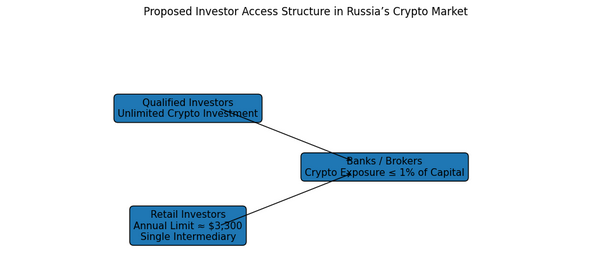
Title: Proposed Investor Access Structure in Russia’s Crypto Market
Diagram Structure:
Qualified Investors
→ Unlimited crypto investment access
Retail Investors
→ Annual cap: $3,300
→ Transactions through one intermediary
Banks / Brokers
→ Crypto exposure capped at 1% of capital
Chart: Russia’s Proposed Regulatory Structure
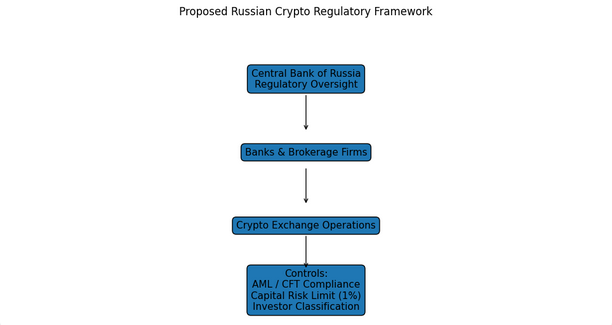
Title: Proposed Russian Crypto Regulatory Framework
Central Bank of Russia
↓
Banks / Brokerage Firms
↓
Crypto Exchange Operations
Regulatory Controls
• AML / CFT compliance
• Capital risk limit (1%)
• Investor classification rules
Implications for Crypto Investors and Builders
For investors and entrepreneurs interested in emerging blockchain opportunities, Russia’s proposal offers several important signals.
First, it indicates that governments increasingly view cryptocurrencies as financial instruments that must be integrated into existing regulatory systems, rather than banned outright.
Second, institutional involvement could significantly increase liquidity in the Russian market. If major banks and exchanges begin offering crypto services, the scale of participation could expand dramatically.
Third, regulatory clarity often leads to new business opportunities.
Examples include:
- regulated crypto brokerage services
- custody infrastructure
- institutional trading platforms
- tokenized financial instruments
For developers and blockchain startups, regulatory frameworks such as this can create opportunities to collaborate with traditional financial institutions.
Conclusion: A Controlled Opening of Russia’s Crypto Market
Russia’s proposed regulatory framework represents a careful attempt to balance innovation and financial stability.
By allowing banks and brokerage firms to operate cryptocurrency exchanges under existing licenses, regulators hope to bring digital asset trading into a more transparent and controlled environment.
At the same time, strict safeguards—such as the 1% capital exposure limit and retail investor purchase caps—demonstrate a cautious approach toward systemic risk.
If approved by parliament in spring 2026 and implemented by July 1, the framework could significantly reshape Russia’s cryptocurrency landscape.
More broadly, the proposal highlights a global trend toward institutionalizing crypto markets within traditional financial systems.
For investors seeking the next wave of opportunities in digital assets, this trend suggests that the future of crypto may increasingly involve collaboration between blockchain innovation and established financial infrastructure.



