Main Points :
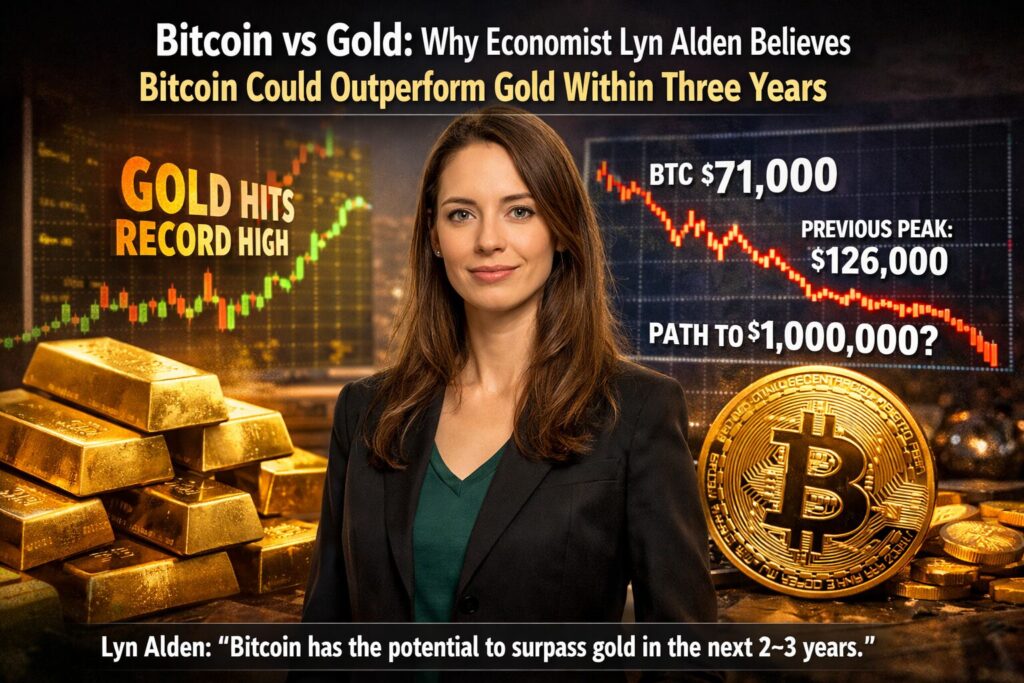
- Economist Lyn Alden predicts Bitcoin may outperform gold in price performance within the next 2–3 years.
- Gold recently surged to record highs, creating euphoric sentiment in the gold market, while crypto sentiment remains deeply bearish.
- Bitcoin is currently trading around $71,000, roughly 44% below its previous peak near $126,000.
- Some industry leaders believe Bitcoin could reach $1,000,000 by 2030 if regulatory clarity improves.
- The relationship between gold and Bitcoin is not fixed — they sometimes move together and sometimes diverge depending on macroeconomic conditions.
The Next Battle of Store-of-Value Assets
For decades, gold has held the undisputed title as the world’s ultimate store of value. Governments hold it in reserves, central banks accumulate it during times of uncertainty, and investors turn to it during inflationary crises.
However, the rise of Bitcoin has introduced a new contender.
Often referred to as “digital gold,” Bitcoin has steadily gained recognition as a scarce, decentralized asset that can protect wealth from currency debasement. Now, a growing number of economists and institutional investors are asking a provocative question:
Could Bitcoin eventually outperform gold?
According to macroeconomist Lyn Alden, the answer may arrive sooner than many investors expect.
Speaking on the New Era Finance podcast, Alden stated that if she had to choose between Bitcoin and gold for the next few years, she would choose Bitcoin.
Her reasoning highlights a fascinating shift in macroeconomic cycles, market psychology, and the evolving narrative of alternative assets.
Gold’s Massive Rally and Emerging Market Euphoria
Gold has recently experienced one of its strongest rallies in modern history.
Prices surged to approximately $5,608 per ounce, marking a new all-time high and fueling intense optimism among investors. The rally has been driven by several macroeconomic forces:
- Persistent global inflation
- Central bank accumulation of gold reserves
- Rising geopolitical tensions
- Concerns about fiat currency stability
While Alden does not believe gold is necessarily in a speculative bubble, she warns that market sentiment has become somewhat euphoric.
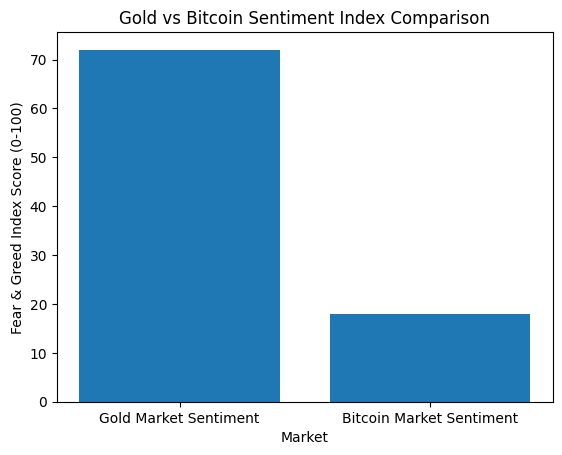
A key indicator supporting this view is the Gold Fear & Greed Index, which recently registered around 72 out of 100, signaling strong investor greed.
Historically, markets tend to become vulnerable to corrections when sentiment becomes excessively optimistic.Graph Insert Location
Gold vs Bitcoin Sentiment Index Comparison
Caption:
Gold markets show strong optimism while crypto markets remain deeply fearful.
Bitcoin’s Sentiment Crisis: Extreme Fear in the Market
While gold investors are celebrating record highs, Bitcoin is experiencing the opposite psychological cycle.
The Crypto Fear & Greed Index recently showed a reading of 18, classified as “Extreme Fear.”
At the same time, Bitcoin’s price is around $71,164, significantly below its previous high near $126,000.
This decline of roughly 44% has triggered pessimism among retail investors and raised questions about whether the crypto bull cycle has ended.
However, Alden argues that this pessimism may be unjustified.
Markets frequently overshoot in both directions — exuberance during peaks and excessive fear during downturns.
Historically, the best investment opportunities often emerge during periods of maximum pessimism.
Bitcoin and Gold: A Pendulum Relationship
One of Alden’s most important insights is that the relationship between gold and Bitcoin is not static.
Many narratives attempt to frame the assets in simple terms:
- Gold = safe haven
- Bitcoin = risk asset
But reality is far more complex.
According to Alden, the two assets often behave like a pendulum.
At times they move in the same direction, especially during periods of monetary expansion. At other times they diverge depending on investor sentiment and liquidity conditions.
For example:
- During inflation scares, both assets may rise.
- During liquidity crises, both may fall as investors seek cash.
- During technology-driven investment cycles, Bitcoin may outperform.
Understanding this dynamic is critical for investors who want to allocate capital between the two assets effectively.
The $1,000,000 Bitcoin Narrative
Another powerful force shaping Bitcoin’s long-term outlook is the growing belief that the asset could eventually reach $1,000,000 per coin.
Several major crypto executives have publicly discussed this possibility.
Among them is Coinbase CEO Brian Armstrong, who suggested that regulatory clarity in the United States could unlock enormous institutional demand for Bitcoin.
If pension funds, sovereign wealth funds, and major asset managers begin allocating even a small percentage of their portfolios to Bitcoin, the supply shock could be dramatic.
Bitcoin’s total supply is capped at 21 million coins, and a large portion of those coins are permanently lost or held by long-term investors.
This structural scarcity creates a powerful foundation for price appreciation if demand continues growing.Graph Insert Location
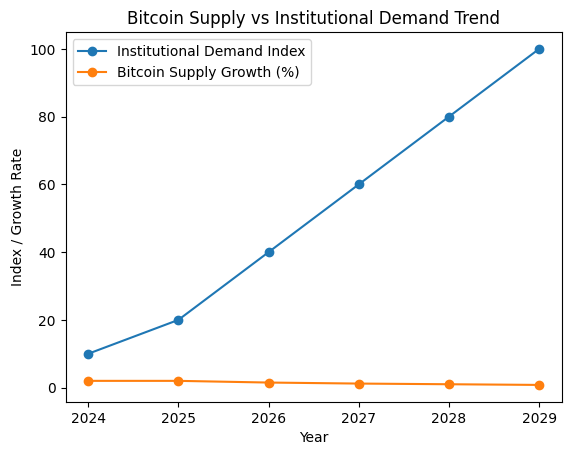
Bitcoin Supply vs Institutional Demand
Caption:
Bitcoin supply growth continues declining while institutional demand accelerates.
The Ray Dalio Counterargument
Not everyone agrees with the bullish Bitcoin narrative.
Legendary hedge fund investor Ray Dalio recently expressed skepticism about Bitcoin’s long-term role as a reserve asset.
Dalio emphasized that gold remains one of the most established forms of money in the global financial system.
Central banks hold massive quantities of gold as part of their foreign reserves, making it the second largest reserve asset after the U.S. dollar.
Dalio also raised concerns about Bitcoin, including:
- Lack of central bank backing
- Privacy concerns
- Potential vulnerability to future quantum computing technologies
These criticisms highlight an important reality: the competition between Bitcoin and gold is still evolving.
The Institutionalization of Bitcoin
Despite skepticism from some traditional investors, Bitcoin’s institutional adoption continues to accelerate.
Recent developments include:
- The launch of spot Bitcoin ETFs
- Corporate treasury allocations
- Increasing integration into payment networks
- Expanding regulatory frameworks worldwide
Major asset managers such as BlackRock and Fidelity have begun offering Bitcoin investment products, bringing cryptocurrency exposure to millions of traditional investors.
This shift could fundamentally transform Bitcoin’s role in global finance.
Instead of being viewed purely as a speculative asset, Bitcoin may increasingly function as a strategic macro hedge.
Practical Implications for Investors
For investors seeking new income opportunities and emerging digital assets, the Bitcoin vs gold debate presents several important insights.
First, diversification between the two assets may offer strong risk management benefits.
Gold provides stability during macroeconomic stress, while Bitcoin offers higher growth potential during technology-driven cycles.
Second, market sentiment can create powerful investment opportunities.
Periods of extreme fear in crypto markets have historically preceded major bull runs.
Third, regulatory clarity may become the single most important catalyst for Bitcoin adoption in the coming decade.
As governments establish clearer rules around digital assets, institutional capital may begin flowing into Bitcoin at unprecedented scale.
Conclusion: A New Monetary Era May Be Emerging
The debate between Bitcoin and gold is ultimately about more than investment returns.
It reflects a deeper transformation in how societies define money and store wealth.
Gold represents thousands of years of monetary history.
Bitcoin represents the first globally decentralized digital monetary network.
According to Lyn Alden, the next few years may reveal whether Bitcoin can begin to surpass gold in market performance.
If that happens, it could mark the beginning of a new era in the global financial system — one in which digital scarcity competes directly with physical scarcity as a foundation for wealth preservation.
For investors, entrepreneurs, and technologists exploring the future of blockchain, the coming years may prove to be one of the most consequential periods in the history of finance.