
Main Points :
- American Bitcoin accumulated more than 500 BTC in the past 21 days, pushing total holdings beyond 6,500 BTC.
- The company maintains a “Mining-to-Treasury” strategy, holding mined Bitcoin instead of selling it.
- The firm recently purchased 11,298 additional ASIC mining machines, expanding its infrastructure in Alberta, Canada.
- Total mining capacity is expected to reach 28.1 EH/s, placing the company among major industrial miners.
- Despite a $150 million accounting loss in 2025, the mining operation itself achieved 53% gross profit margins in Q4.
- The strategy reflects a broader trend among public companies accumulating Bitcoin as a strategic reserve asset.
1. American Bitcoin’s Rapid BTC Accumulation
In a significant development within the corporate Bitcoin mining sector, the publicly listed American Bitcoin (ticker: ABTC) has revealed that it accumulated more than 500 Bitcoin in the last 21 days, increasing its total corporate treasury holdings to over 6,500 BTC.
At current market prices, this stash represents roughly $490 million in Bitcoin reserves. This makes American Bitcoin one of the notable corporate holders of BTC among publicly traded companies.
According to industry data compiled by Bitcoin Treasuries, the company currently ranks around 17th among public companies holding Bitcoin. Although this position places it behind giants such as MicroStrategy, Tesla, and several major mining firms, its accumulation speed is noteworthy.
Following the disclosure, the company’s stock price rose approximately 11.7% in a single trading day, signaling positive investor sentiment toward the firm’s strategy. However, the stock still remains down roughly 34% year-to-date, reflecting broader volatility across both cryptocurrency and mining equities.
This rapid accumulation suggests that American Bitcoin views Bitcoin not merely as a commodity produced through mining but as a long-term treasury asset.
[Corporate Bitcoin Holdings Comparison]
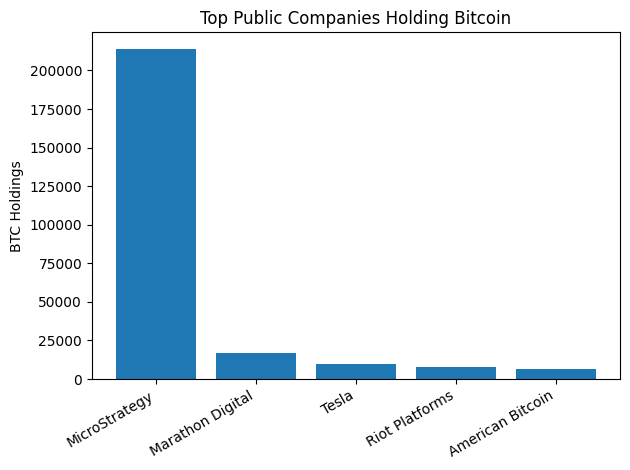
Suggested chart structure:
| Company | BTC Holdings |
|---|---|
| MicroStrategy | ~214,000 BTC |
| Marathon Digital | ~17,000 BTC |
| Tesla | ~9,700 BTC |
| Riot Platforms | ~8,000 BTC |
| American Bitcoin | ~6,500 BTC |
This chart visually places American Bitcoin among the leading corporate Bitcoin holders.
2. Expansion of Mining Infrastructure
A key driver behind the company’s growing Bitcoin treasury is its aggressive expansion of mining capacity.
American Bitcoin recently announced the purchase of 11,298 new ASIC mining machines, specialized hardware designed specifically for Bitcoin mining.
These machines will be deployed in Drumheller, Alberta, Canada, a region increasingly favored by miners due to:
- relatively low energy costs
- favorable regulatory environments
- access to large-scale energy infrastructure
Once deployed, the company’s mining fleet will total approximately 89,242 machines, boosting its computational power to roughly 28.1 exahashes per second (EH/s).
To understand the significance of this number, consider that the entire Bitcoin network currently operates at several hundred EH/s. A mining operation with more than 25 EH/s places American Bitcoin among the most powerful individual mining operators globally.
The expansion highlights how industrial-scale mining has evolved into a capital-intensive infrastructure business, similar to data centers or energy utilities.
[Mining Hashrate Growth]
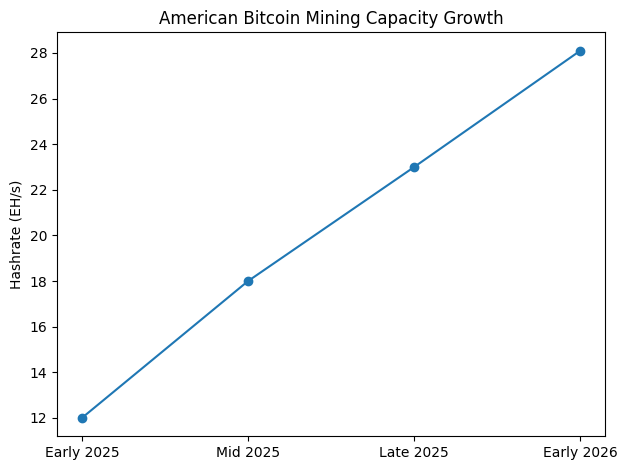
Example data structure:
| Period | Hashrate |
|---|---|
| Early 2025 | 12 EH/s |
| Mid-2025 | 18 EH/s |
| Late 2025 | 23 EH/s |
| Early 2026 | 28.1 EH/s |
This graph demonstrates the company’s rapid scaling of mining infrastructure.
3. The “Mining-to-Treasury” Strategy
Perhaps the most distinctive aspect of American Bitcoin’s strategy is its Mining-to-Treasury approach.
Rather than selling newly mined Bitcoin to cover operational costs—a practice historically common among miners—the company retains its mined BTC in corporate reserves.
This approach has several strategic implications:
- Exposure to long-term Bitcoin price appreciation
- Positioning Bitcoin as a strategic balance-sheet asset
- Creating a hybrid mining-and-treasury investment model
This philosophy resembles the well-known Bitcoin accumulation strategy pioneered by MicroStrategy, but in American Bitcoin’s case the BTC is generated directly through mining operations.
In essence, the company is building a vertically integrated Bitcoin accumulation machine:
Energy → Mining → BTC Production → Treasury Accumulation
This approach contrasts with many competitors.
Several major mining companies have recently begun selling their mined Bitcoin to fund operations or pivoting toward AI and high-performance computing (HPC) data centers.
American Bitcoin, by comparison, has doubled down on a pure Bitcoin strategy.
4. Financial Performance and Profitability
While the strategy appears bold, the company’s financial statements illustrate the complexity of operating in the mining sector.
During fiscal year 2025, American Bitcoin reported over $150 million in net losses, largely driven by accounting write-downs related to falling Bitcoin prices.
However, these losses do not necessarily reflect the operational efficiency of the mining business.
In fact, the company reported:
- $185 million in revenue in its first full year
- 53% gross margin in Q4 mining operations
This indicates that the core mining activity remains profitable, even if accounting rules tied to digital asset valuation introduce volatility into financial statements.
Such dynamics are common among Bitcoin miners because accounting standards often require companies to recognize unrealized losses during market downturns but limit recognition of unrealized gains.
As a result, the true economic value of the company’s BTC holdings may not be fully reflected in reported earnings.
[Mining Profitability vs Bitcoin Price]
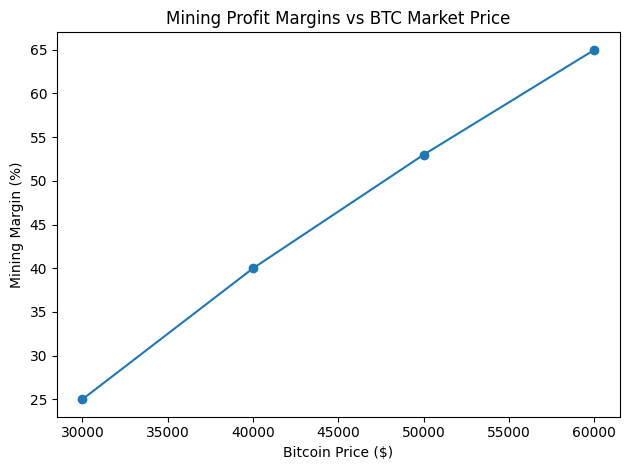
Suggested structure:
| BTC Price | Mining Margin |
|---|---|
| $30,000 | 25% |
| $40,000 | 40% |
| $50,000 | 53% |
| $60,000 | 65% |
This chart illustrates how mining profitability correlates with Bitcoin market price.
5. Corporate Bitcoin Treasuries: A Growing Trend
American Bitcoin’s strategy reflects a broader shift in how corporations view Bitcoin.
Originally, mining companies typically sold most of their Bitcoin immediately after production to cover electricity costs, equipment purchases, and operational expenses.
However, a new trend has emerged:
Bitcoin as a corporate reserve asset.
Several factors have contributed to this shift:
Institutional adoption
Major financial institutions are increasingly integrating digital assets into their offerings.
Spot Bitcoin ETFs in the United States have attracted tens of billions of dollars in inflows, providing institutional investors with regulated exposure to BTC.
Inflation hedge narrative
Many companies view Bitcoin as a hedge against currency debasement, similar to gold but with greater portability and verifiability.
Treasury diversification
Corporate treasuries traditionally rely on cash, bonds, and short-term securities.
Bitcoin introduces a new category: digital scarcity assets.
For companies willing to tolerate volatility, holding BTC may offer asymmetric upside potential.
6. Strategic Risks and Future Outlook
Despite the optimism surrounding Bitcoin accumulation, several risks remain.
Mining difficulty increases
As more miners join the network, the computational difficulty of mining Bitcoin rises. This can reduce profit margins unless miners continually upgrade hardware and expand operations.
Energy costs
Electricity remains the largest operating cost for miners. Fluctuations in energy markets can significantly impact profitability.
Market volatility
Bitcoin prices remain highly volatile, meaning corporate balance sheets can fluctuate dramatically depending on market conditions.
Regulatory uncertainty
Cryptocurrency mining and corporate crypto holdings are still evolving regulatory topics in many jurisdictions.
Nevertheless, American Bitcoin’s continued investment in infrastructure suggests that the company expects long-term Bitcoin demand to remain strong.
If Bitcoin prices rise in the coming years, the company’s accumulated BTC reserves could become a powerful driver of shareholder value.
Conclusion
American Bitcoin’s recent accumulation of over 6,500 BTC highlights a significant shift in the strategy of cryptocurrency mining companies.
Instead of simply extracting Bitcoin and selling it to fund operations, the company is transforming its mining infrastructure into a Bitcoin accumulation engine.
By expanding mining capacity, maintaining high profit margins, and retaining mined BTC as treasury assets, American Bitcoin is positioning itself as both a Bitcoin producer and a Bitcoin investment vehicle.
This hybrid model reflects a broader evolution within the crypto industry: the convergence of mining, treasury management, and long-term digital asset accumulation.
As institutional demand for Bitcoin continues to grow and corporate adoption expands, strategies like American Bitcoin’s may become increasingly common.
For investors and blockchain practitioners searching for the next wave of opportunity, the rise of corporate Bitcoin treasuries backed by industrial mining operations represents a development worth watching closely.