Main Points :
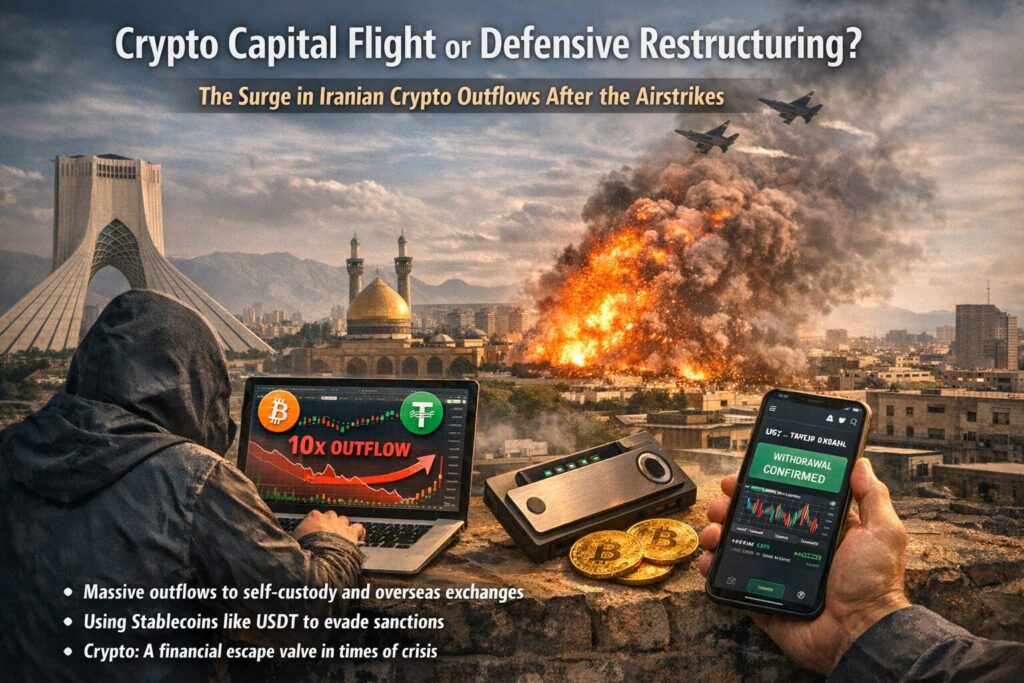
- Crypto outflows from Iran’s largest exchange surged nearly 10× immediately after the airstrikes.
- Analysts disagree whether this represents capital flight by citizens or exchange risk management.
- Blockchain data shows significant movement to self-custody wallets and overseas exchanges.
- Iran increasingly uses stablecoins such as USDT to circumvent sanctions and stabilize trade flows.
- The event highlights how cryptocurrency functions as a financial escape valve during geopolitical crises.
Introduction: War, Sanctions, and the Rise of Crypto Finance
When geopolitical conflict erupts, capital moves quickly. In the modern digital era, that movement increasingly occurs through cryptocurrencies rather than traditional banking systems.
Following the February 28 airstrikes conducted by U.S. and Israeli forces, blockchain monitoring firms reported a dramatic spike in crypto withdrawals from Nobitex, Iran’s largest cryptocurrency exchange. According to analytics companies Elliptic and Chainalysis, funds leaving the exchange surged nearly tenfold within minutes of the attack.
Within the first hours after the strikes, more than $2 million per hour flowed out of the exchange—far above normal levels. Over the following three days, blockchain data suggests that roughly $10.3 million left Nobitex wallets.
Yet while analysts agree on the data, they disagree sharply about what it means.
Some believe the surge reflects ordinary citizens protecting their assets during a crisis, effectively turning cryptocurrency into a tool for capital flight. Others argue the activity may simply reflect routine exchange operations, internal wallet restructuring, or government-related financial maneuvers.
Understanding the reality behind these movements provides insight into a much broader phenomenon: the growing role of cryptocurrency as a parallel financial system in sanctioned economies.
Immediate Surge in Crypto Withdrawals
Blockchain analytics firm Elliptic reported that transfer volumes leaving Nobitex increased by 700% within minutes of the first airstrike.
At peak levels, outflows reached approximately $2.89 million per hour, nearly eight times the previous day’s activity.
Meanwhile, Chainalysis detected similar patterns. Their data indicates that hourly outflows exceeded $2 million, representing an increase of 873% compared with the 2026 average transaction flow.
Across the three days between February 28 and March 2, a total of approximately $10.3 million exited the exchange.
While this amount is relatively small compared with global crypto markets, the speed and timing of the movement immediately after the military strike drew attention from analysts worldwide.
The blockchain data itself is not disputed. However, the interpretation remains controversial.
Capital Flight Hypothesis
Elliptic argues that the observed pattern strongly suggests capital flight from Iran.
Early transaction tracing indicates that some funds were transferred to international cryptocurrency exchanges, potentially allowing Iranian users to move their assets outside domestic jurisdiction.
If citizens believed that the conflict could escalate or disrupt domestic financial infrastructure, moving assets to crypto exchanges abroad—or to self-custody wallets—would represent a logical defensive action.
Historically, war or political instability has triggered capital flight through banks, foreign currencies, or gold. Cryptocurrency now represents a faster and more censorship-resistant alternative.
In countries with strict capital controls, such as Iran, the appeal is even stronger. Blockchain transfers can bypass traditional financial restrictions, enabling funds to cross borders without relying on banks.
From this perspective, the spike in withdrawals may reflect a digital version of the classic bank run.
Chainalysis: Multiple Possible Explanations
While acknowledging the unusual spike in activity, Chainalysis takes a more cautious interpretation.
Their analysis shows that funds leaving Nobitex were distributed across multiple destinations:
- Foreign cryptocurrency exchanges
- Other Iranian exchanges
- Self-custody wallets
- Unidentified blockchain addresses
The largest portion of funds flowed into “other wallets,” which makes it difficult to determine the ultimate purpose of the transfers.
Chainalysis outlined three main possible explanations:
1. Citizens Moving Funds to Self-Custody
Ordinary Iranians may have withdrawn their funds from exchanges into personal wallets to protect them during geopolitical uncertainty.
Self-custody eliminates the risk of exchange shutdowns, government restrictions, or internet disruptions.
2. Exchanges Obscuring On-Chain Activity
Another possibility is that Iranian exchanges themselves moved funds internally in order to obfuscate transaction flows or manage operational risk during the conflict.
Such behavior could include reorganizing liquidity pools or shifting funds between wallets.
3. State-Linked Financial Operations
A third possibility involves state-linked entities using exchanges to move funds in response to sanctions or wartime financial pressure.
Iran has previously been linked to crypto transactions connected with government institutions and sanctioned organizations.
Chainalysis concludes that while civilian capital protection is plausible, other explanations cannot be ruled out.
TRM Labs: Evidence Does Not Prove Capital Flight
A third blockchain intelligence firm, TRM Labs, rejects the capital flight narrative entirely.
According to TRM’s analysis, cryptocurrency trading activity inside Iran actually dropped sharply during the same period.
Between February 27 and March 1, trading volume reportedly fell by nearly 80%.
TRM attributes this decline to a different cause: government internet restrictions.
Reports indicate that Iranian authorities temporarily blocked approximately 99% of internet connectivity, limiting access to exchanges, trading systems, and blockchain services.
This disruption would have several effects:
- Automated trading systems disconnect
- Arbitrage activity collapses
- API access to exchanges becomes unstable
- Retail investors lose platform access
TRM also analyzed Nobitex wallet activity and concluded that roughly $3 million of the observed movement consisted of internal transfers between hot wallets and cold storage on the Polygon network.
In addition, more than $35 million in cold storage transfers were identified but considered routine liquidity management rather than crisis-driven capital flight.
TRM’s global policy head Ari Redbord argued that such activity is insignificant in a market that processes billions of dollars annually.
According to Redbord, genuine capital flight would show clear patterns:
- sustained multi-day net outflows
- concentration toward identifiable self-custody wallets
- final transfers to offshore exchanges
The current data does not yet display these characteristics.
Iran’s Expanding Cryptocurrency Economy
Regardless of the interpretation of the Nobitex activity, one fact is clear: Iran’s cryptocurrency ecosystem has grown dramatically in recent years.
Blockchain analytics firms estimate that the Iranian crypto market processed more than $11 billion in transaction volume from early 2025 through early 2026.
Chainalysis previously reported that the country’s crypto economy expanded to roughly $7.78 billion in 2025 alone.
Several economic conditions explain this rapid growth.
Currency Instability
Iran’s national currency, the rial, has experienced severe depreciation due to inflation and sanctions.
As a result, many citizens use cryptocurrencies as an alternative store of value.
Sanctions and Financial Isolation
U.S. and international sanctions have largely cut Iranian banks off from the global financial system.
Cryptocurrency provides an alternative method for international payments and trade settlement.
Mining and Energy Advantage
Iran has also become a notable player in Bitcoin mining, benefiting from relatively cheap electricity.
Mining operations allow the country to generate cryptocurrency directly, effectively converting energy into globally transferable digital assets.
Stablecoins and the Shadow Dollar System
Perhaps the most strategically significant development involves the use of stablecoins, particularly Tether (USDT).
Stablecoins maintain a value linked to the U.S. dollar, allowing users to hold digital dollars on the blockchain.
Elliptic’s research indicates that the Central Bank of Iran may have accumulated at least $507 million worth of USDT.
These funds are believed to support foreign trade operations and foreign exchange management.
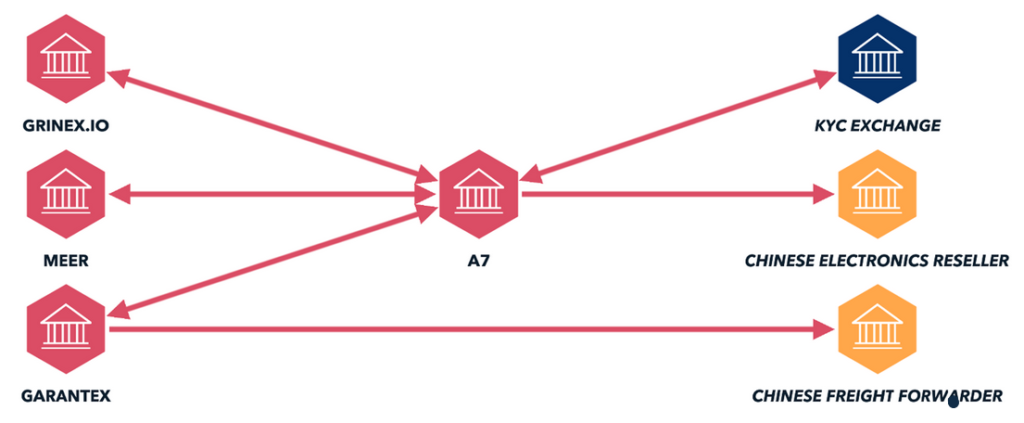
In effect, USDT can function as a digital offshore dollar account beyond the reach of U.S. regulators.
Elliptic describes this system as a sanctions-resistant financial architecture.
Rather than relying on traditional correspondent banking networks, Iranian entities can hold dollar-equivalent assets on blockchain networks and settle transactions internationally.
This approach creates what analysts describe as a “shadow Eurodollar system” on blockchain infrastructure.
Broader Implications for the Global Crypto Market
The Iranian case highlights several important trends that extend far beyond one country.
Cryptocurrency as Crisis Finance
Crypto increasingly serves as a financial escape mechanism during political instability.
From Ukraine and Russia during the early stages of the war to Venezuela and Argentina during hyperinflation, blockchain networks provide a way to preserve and move wealth quickly.
Stablecoins as the New Global Payment Layer
Stablecoins such as USDT and USDC are becoming a foundational layer for cross-border trade.
Their ability to replicate dollar liquidity without banks makes them particularly attractive in sanctioned or financially isolated economies.
The Rise of Geopolitical Blockchain Finance
As more countries face sanctions or financial restrictions, cryptocurrencies may evolve into a parallel global financial system operating outside traditional institutions.
This trend presents both opportunities and regulatory challenges.
Conclusion
The sudden surge in crypto outflows from Iran following the February airstrikes offers a fascinating glimpse into how digital finance interacts with geopolitics.
Whether the movement represented citizens fleeing financial risk, exchange liquidity management, or state-linked financial maneuvering, the episode underscores the growing importance of cryptocurrency during times of crisis.
In sanctioned economies, blockchain networks are increasingly functioning as a parallel financial infrastructure, enabling trade, capital movement, and value storage beyond the reach of conventional banking systems.
At the same time, stablecoins such as USDT are emerging as the backbone of this new system, effectively creating digital dollar markets operating outside the traditional financial order.
For investors and blockchain developers alike, the lesson is clear: cryptocurrency is no longer just a speculative asset class. It is rapidly evolving into a geopolitical financial technology capable of reshaping how money moves in a fragmented world.