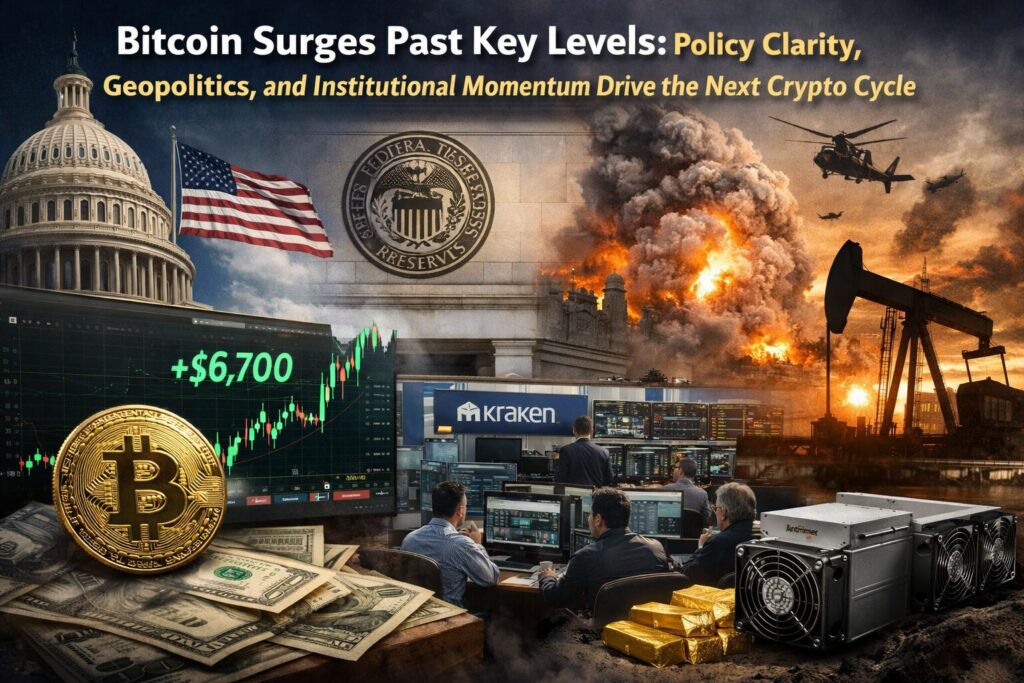
Main Points :
- Bitcoin surged sharply, rising more than $6,700 equivalent in one day amid strong spot buying.
- U.S. crypto policy progress, particularly movement on the Clarity for Digital Assets legislation, improved investor confidence.
- Kraken obtaining a Federal Reserve master account signals growing institutional integration between crypto firms and the U.S. banking system.
- Rising geopolitical tensions in the Middle East are accelerating capital inflows into Bitcoin as a neutral, non-sovereign hedge asset.
- Options market indicators show strong bullish sentiment, while thin order book liquidity suggests continued volatility.
- Energy market risks remain, as rising oil prices could impact Bitcoin mining profitability.
1. Bitcoin’s Sudden Price Surge Signals Renewed Institutional Demand
(“Bitcoin Price Surge – March 2026 Market Movement”)
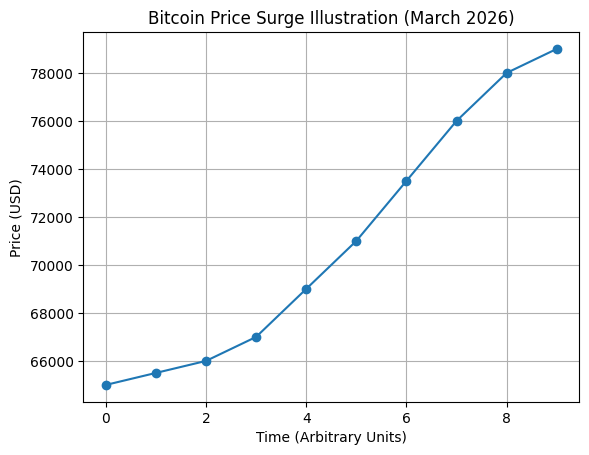
Bitcoin experienced a dramatic price surge between March 4 and March 5, climbing more than $6,700 within roughly 24 hours. The move represents one of the most notable short-term price increases of 2026 so far and reflects a renewed wave of capital entering the crypto market.
Market analysts observed that the rally was driven primarily by spot market buying rather than leveraged derivatives speculation, suggesting that real capital inflows were responsible for the upward momentum.
In cryptocurrency markets, the distinction between spot-driven rallies and derivative-driven rallies is crucial. When price increases are driven by spot purchases—meaning investors directly acquire Bitcoin rather than trading futures—it generally indicates stronger underlying demand and more sustainable price movement.
Trading data from exchanges showed large buy orders appearing across major spot markets, confirming that institutional and large-scale investors were accumulating Bitcoin during the move.
Such patterns have historically marked the early stages of broader market cycles, where capital first flows into Bitcoin before eventually spreading into Ethereum and high-potential altcoins.
For investors seeking the next generation of blockchain opportunities, understanding these macro market signals is essential because Bitcoin often acts as the liquidity gateway for the entire digital asset ecosystem.
2. The U.S. “Clarity Act” and Regulatory Progress
(“Regulatory Impact on Crypto Market Capital Flows”)
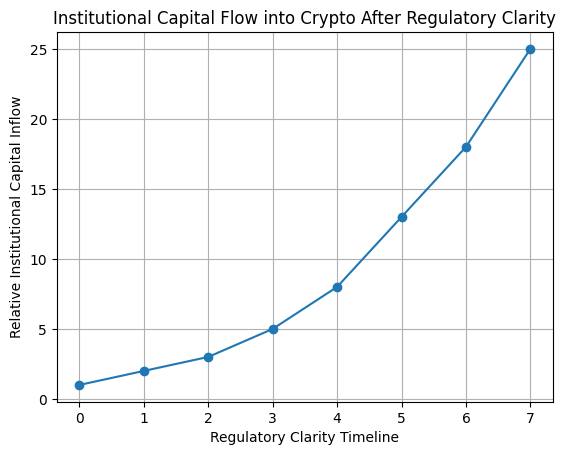
One of the primary catalysts behind Bitcoin’s price rally was positive developments in U.S. cryptocurrency policy.
Recent reports indicated that senior officials in the U.S. administration—including advisors aligned with President Donald Trump—have pushed forward progress on the long-discussed “Clarity for Digital Assets” legislation, commonly referred to as the Clarity Act.
The bill aims to resolve one of the most persistent challenges facing the crypto industry: regulatory uncertainty between financial regulators and the banking sector.
For years, banks and cryptocurrency companies have struggled with overlapping jurisdiction among regulators such as:
- The Securities and Exchange Commission (SEC)
- The Commodity Futures Trading Commission (CFTC)
- Federal banking regulators
The Clarity Act seeks to define which digital assets are securities, commodities, or payment instruments.
If passed, the legislation would significantly improve the legal operating environment for blockchain startups, exchanges, stablecoin issuers, and tokenized financial platforms.
For investors and entrepreneurs, regulatory clarity reduces risk premiums. When regulatory frameworks become predictable, institutional capital—such as hedge funds, pension funds, and banks—can participate more confidently in crypto markets.
The market appears to be pricing in this potential shift.
3. Kraken’s Federal Reserve Master Account: A Historic Banking Milestone
(“Crypto Exchange Integration into Federal Payment Infrastructure”)
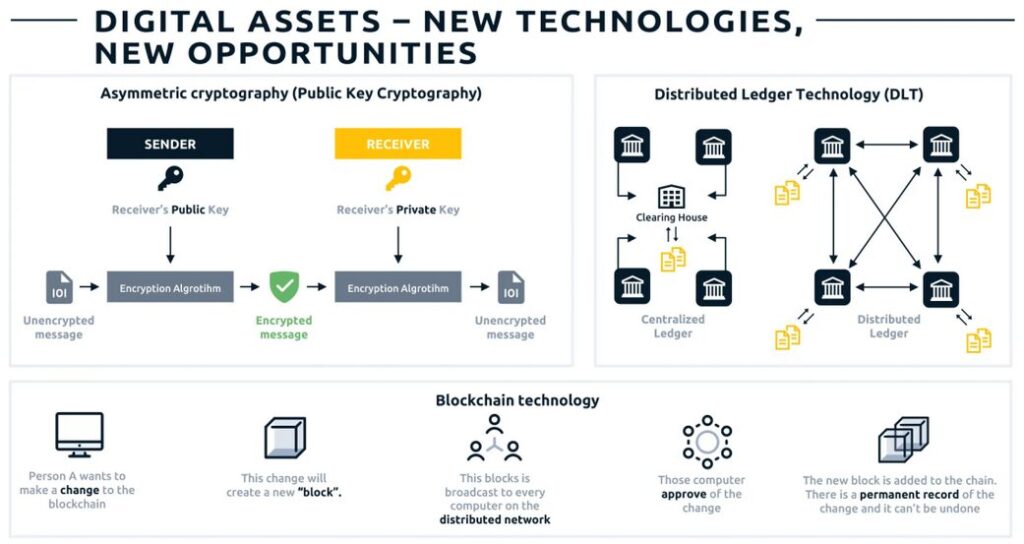
Another important development fueling market optimism was the news that Kraken Financial, part of the major U.S. cryptocurrency exchange Kraken group, successfully obtained a Federal Reserve master account.
This is a landmark moment for the cryptocurrency industry.
A master account allows a financial institution to directly access the Federal Reserve’s payment rails, including systems used for interbank settlement and clearing.
Traditionally, crypto companies have been forced to rely on intermediary banks for payment services. This dependence often created operational friction, including delayed transfers, account closures, and compliance barriers.
Direct access to the Federal Reserve network allows a crypto firm to operate closer to the core of the financial system, significantly improving efficiency and legitimacy.
The implications extend beyond Kraken.
If other digital asset companies eventually obtain similar access, the result could be:
- Faster fiat-to-crypto settlement
- Improved liquidity
- Lower transaction costs
- Greater institutional adoption
For fintech builders and blockchain entrepreneurs, this milestone signals the gradual merging of traditional finance infrastructure and decentralized digital asset networks.
4. Geopolitical Risk Drives Demand for Neutral Assets
(“Bitcoin vs Traditional Safe Haven Assets During Geopolitical Crises”)

Another powerful factor behind Bitcoin’s rally is the escalation of geopolitical tensions in the Middle East.
Reports suggest that military confrontation involving the United States, Israel, and Iran has intensified. The situation has raised concerns about potential disruptions to shipping routes near the Strait of Hormuz, one of the most critical chokepoints for global energy trade.
Roughly 20% of the world’s oil supply passes through the Strait of Hormuz, meaning any disruption could trigger global economic consequences.
In times of geopolitical uncertainty, investors traditionally seek safe-haven assets such as gold, U.S. Treasury bonds, or the Swiss franc.
However, Bitcoin is increasingly being considered a digital hedge against geopolitical risk.
Unlike national currencies or government bonds, Bitcoin operates independently of any sovereign state. This characteristic makes it attractive during periods when trust in governments or financial systems declines.
Over the past decade, several major geopolitical crises—including currency devaluations and capital controls—have demonstrated how digital assets can serve as portable and censorship-resistant stores of value.
As the world becomes more multipolar and financial fragmentation increases, Bitcoin’s role as “digital gold” continues to strengthen.
5. Market Structure: Bullish Sentiment but Rising Volatility
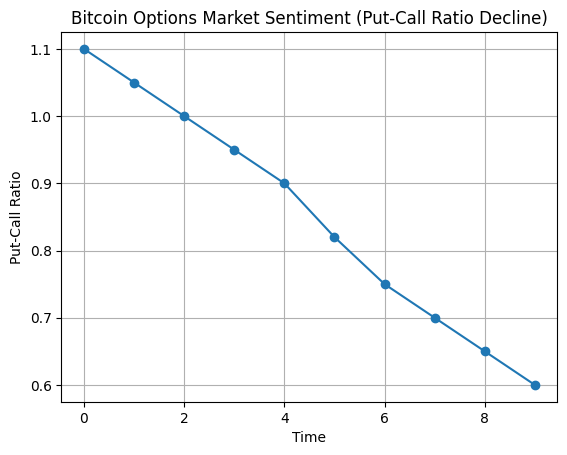
(“Bitcoin Options Market Put-Call Ratio Trend”)
Technical indicators also support the bullish interpretation of recent market movements.
One notable metric is the Put-Call Ratio (PCR) in the Bitcoin options market.
The PCR measures the balance between bearish put options and bullish call options.
A declining PCR indicates that traders are increasingly betting on price increases.
Recent market data shows that the PCR has fallen significantly, signaling growing optimism among investors.
However, order book data reveals another important structural feature: thin liquidity near the current price range.
While some buy orders exist around the $75,000 level, the surrounding price range contains relatively few large limit orders.
This creates conditions where price movements can accelerate quickly in either direction.
In practical terms, the market may experience sharp upward spikes but also sudden corrections as liquidity shifts.
For active traders and crypto investors, this means risk management remains essential.
6. Energy Market Risks and Mining Economics
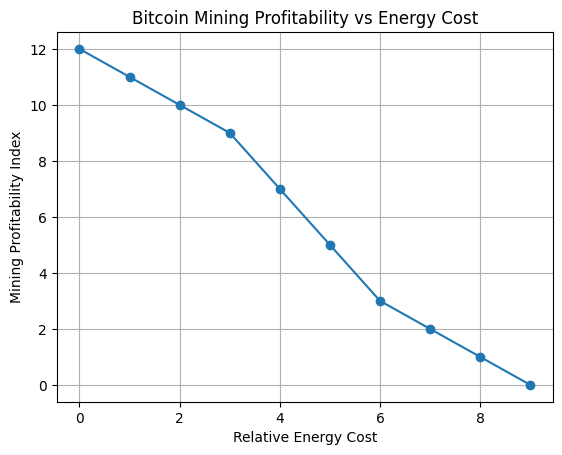
(“Bitcoin Mining Profitability vs Energy Cost Model”)
Despite the positive momentum, one macroeconomic risk deserves attention: rising oil prices.
If geopolitical tensions disrupt energy markets, global oil prices could surge.
Higher energy costs directly affect Bitcoin miners because mining operations rely heavily on electricity.
Mining profitability depends on three key variables:
- Bitcoin price
- Network difficulty
- Energy cost
If electricity prices rise dramatically, some mining operations could become unprofitable, potentially reducing network hash rate.
However, the Bitcoin mining industry has increasingly shifted toward renewable and stranded energy sources, such as hydroelectric power, flare gas recovery, and surplus grid capacity.
As a result, the long-term impact of oil price volatility may be less severe than in earlier years of the industry.
7. Upcoming Economic Events to Watch
Several macroeconomic indicators and financial events could influence crypto markets in the coming days:
- FIN/SUM Fintech Event in Japan (March 3–6)
One of Japan’s largest fintech conferences hosted by the Financial Services Agency and Nikkei. - U.S. ISM Non-Manufacturing Index (March 5)
A key indicator of the strength of the U.S. service sector. - U.S. Retail Sales Data (March 6)
A major signal of consumer spending trends.
Macroeconomic data often impacts cryptocurrency markets indirectly through interest rate expectations, liquidity conditions, and risk sentiment.
Conclusion: Bitcoin’s Next Phase Is Being Shaped by Policy, Infrastructure, and Global Instability
Bitcoin’s recent surge reflects a powerful convergence of structural forces.
Regulatory developments in the United States are gradually clarifying the legal status of digital assets, potentially unlocking large pools of institutional capital. At the same time, financial infrastructure integration—illustrated by Kraken’s Federal Reserve master account—signals that cryptocurrency firms are moving closer to the core of the global banking system.
Meanwhile, geopolitical instability continues to highlight Bitcoin’s value as a neutral, decentralized financial asset outside the control of nation states.
These three trends—policy clarity, institutional infrastructure, and geopolitical hedging demand—are reshaping the role of Bitcoin in the global financial system.
For investors searching for new crypto opportunities and practical blockchain applications, the current environment suggests that the next phase of the market cycle may not simply be driven by speculation.
Instead, it may be driven by the structural integration of blockchain technology into the foundations of global finance.