
Main Points :
- Indiana has passed a law allowing cryptocurrency investments in state-managed retirement plans.
- Public retirement programs must provide at least one crypto investment option by July 1, 2027.
- Eligible assets include Bitcoin and Ethereum spot ETFs, while stablecoin-related funds are excluded due to regulatory uncertainty.
- The policy reflects a broader U.S. trend, with at least 21 states exploring or implementing similar initiatives.
- Institutional adoption of digital assets continues to expand through pension funds, sovereign funds, and ETFs.
1. Indiana’s Landmark Pension Reform
Indiana has taken a significant step toward institutionalizing digital assets in public finance. Governor Mike Braun signed House Enrolled Act 1042 (HEA 1042) into law, enabling cryptocurrency investment within state-managed retirement and savings plans. The legislation represents one of the clearest signals yet that digital assets are moving from speculative markets into long-term institutional portfolios.
Under the new law, Indiana’s public retirement programs—including the Public Employees’ Retirement Fund (PERF), Teachers’ Retirement Fund, and certain defined-contribution plans for legislators—must introduce self-directed investment accounts by July 1, 2027. These accounts will allow participants to allocate a portion of their retirement savings into approved cryptocurrency investment vehicles.
Importantly, the law does not mandate that every participant invest in crypto. Instead, it requires that retirement systems offer at least one cryptocurrency investment option, leaving the final decision to individual participants.
This approach mirrors how retirement accounts currently provide exposure to alternative assets such as commodities or real-estate investment trusts (REITs). The difference is that digital assets—once dismissed as fringe investments—are now entering the mainstream infrastructure of pension finance.
2. Bitcoin and Ethereum ETFs as the Primary Gateway
The Indiana legislation specifically mentions spot Bitcoin ETFs and Ethereum ETFs as eligible investment vehicles. This choice reflects a deliberate effort to balance innovation with regulatory clarity.
Direct purchases of cryptocurrencies often raise concerns about custody, volatility, and regulatory compliance. ETFs provide a familiar structure for pension funds because they operate within the traditional securities framework.
Why ETFs Matter
- Regulated by U.S. securities authorities
- Custodied by established financial institutions
- Easily integrated into retirement portfolio platforms
- Transparent pricing linked to underlying assets
Following the approval of multiple spot Bitcoin ETFs in the United States in 2024, institutional demand surged. Large asset managers—including BlackRock, Fidelity, and others—began offering regulated products that track the price of Bitcoin.
Ethereum ETFs followed shortly afterward, giving institutions diversified exposure to the second-largest blockchain ecosystem.
By using ETFs rather than direct token purchases, Indiana reduces operational risk while still allowing retirees to participate in potential digital-asset growth.
However, the law explicitly excludes stablecoin-related funds, citing regulatory uncertainty surrounding stablecoins in the United States. Stablecoins remain under review by regulators due to concerns about reserves, systemic risk, and financial stability.
3. A Broader U.S. Trend: 21 States Exploring Crypto Reserves
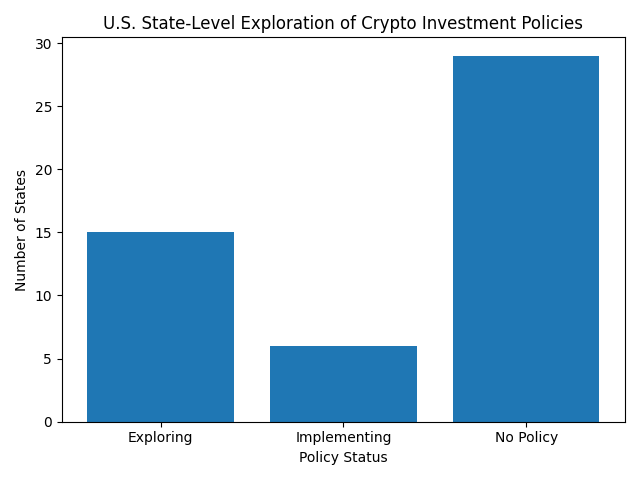
Indiana’s decision is not occurring in isolation. Across the United States, state governments are increasingly exploring digital assets as part of public investment strategies.
According to recent industry analyses, at least 21 states are currently considering or implementing policies related to cryptocurrency investments for public funds. These initiatives include:
- Allowing pension funds to invest in crypto ETFs
- Exploring state-level Bitcoin reserves
- Allocating small portions of treasury funds to digital assets
- Studying blockchain for financial infrastructure
Some states—particularly those with strong tech sectors—view blockchain investments as both a financial opportunity and a strategic technology play.
The movement also aligns with discussions at the federal level about creating a U.S. strategic Bitcoin reserve, a concept that has gained political traction in recent years.
If multiple states begin holding Bitcoin through pension funds or treasury reserves, the cumulative institutional demand could significantly influence global crypto markets.
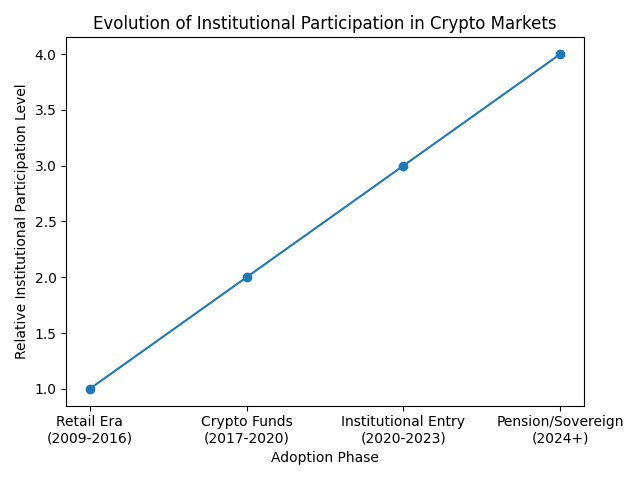
4. Institutional Adoption Is Accelerating
The Indiana pension decision reflects a much larger macro trend: the rapid institutionalization of cryptocurrency markets.
Over the past decade, digital assets evolved through several phases:
| Phase | Period | Key Participants |
|---|---|---|
| Early Adoption | 2009–2016 | Individual investors and developers |
| Crypto Hedge Funds | 2017–2020 | Specialized crypto funds |
| Institutional Entry | 2020–2023 | Hedge funds, family offices |
| Pension & Sovereign Funds | 2024–present | Governments, pension systems |
The launch of regulated Bitcoin ETFs marked a turning point. These products dramatically lowered the barrier for large institutions to gain exposure.
Global pension funds—traditionally among the most conservative investors—are now cautiously entering the market.
Examples include:
- Canadian pension funds investing in blockchain infrastructure
- European retirement systems allocating small percentages to crypto funds
- Middle Eastern sovereign funds investing in blockchain companies
Indiana’s move may therefore represent only the beginning of a broader wave of public-sector digital-asset adoption.
5. Potential Benefits for Retirement Portfolios
For retirement investors, adding cryptocurrency exposure could provide several potential benefits.
1. Portfolio Diversification

Digital assets historically show low correlation with traditional assets such as stocks and bonds. Even a small allocation can improve portfolio diversification.
2. Inflation Hedge
Some investors view Bitcoin as “digital gold” due to its fixed supply of 21 million coins. This scarcity has attracted investors seeking protection from currency inflation.
3. Exposure to Emerging Technology
Ethereum and other blockchain ecosystems represent foundational infrastructure for decentralized finance, tokenized assets, and digital identity systems.
By allowing pension participants to invest in crypto ETFs, Indiana is effectively giving public workers access to an emerging technological sector.
However, regulators emphasize that such investments should remain a small portion of retirement portfolios due to volatility risks.
6. Risks and Regulatory Considerations
Despite growing acceptance, cryptocurrency investments still carry significant risks.
Market Volatility
Bitcoin and Ethereum prices can fluctuate dramatically. Pension systems must ensure participants understand these risks.
Regulatory Uncertainty
Although ETFs are regulated securities, the broader digital-asset ecosystem remains subject to evolving rules.
Custody and Security
While ETFs mitigate custody concerns, the underlying assets still rely on secure blockchain infrastructure.
For these reasons, Indiana’s law leaves key details—such as investment limits and fees—to individual pension plan committees.
These committees will determine:
- Maximum allocation percentages
- Eligible ETFs or funds
- Risk disclosures and investor education
Such oversight is essential to balance innovation with fiduciary responsibility.
7. The Global Implications of State-Level Crypto Adoption
If U.S. states continue integrating digital assets into public finance, the implications could be profound.
First, pension funds control trillions of dollars in assets globally. Even a 1–2% allocation to crypto could represent hundreds of billions of dollars in new demand.

Second, state-level adoption may encourage other countries to explore similar policies.
Countries already experimenting with national crypto strategies include:
- El Salvador, which adopted Bitcoin as legal tender
- Switzerland, which supports crypto banking infrastructure
- Singapore, which promotes blockchain innovation
The difference with Indiana and other U.S. states is that the initiative focuses on investment exposure rather than legal tender status.
This model may prove more practical for large economies.
8. What This Means for Crypto Investors
For crypto investors and entrepreneurs, Indiana’s policy sends a clear signal: digital assets are gradually becoming part of the traditional financial system.
Three implications stand out:
Institutional Liquidity Will Increase
Pension funds represent long-term capital. Their participation could stabilize markets and reduce volatility over time.
Regulated Products Will Dominate
ETFs and regulated funds are likely to become the primary gateway for institutional investment.
Blockchain Infrastructure Will Gain Strategic Importance
As governments become investors, they may also support blockchain innovation in payments, identity, and digital asset settlement.
This environment could create new opportunities for blockchain startups and infrastructure providers.
Conclusion: A Turning Point for Public Finance and Crypto
Indiana’s new law allowing cryptocurrency investments in public retirement plans marks a significant milestone in the evolution of digital assets.
By mandating the introduction of crypto investment options by 2027, the state is acknowledging that blockchain-based assets are no longer fringe technologies. Instead, they are emerging as a legitimate component of diversified investment portfolios.
The decision also reflects a broader shift in the United States, where dozens of states are exploring similar initiatives. Combined with the growth of regulated ETFs and institutional investment products, these developments suggest that digital assets are steadily integrating into mainstream finance.
For investors seeking the next generation of financial opportunities, the key takeaway is clear: cryptocurrency adoption is no longer driven solely by retail speculation. It is increasingly supported by pension funds, governments, and global financial institutions.
As this institutional wave grows, the crypto market may enter a new phase—one defined not just by innovation, but by long-term capital and structural legitimacy.