
Main Points :
- Former U.S. President Donald Trump reportedly met privately with Coinbase CEO Brian Armstrong before criticizing the banking industry over a stalled crypto market structure bill.
- The proposed CLARITY Act has become a battleground between crypto firms and traditional banks.
- The most controversial issue is whether stablecoins should be allowed to offer yield to holders.
- Crypto companies argue yield is essential for innovation and competition with banks.
- Banks fear yield-bearing stablecoins could drain deposits from the traditional financial system.
- The outcome of this regulatory fight could shape the next decade of blockchain-based financial infrastructure.
1. A Private Meeting Before a Public Attack on Banks
Reports recently emerged that Donald Trump held a private meeting with Coinbase CEO Brian Armstrong shortly before launching a public criticism of the U.S. banking industry.
According to reports citing sources familiar with the matter, a Coinbase delegation visited the White House, after which Armstrong reportedly held a direct discussion with Trump. Only hours later, Trump posted on Truth Social criticizing banks for allegedly obstructing a major cryptocurrency market structure bill known as the CLARITY Act.
Trump argued that the United States must pass crypto market legislation “as soon as possible,” warning that traditional banks should not be allowed to sabotage pro-crypto policy.
In his message, Trump stated:
“Banks are making record profits. We will not allow them to sabotage our strong crypto policies.”
The timing of the statement suggests that the administration is actively engaging with the crypto industry while positioning itself against what it perceives as entrenched financial interests resisting digital asset innovation.
For crypto markets, this signals that policy debates are no longer purely technical regulatory questions but are becoming geopolitical and economic power struggles between financial sectors.
2. The CLARITY Act: A Defining Crypto Market Structure Bill
At the center of the controversy is the proposed CLARITY Act, a bill designed to define the regulatory framework governing digital assets in the United States.
The bill aims to clarify several unresolved issues:
- Whether crypto tokens should be classified as securities or commodities
- How exchanges and brokers should be regulated
- Which agency has jurisdiction — the SEC or the CFTC
- Rules governing stablecoins and digital payment infrastructure
For years, the lack of regulatory clarity has been cited as one of the main reasons why crypto companies consider relocating outside the United States.
Industry leaders argue that the absence of clear legislation has:
- slowed institutional investment
- discouraged startups
- pushed blockchain innovation overseas
The CLARITY Act was intended to solve these issues by creating a consistent market structure similar to those used in traditional financial markets.
However, negotiations have stalled due to disagreements between the crypto industry and the banking sector.
3. The Core Dispute: Stablecoin Yield
The largest disagreement surrounding the bill concerns a seemingly technical but extremely important question:
Should stablecoins be allowed to pay yield to holders?
Stablecoins such as USDC or USDT are digital tokens pegged to fiat currencies like the U.S. dollar.
Traditionally, these tokens do not pay interest. However, some crypto platforms distribute yield to users through:
- lending programs
- staking mechanisms
- treasury-backed returns
Crypto companies argue that allowing stablecoin yield is essential for the evolution of decentralized finance (DeFi) and blockchain-based financial services.
Banks strongly oppose this concept.
They argue that yield-bearing stablecoins could effectively become unregulated bank deposits, pulling funds away from the traditional banking system.
Stablecoin Yield vs Traditional Bank Deposits

This diagram illustrates the economic conflict between stablecoin issuers and banks.
In a traditional banking model:
- Users deposit money into banks.
- Banks lend those deposits or invest them.
- Banks keep most of the interest revenue.
In a stablecoin yield model:
- Users hold stablecoins.
- The issuer holds reserves (often Treasury bills).
- Yield from reserves can be partially distributed to token holders.
If yield distribution becomes widespread, stablecoins could function as programmable digital savings accounts.
This possibility is precisely what concerns traditional banks.
4. Coinbase CEO’s Opposition to the Bill
Brian Armstrong previously criticized a version of the legislation currently under debate.
According to Armstrong, amendments to the bill would effectively prohibit stablecoin yield, allowing banks to eliminate competition.
Armstrong argued that banning yield would:
- reduce consumer benefits
- weaken innovation
- protect incumbent financial institutions
From the perspective of crypto companies, yield-bearing stablecoins are one of the most powerful tools for expanding blockchain adoption.
If users can earn passive income simply by holding digital dollars, stablecoins could become a major alternative to traditional savings accounts.
This would represent a fundamental shift in how money is stored and transferred.
5. Banking Industry Concerns
Traditional banks see the issue very differently.
Their concerns include:
Deposit Flight
If stablecoins offer yield while maintaining dollar parity, large amounts of money could leave bank deposits.
This could weaken banks’ ability to lend and maintain liquidity.
Financial Stability Risks
Banks argue that if stablecoin issuers fail or reserves are mismanaged, a large-scale run on digital dollars could destabilize financial markets.
Regulatory Imbalance
Banks operate under strict capital requirements, compliance costs, and supervision.
Allowing stablecoin issuers to compete with fewer regulations could create what banks consider an unfair competitive environment.
6. White House Negotiations Between Crypto and Banking Sectors
After the legislative debate stalled, the White House reportedly held three rounds of meetings with representatives from both industries.
These negotiations highlight how seriously the U.S. government views the issue.
Digital asset policy is no longer a niche topic.
It now affects:
- global financial competitiveness
- payment infrastructure
- dollar dominance
- fintech innovation
The United States faces competition from jurisdictions such as:
- Singapore
- the United Arab Emirates
- Hong Kong
- the European Union (through MiCA regulation)
These regions are actively creating regulatory frameworks designed to attract crypto businesses.
7. Coinbase’s Increasing Political Influence
Another notable aspect of the situation is the growing political visibility of Coinbase.
Since Trump’s election victory in 2024, Armstrong has been seen interacting frequently with government officials.
Examples include:
- invitations to presidential inauguration events
- participation in crypto policy discussions
- lobbying efforts in Congress
Coinbase has also financially supported public events in Washington, including celebrations tied to the America250 initiative, which commemorates the upcoming 250th anniversary of the United States.
This reflects a broader trend in the crypto industry:
major crypto companies are becoming powerful political actors.
Stakeholders in the Crypto Market Structure Debate
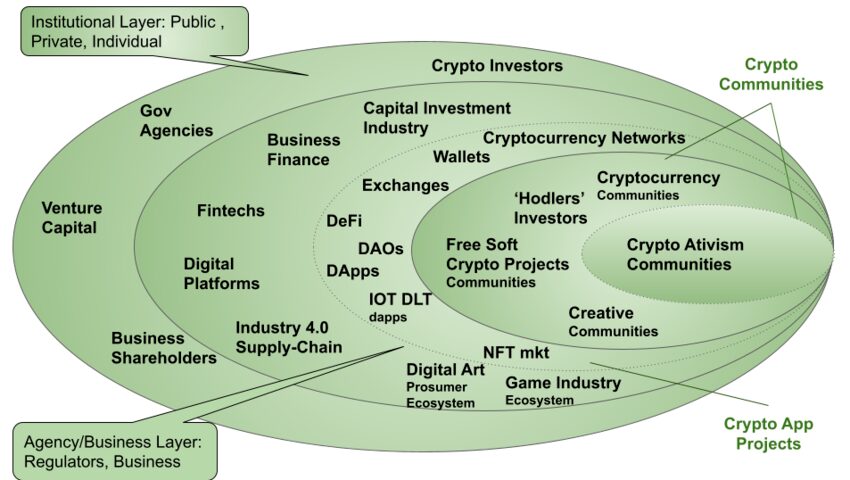
This diagram shows the competing forces shaping crypto regulation:
- Crypto companies seeking innovation freedom
- Banks protecting traditional finance
- Regulators trying to balance stability and growth
- Politicians responding to economic and electoral pressures
The resulting policy framework will likely determine where the next wave of blockchain infrastructure is built.
8. The Strategic Importance of Stablecoins
Stablecoins have quietly become one of the most important pillars of the crypto ecosystem.
Today they are used for:
- global remittances
- crypto trading liquidity
- cross-border payments
- DeFi lending markets
- on-chain treasury management
Total stablecoin supply has exceeded $160 billion globally in recent years.
More importantly, stablecoins are increasingly backed by short-term U.S. Treasury securities, meaning they are indirectly tied to the U.S. government debt market.
Some analysts believe stablecoins could eventually become a major buyer of U.S. Treasury bills, strengthening dollar dominance in digital finance.
9. Implications for Crypto Investors and Builders
For readers looking for new crypto investment opportunities or blockchain business models, the regulatory battle carries major implications.
If stablecoin yield becomes legal:
Potential opportunities include:
- yield-bearing stablecoin protocols
- tokenized treasury markets
- DeFi savings platforms
- programmable payment networks
If yield is restricted:
Innovation may shift toward:
- offshore jurisdictions
- synthetic stablecoins
- decentralized lending protocols
In either scenario, the fight over stablecoin regulation is shaping the future structure of the digital asset economy.
Conclusion: A Defining Moment for Crypto Finance
The reported meeting between Donald Trump and Coinbase CEO Brian Armstrong highlights the growing political importance of cryptocurrency policy.
What began as a niche technological experiment has evolved into a strategic battle over the future architecture of finance.
At the center of this conflict lies a deceptively simple question:
Who controls yield on digital dollars?
Banks want to preserve the traditional deposit model.
Crypto companies want programmable money capable of distributing returns directly to users.
The decision policymakers make regarding the CLARITY Act could determine whether the United States becomes the global hub for blockchain innovation—or whether that role shifts elsewhere.
For investors, developers, and entrepreneurs, the outcome will shape the next generation of financial infrastructure built on blockchain technology.