Main Points :
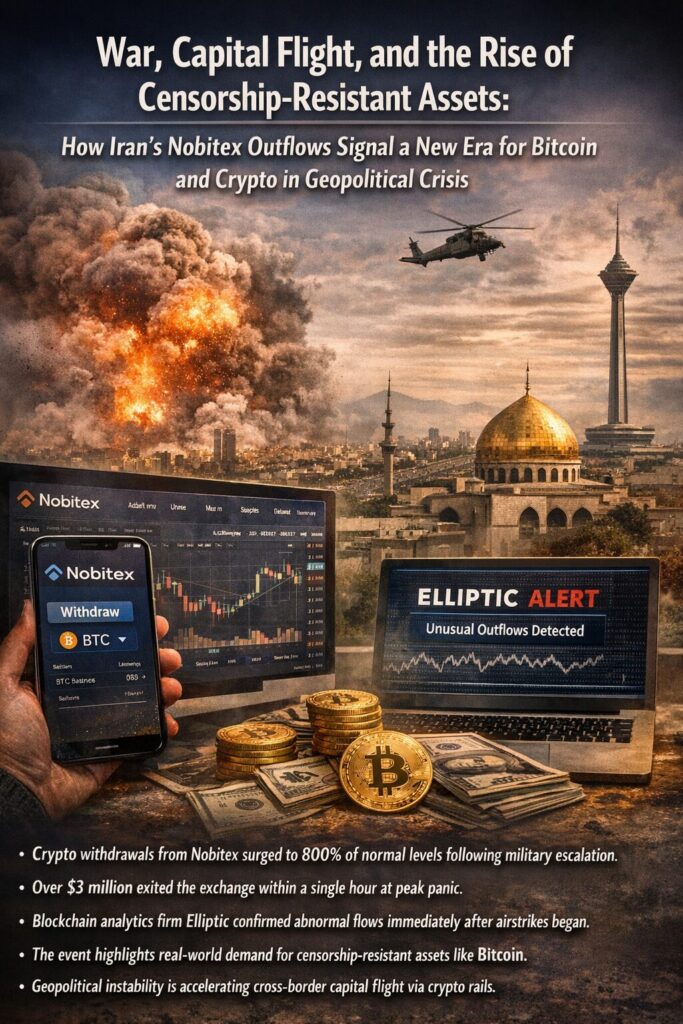
- Crypto withdrawals from Nobitex surged to 800% of normal levels following military escalation.
- Over $3 million exited the exchange within a single hour at peak panic.
- Blockchain analytics firm Elliptic confirmed abnormal flows immediately after airstrikes began.
- The event highlights real-world demand for censorship-resistant assets like Bitcoin.
- Geopolitical instability is accelerating cross-border capital flight via crypto rails.
- Emerging markets are increasingly using crypto as a parallel financial system during systemic shocks.
1. Shockwaves Through Iran’s Financial System
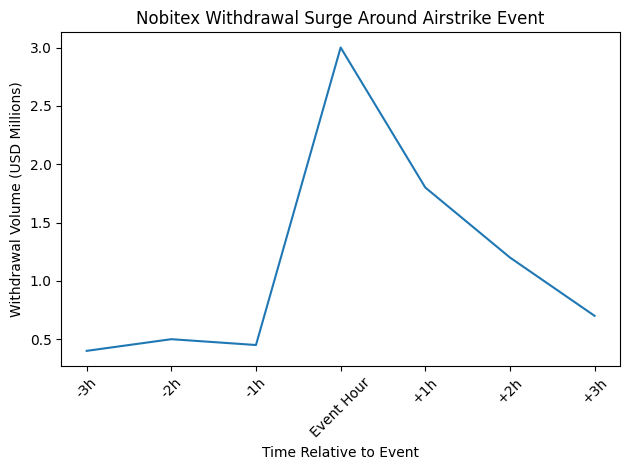
The Iranian cryptocurrency market experienced a dramatic and unprecedented surge in capital outflows following reports of military escalation and the assassination of Supreme Leader Ali Khamenei. According to blockchain analytics firm Elliptic, withdrawals from Iran’s largest crypto exchange, Nobitex, spiked to nearly eight times normal levels immediately after airstrikes began on February 28.
At peak intensity, roughly $3 million in crypto assets left the exchange in just one hour. For an emerging market exchange operating under heavy international sanctions, this volume represents a historic liquidity event.
Nobitex reportedly serves over 11 million users, positioning it as a major financial artery within Iran’s shadow-banking ecosystem. When confidence in traditional financial systems deteriorates, crypto becomes not merely speculative — but infrastructural.
The timing of the outflows strongly suggests panic-driven capital flight. In moments of political decapitation and potential regime instability, citizens and institutions alike seek portable, seizure-resistant assets. Historically, this meant gold or offshore dollars. Today, it increasingly means Bitcoin and stablecoins.
2. Crypto as a Wartime Escape Valve
The surge in withdrawals underscores crypto’s evolving role as a financial escape mechanism. Unlike traditional bank transfers, which can be frozen, delayed, or restricted under capital controls, blockchain transactions function independently of domestic banking rails.
In Iran’s case, sanctions have already limited integration with SWIFT and global banking systems. This isolation has accelerated domestic crypto adoption over the past decade. Peer-to-peer markets, over-the-counter desks, and centralized exchanges like Nobitex effectively operate as parallel payment networks.
The recent spike demonstrates what economists describe as “real demand” for censorship-resistant assets. During systemic risk events:
- Fiat currency faces devaluation pressure.
- Banks may impose withdrawal limits.
- Cross-border remittance becomes restricted.
- Political targeting of financial accounts becomes plausible.
Crypto assets, particularly Bitcoin, provide:
- Borderless transferability
- Self-custody capability
- Resistance to account seizure
- Global liquidity access
In this context, Bitcoin is not merely an investment vehicle — it becomes crisis infrastructure.
3. Capital Flight in the Digital Age
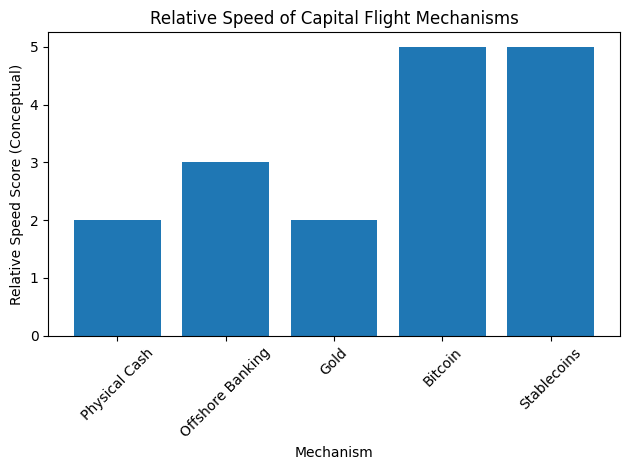
Geopolitical instability historically leads to capital flight. However, the mechanism of flight has evolved dramatically.
In past decades, capital flight required:
- Physical cash transport
- Offshore banking connections
- Shell corporations
- Precious metal storage
Today, a smartphone and a seed phrase can replace an offshore trust.
Data from previous crises supports this pattern. During the Russia–Ukraine war in 2022, crypto volumes surged across Eastern Europe. Stablecoin trading pairs spiked in Turkey during lira volatility. In Argentina, Bitcoin volumes repeatedly climb during peso devaluations.
The Nobitex event fits into a broader pattern: crypto acts as a pressure-release valve in fragile monetary environments.
Recent global trends further reinforce this thesis:
- Sovereign debt stress in emerging markets
- Rising sanctions regimes
- Weaponization of banking infrastructure
- Increased surveillance of cross-border transfers
As state control over financial systems tightens, decentralized alternatives gain strategic value.
4. The Strategic Role of Stablecoins
While Bitcoin symbolizes censorship resistance, stablecoins play an equally important role in capital preservation.
Dollar-backed stablecoins such as USDT and USDC provide:
- Price stability relative to USD
- Faster settlement than bank wires
- Access to global exchanges
- Hedging against local currency collapse
Although specific asset breakdowns were not disclosed in the Nobitex outflow report, historically sanctioned regions show high stablecoin adoption due to their dollar peg.
For investors seeking revenue opportunities, stablecoins are also integrated into:
- DeFi yield farming
- Lending protocols
- Cross-border remittance businesses
- Treasury management for SMEs
In crisis conditions, capital first moves to safety (stablecoins), then redeploys into opportunity (Bitcoin or other assets).
5. Bitcoin’s Real-World Stress Test
The Iranian situation provides a real-time stress test of Bitcoin’s original thesis.
When Satoshi Nakamoto embedded the message referencing bank bailouts in Bitcoin’s genesis block, the underlying philosophy centered on sovereign-independent money. Events like this move that philosophy from theory to proof-of-concept.
In extreme political scenarios:
- Ownership remains tied to private keys.
- Transfers cannot be censored by local authorities.
- Assets can cross borders digitally.
- Liquidity exists globally.
However, this also raises regulatory scrutiny. Western regulators have long expressed concern about crypto facilitating sanctions evasion. Blockchain analytics firms, including Elliptic, monitor flows to detect illicit activity.
Thus, the tension between privacy and compliance intensifies during geopolitical crises.
6. Implications for Investors and Builders
For readers seeking new crypto assets or practical blockchain applications, several strategic insights emerge:
A. Crisis Adoption Is Structural, Not Temporary
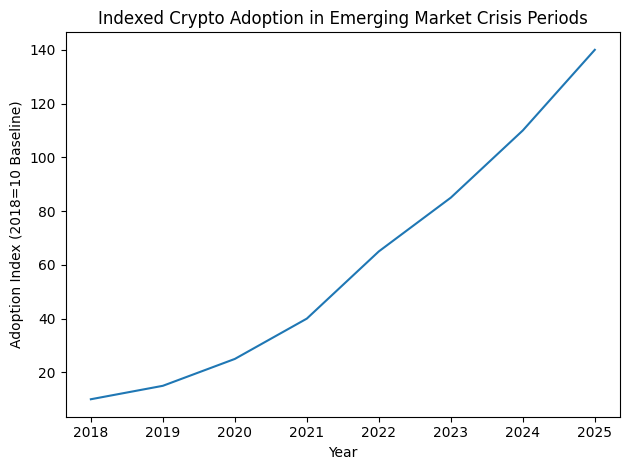
Each geopolitical shock increases long-term crypto penetration in unstable regions. Adoption rarely fully reverses after stability returns.
B. Infrastructure Tokens May Benefit
Exchanges, custody solutions, and cross-chain bridges become critical tools during crises. Projects building resilient financial rails could see organic demand growth.
C. Privacy-Focused Assets May See Renewed Interest
Heightened capital controls historically increase interest in privacy-enhancing technologies, though regulatory risk remains high.
D. Bitcoin’s Store-of-Value Narrative Strengthens
Events like this reinforce Bitcoin’s positioning relative to gold in emerging markets.
7. A Glimpse Into the Future
If geopolitical fragmentation continues, we may see:
- Regional crypto corridors emerging between sanctioned states.
- Increased self-custody adoption.
- Hybrid on-chain/off-chain remittance networks.
- Governments developing tighter blockchain surveillance.
The global financial system is entering a bifurcated phase: regulated fiat rails versus decentralized crypto rails.
Iran’s Nobitex outflow event may be remembered not merely as a crisis reaction, but as another milestone in crypto’s transformation from speculative asset class to strategic financial infrastructure.
Conclusion: When Theory Meets Reality
The 800% surge in withdrawals from Nobitex is more than a headline statistic — it is a signal.
In moments of existential uncertainty, individuals revert to assets they can control. In the 20th century, that meant gold. In the 21st century, increasingly, it means Bitcoin and stablecoins.
For investors, this underscores the structural demand case for censorship-resistant networks. For builders, it highlights the importance of scalable, secure infrastructure capable of supporting capital flight during systemic stress.
Geopolitical risk is no longer an abstract macro factor. It is becoming one of the strongest real-world adoption drivers for cryptocurrency.
The Iranian case demonstrates that when borders close and banks restrict movement, blockchains remain open.
And that may be crypto’s most powerful value proposition of all.