
Main Points :
- Bitmine purchased over 59,928 ETH last week, continuing a disciplined weekly accumulation strategy.
- Total holdings now stand at 4,473,587 ETH, representing 3.71% of total ETH supply.
- The company faces an estimated $7.4 billion unrealized loss at current price levels.
- Bitmine’s “Alchemy of 5%” strategy targets acquiring 5% of total ETH supply.
- Over 3.04 million ETH are staked, generating approximately $172 million annual yield, potentially rising to $253 million with full MAVAN validator deployment.
- Chairman Thomas Lee maintains that ETH’s current valuation does not reflect Wall Street adoption, real-world utility, or AI-driven payment demand.
- Bitmine ranks as the world’s largest Ethereum treasury company and the second-largest overall crypto treasury firm after Strategy (MicroStrategy).
1. Strategic Accumulation in Volatile Markets
Bitmine, led by Wall Street strategist Thomas Lee, announced on March 2 that it acquired an additional 59,928 ETH over the past week. Although slightly below the previous week’s 51,162 ETH purchase, the scale of capital allocation signals disciplined execution rather than opportunistic buying.
At an average ETH price of $1,976, Bitmine’s total Ethereum holdings have reached 4,473,587 ETH, equivalent to approximately $8.84 billion in Ethereum exposure. Including $8.68 billion in cash reserves, the company’s total crypto and cash assets amount to roughly $9.9 billion.
This accumulation brings Bitmine’s share of total circulating Ethereum supply to 3.71%, up from 3.66% the previous week. The pace suggests a deliberate attempt to approach its strategic target of acquiring 5% of all ETH in circulation.
However, the aggressive accumulation comes with a cost. Based on disclosed estimates, Bitmine’s unrealized losses on its ETH position are approximately $7.4 billion (converted from ¥1.1 trillion). This figure reflects a long-term treasury strategy rather than short-term trading.
2. The “Alchemy of 5%” Strategy
Bitmine’s strategy—dubbed the “Alchemy of 5%”—is one of the most ambitious Ethereum treasury strategies ever executed by a public crypto firm.
The objective is clear:
Accumulate 5% of Ethereum’s total supply and convert mining surplus capital into long-term ETH reserves.
The company began implementing this strategy approximately eight months ago and has already achieved over 74% of its 5% target, demonstrating extraordinary speed and capital mobilization.
Unlike traditional Bitcoin treasury strategies popularized by companies like Strategy (formerly MicroStrategy), Bitmine’s approach reflects a structural bet on Ethereum’s programmable economy.
Why Ethereum Instead of Bitcoin?
While Bitcoin remains digital gold, Ethereum represents programmable capital:
- Smart contracts
- Decentralized finance (DeFi)
- Stablecoin settlement infrastructure
- NFT and tokenization platforms
- AI-agent payment rails
Bitmine’s thesis suggests that future financial infrastructure will run on Ethereum-based networks, and supply concentration today may generate outsized leverage tomorrow.
3. Staking Yield: Turning Treasury into Productive Capital
Unlike Bitcoin treasury models that rely solely on price appreciation, Ethereum offers yield through staking.
Bitmine currently stakes 3.04 million ETH, generating approximately $172 million in annualized staking revenue.
Once its proprietary validator infrastructure—
MAVAN (Made-in-America Validator Network)—
reaches full deployment, annual staking revenue is projected to reach $253 million.
Staking Revenue Breakdown (Estimated)
[“Projected Annual Staking Revenue Growth”]
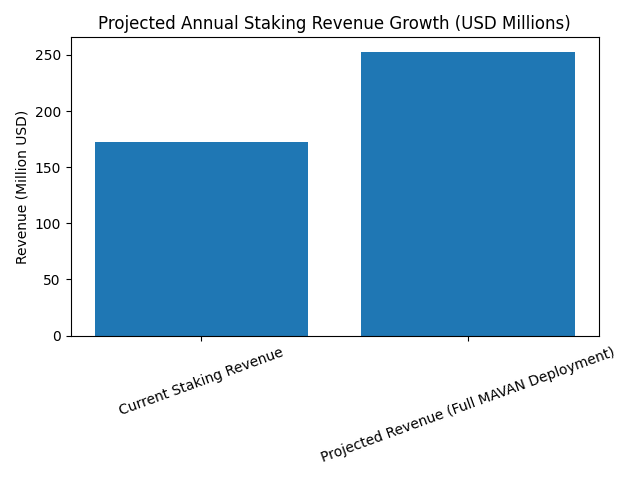
The graph should illustrate:
- Current staking revenue: $172M
- Projected revenue at full MAVAN capacity: $253M
- Percentage growth increase
This transforms Bitmine from a passive holder into an active network participant.
Staking rewards act as:
- A hedge against volatility
- A cash-flow engine
- A validator-based infrastructure play
For treasury investors, this hybrid model—asset accumulation + yield generation—represents a more capital-efficient strategy than Bitcoin-only accumulation.
4. Unrealized Losses vs. Strategic Conviction
The estimated $7.4 billion unrealized loss might appear alarming at first glance. However, it reflects:
- Long-term accumulation during market weakness
- Mark-to-market accounting
- Strategic positioning rather than speculative timing
Thomas Lee emphasized that current ETH prices fail to reflect:
- Wall Street institutional demand
- Ethereum’s role in global settlement
- AI-driven autonomous payment demand
- Growing stablecoin transaction volumes
Recent industry data supports part of this thesis:
- Stablecoin settlement volumes on Ethereum Layer 1 and Layer 2 networks continue to exceed traditional payment processors in certain quarters.
- AI agent frameworks increasingly experiment with on-chain microtransactions.
- Tokenization of real-world assets (RWAs) is increasingly built on Ethereum-based ecosystems.
5. Broader Market Context: Ethereum’s Institutional Narrative in 2026
Ethereum in 2026 stands at a crossroads.
Recent developments shaping the narrative include:
- Expansion of ETH staking ETFs in multiple jurisdictions
- Increased corporate treasury diversification beyond Bitcoin
- Layer 2 scaling adoption driving transaction cost reductions
- Institutional tokenization pilots (bonds, funds, treasuries)
Bitmine’s strategy may be viewed as a high-beta institutional bet on Ethereum’s settlement dominance.
While Bitcoin treasury companies focus on scarcity narrative, Ethereum treasury firms focus on utility narrative.
This reflects two competing models:
| Model | Asset Thesis | Revenue Model |
|---|---|---|
| Bitcoin Treasury | Digital Gold | Appreciation |
| Ethereum Treasury | Programmable Infrastructure | Appreciation + Yield |
Bitmine clearly aligns with the latter.
6. Ranking Among Crypto Treasury Giants
Bitmine has now become:
- World’s largest Ethereum treasury company
- Second-largest overall crypto treasury firm, following Strategy, which holds approximately 720,000 BTC.
This positioning is critical.
If Ethereum’s utility narrative gains traction, treasury dominance could translate into:
- Governance influence
- Validator centralization leverage
- Institutional negotiation power
- Strategic DeFi integration advantages
Supply concentration in Ethereum has greater implications than in Bitcoin because ETH actively participates in network consensus.
7. Risks and Strategic Considerations
For investors exploring new crypto opportunities or practical blockchain use cases, several risk vectors should be considered:
Concentration Risk
Holding 3.71% of total supply introduces systemic exposure.
Regulatory Risk
Large staking entities may face regulatory scrutiny, particularly in the U.S.
Liquidity Risk
Large treasury holdings are not easily liquidated without market impact.
Smart Contract Infrastructure Risk
Validator infrastructure like MAVAN must maintain uptime and security.
However, the reward side includes:
- Structural yield generation
- Institutional leverage
- Long-term supply compression
8. What This Means for Investors Seeking New Opportunities
Bitmine’s strategy provides three signals to forward-looking investors:
- Corporate ETH treasury accumulation is accelerating.
- Yield-bearing crypto assets may outperform passive holdings.
- Ethereum infrastructure exposure (validators, staking services, L2 scaling) may represent the next institutional capital rotation.
Investors should not merely ask, “Will ETH go up?”
Instead, the more relevant questions are:
- Who controls supply?
- Who earns network yield?
- Who builds validator infrastructure?
- Where does AI-driven on-chain demand settle?
Bitmine is positioning itself at the intersection of these trends.
9. Visual Overview of Bitmine’s Treasury Structure
[“Bitmine ETH Treasury Allocation Model”]
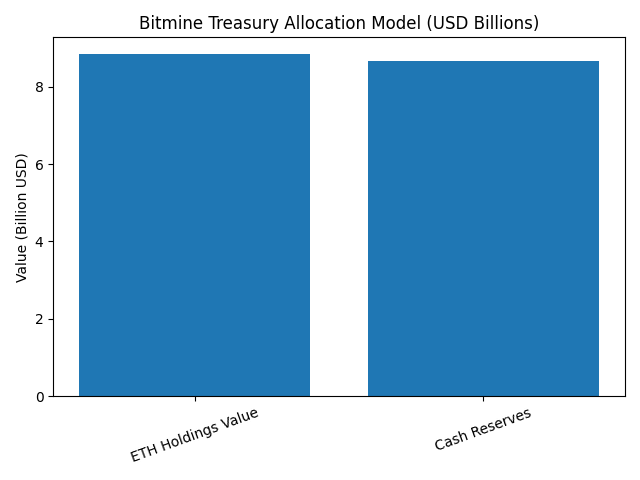
The chart should display:
- Total ETH holdings: 4,473,587 ETH
- Staked ETH: 3,040,000 ETH
- Cash reserves: $8.68B
- Total assets: $9.9B
- Target: 5% of ETH supply
This visual reinforces the hybrid treasury + infrastructure strategy.
Conclusion: A High-Conviction Ethereum Infrastructure Bet
Bitmine’s weekly accumulation strategy—despite expanding unrealized losses—reflects one of the most aggressive institutional Ethereum bets in crypto history.
Rather than reacting to volatility, the company appears to be:
- Compressing long-term supply
- Converting mining capital into yield-bearing ETH
- Building validator infrastructure
- Anticipating AI-integrated on-chain settlement
For readers seeking new crypto assets, yield strategies, or practical blockchain exposure, Bitmine’s model offers a blueprint for a new type of treasury company:
Not just holding crypto—but becoming part of the network itself.
Whether this becomes visionary or overextended will depend on:
- Ethereum adoption trajectory
- Institutional participation
- Regulatory clarity
- AI-driven transaction growth
But one thing is clear:
The era of passive crypto treasuries is evolving into active, infrastructure-driven digital capital strategies.