
Main Points :
- Digital asset investment products recorded $1.06 billion in net inflows, ending five consecutive weeks of $4 billion in total outflows.
- Bitcoin ETFs led the recovery, while short-Bitcoin products also saw inflows, reflecting divided market sentiment.
- Ethereum experienced its largest inflow since mid-January.
- U.S. investors returned aggressively after weeks of capital flight.
- Whale accumulation and technical chart dynamics appear to be driving renewed positioning.
- Institutional appetite is shifting from defensive reduction toward strategic re-entry.
A Critical Turning Point in Institutional Crypto Flows
According to CoinShares’ latest weekly report, digital asset investment products recorded approximately $1.06 billion in net inflows last week, marking the first positive week after five consecutive weeks of cumulative outflows totaling nearly $4 billion.
This reversal is more than just a statistical bounce. For market participants seeking the next cycle of opportunity — whether through Bitcoin exposure, emerging altcoins, structured products, or ETF-based strategies — this shift represents a potential inflection point in institutional sentiment.
For weeks, capital had steadily exited crypto investment vehicles amid macro uncertainty, regulatory caution, and technical breakdowns in price charts. However, recent developments suggest that sophisticated investors are now repositioning rather than retreating.
[Weekly Digital Asset Investment Flows]
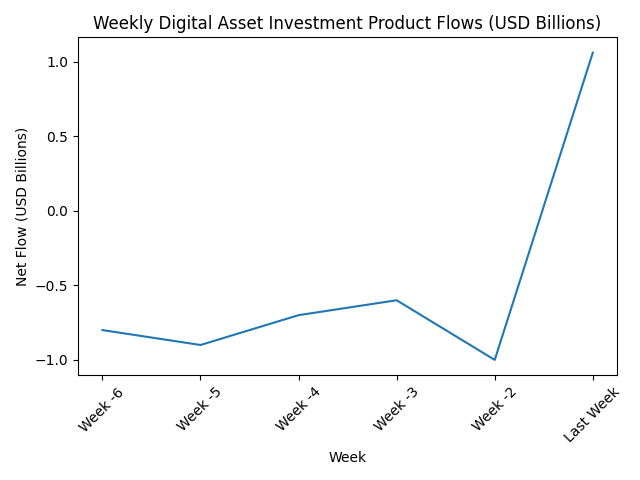
The chart illustrates five consecutive weeks of net outflows followed by a sharp reversal into positive territory. Such structural reversals often precede broader price stabilization or recovery phases.
Why Did Flows Turn Positive?
1. Market Weakness Created Accumulation Opportunity
CoinShares’ Head of Research, James Butterfill, noted that recent market softness likely provided attractive entry points. Historically, large holders — often referred to as “whales” — accumulate during price weakness rather than strength.
On-chain data across multiple analytics providers in recent weeks has shown increased wallet accumulation among large Bitcoin holders. This aligns with ETF inflows, suggesting that both direct and structured exposure are being rebuilt simultaneously.
For investors seeking yield or directional exposure, this is important: institutional capital typically leads rather than follows retail speculation.
2. Technical Chart Factors
Butterfill also pointed to technical analysis factors. In crypto markets, technical breakouts, support retests, and momentum reversals often trigger algorithmic and institutional reallocation.
When multi-week outflows coincide with price stabilization at key support zones, systematic funds may interpret that as reduced downside risk. The shift from persistent outflows to inflows suggests that certain technical thresholds were reached.
This type of rotation is common before volatility compression phases — periods that frequently precede major directional moves.
3. Whale Accumulation Resumes
Large Bitcoin holders appear to have resumed buying activity. Whale accumulation has historically preceded supply tightening events.
With Bitcoin ETF structures absorbing spot supply and long-term holders reducing liquid supply, even modest capital inflows can have outsized price impact.
For readers exploring future revenue opportunities, this structural tightening may create asymmetrical risk-reward setups in both BTC and correlated high-beta assets.
Bitcoin Leads — But With Divided Sentiment
Bitcoin investment products led the inflows. However, notably, short-Bitcoin investment vehicles also recorded net inflows.
This signals that while capital is returning, conviction remains split.
Some investors are positioning for recovery. Others are hedging against further downside. This divergence often occurs during transitional market phases.
For sophisticated traders, such divergence frequently creates volatility — and volatility creates opportunity.
[Asset-Specific Weekly Flows]
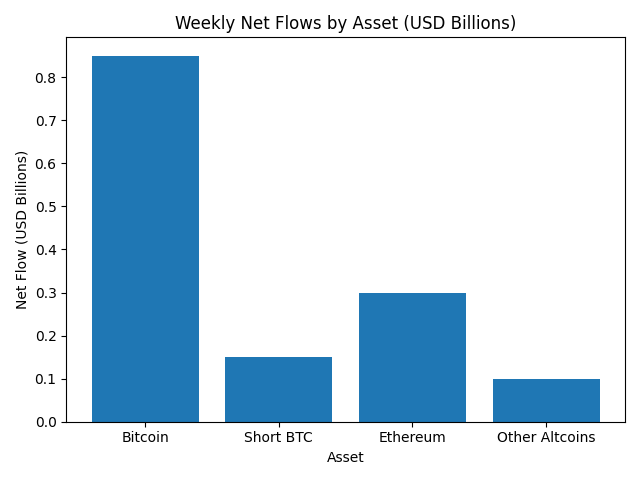
Bitcoin drove the majority of inflows, followed by Ethereum. Short-Bitcoin products also attracted capital, while altcoins saw moderate positive flows.
Ethereum Sees Strongest Inflow Since January
Ethereum investment products recorded their largest inflow since mid-January.
This development is particularly important for those exploring practical blockchain applications and revenue generation models.
Ethereum remains the backbone of DeFi, tokenized real-world assets (RWAs), stablecoin issuance, and smart contract infrastructure. Renewed institutional inflow into ETH products suggests confidence not only in price recovery but in broader ecosystem utility.
Recent developments in staking ETFs, Layer-2 scaling adoption, and tokenization initiatives by major financial institutions have reinforced Ethereum’s relevance in institutional portfolios.
U.S. Investors Return
Country-level data showed that the United States recorded the largest inflows after weeks of dominant outflows.
This is significant.
U.S.-listed Bitcoin ETFs remain a primary channel for institutional capital access. When U.S. flows reverse, it often signals broader macro repositioning.
Recent macro stabilization — including moderating interest rate expectations and improved risk appetite — may be reducing the urgency of capital flight.
For global investors, U.S. ETF flow trends often serve as a leading indicator of global crypto allocation cycles.
Broader Industry Context: ETF Maturation and Institutional Integration
Beyond the weekly flow data, broader industry developments support the thesis that crypto integration into traditional finance is deepening.
Recent months have seen:
- Expansion of spot Bitcoin ETF offerings.
- Increased tokenization initiatives by major asset managers.
- Growth in regulated stablecoin frameworks.
- Continued adoption of blockchain infrastructure by banks and fintech firms.
Institutional infrastructure is no longer experimental. It is operational.
As such, capital flow reversals are occurring within a more mature ecosystem than previous cycles.
What This Means for Investors Seeking New Opportunities
For readers searching for:
- New digital asset exposure
- Yield generation strategies
- Blockchain-based business integration
- Institutional-aligned positioning
This inflow reversal suggests three potential strategic themes:
1. Accumulation During Institutional Repositioning
If whale and ETF accumulation continues, early-stage positioning may offer favorable risk-adjusted setups.
2. Ethereum and Infrastructure Plays
Renewed ETH inflows could extend to Layer-2 ecosystems, staking infrastructure, and tokenized asset platforms.
3. Volatility-Based Strategies
Split sentiment between long and short Bitcoin products implies potential for volatility expansion strategies.
Year-to-Date Perspective: Caution Remains
Despite the positive week, year-to-date flows for Bitcoin and Ethereum products remain negative.
This suggests that the market is not yet in full bullish mode.
Instead, we may be witnessing the early stages of rebalancing after defensive de-risking.
Such environments often reward disciplined allocation rather than emotional speculation.
Conclusion: A Structural Shift, Not Just a Weekly Bounce
The $1.06 billion inflow into digital asset investment products represents more than a temporary reversal.
It signals:
- Institutional capital re-engagement.
- Whale accumulation returning.
- Technical stabilization.
- U.S. investor participation resuming.
- Ethereum infrastructure confidence strengthening.
For investors seeking the next revenue cycle or blockchain integration opportunity, this shift warrants close attention.
While risks remain and sentiment is still divided, the structural foundation of institutional crypto markets is stronger than in previous cycles.
If inflows persist, this week may be remembered as the beginning of a broader repositioning phase.
Capital is no longer simply exiting.
It is reallocating.
And where capital reallocates, opportunity follows.