Main Points :
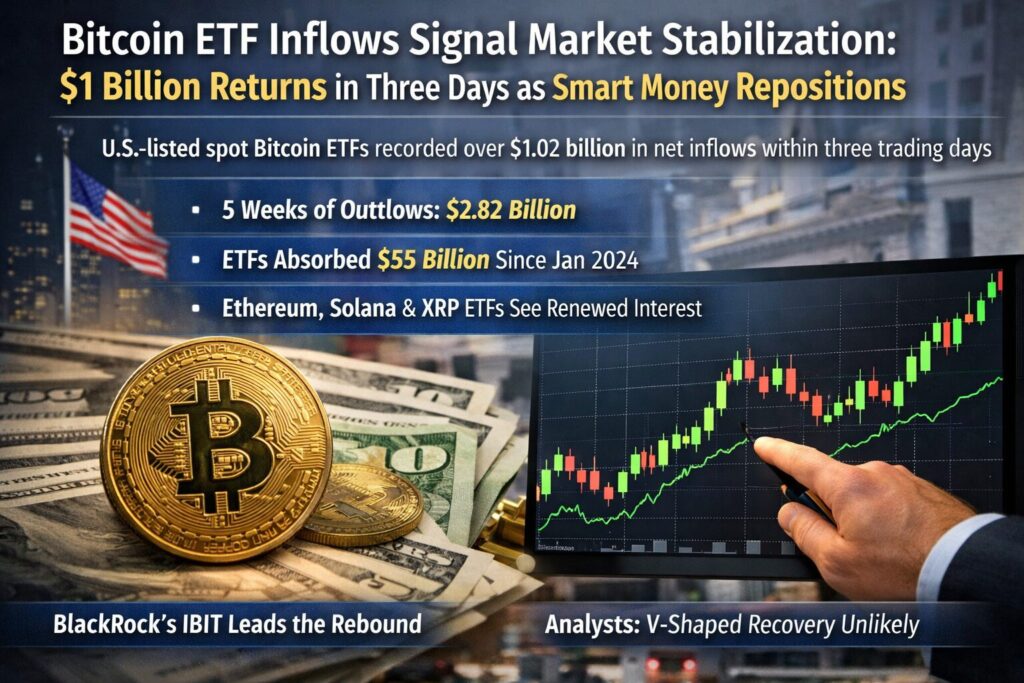
- U.S.-listed spot Bitcoin ETFs recorded over $1.02 billion in net inflows within three trading days
- This reversal follows five consecutive weeks of outflows totaling $2.82 billion
- Since Bitcoin’s October peak, approximately $6.5 billion exited ETFs, yet this is minor compared to $55 billion absorbed since January 2024
- BlackRock’s IBIT led the rebound, while Ethereum, Solana, and XRP ETFs also saw renewed interest
- Analysts suggest ETF flows may signal easing sell pressure, though a sharp V-shaped recovery remains unlikely
- The development may mark a structural shift toward long-term institutional positioning
A Sudden Reversal in ETF Capital Flows
In a significant shift in market dynamics, U.S.-listed spot Bitcoin exchange-traded funds (ETFs) attracted more than $1.02 billion in net inflows over just three trading days this week. The turnaround comes despite Bitcoin trading roughly 50% below its previous all-time high, suggesting that institutional and ETF-based investors may be entering accumulation mode.
According to data from SoSoValue, the inflows occurred from Tuesday through Thursday, reversing what had been a persistent five-week streak of capital withdrawals. In the final two weeks of January alone, approximately $2.82 billion exited Bitcoin ETFs. The recent reversal therefore represents a decisive break in trend.
ETF analyst Nate Geraci commented that investors appear to be “buying the dip.” Since Bitcoin’s early October peak, about $6.5 billion has flowed out of spot Bitcoin ETFs. However, compared to the approximately $55 billion in cumulative inflows absorbed by the category since January 2024, the recent outflow represents a modest adjustment rather than structural capitulation.
For seasoned Bitcoin investors, a 50% drawdown is historically within expectations. What is notable is that even newer investors who entered via ETFs appear relatively unfazed.
Chart Insertion – Bitcoin 3-Day ETF Inflows
[btc_spot_etf_3day_inflows.png]
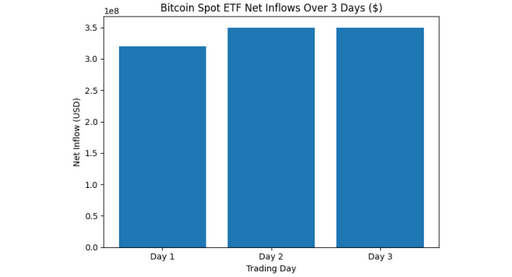
This chart illustrates the aggregated $1.02 billion inflow over three trading sessions.
BlackRock Leads the Charge, Altcoins Follow
The inflow rebound was primarily driven by BlackRock’s iShares Bitcoin Trust (IBIT), which alone recorded approximately $275.82 million in net inflows on Thursday. Although Fidelity’s FBTC and ARK 21Shares’ ARKB experienced outflows, those were more than offset by gains in Bitwise’s BITB and Grayscale’s BTC products.
Interestingly, capital rotation was not limited to Bitcoin.
Spot Ethereum ETFs recorded approximately $173 million in net inflows during the same three-day period. Solana ETFs attracted around $35 million, while XRP ETFs saw about $7 million in inflows. Though smaller in magnitude, these figures indicate that investors are broadening exposure beyond Bitcoin.
This suggests two important dynamics:
- Institutional capital is returning cautiously.
- Investors are beginning to diversify across multiple Layer-1 ecosystems.
Chart Insertion – Altcoin ETF Inflows
[altcoin_etf_inflows.png]
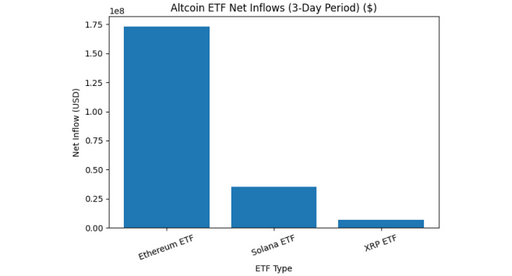
This chart summarizes ETF inflows across Ethereum, Solana, and XRP.
Are We Near the End of the 50% Correction?
Several analysts have argued that Bitcoin’s roughly 50% correction may be approaching exhaustion. Jeff Ko, Chief Analyst at CoinEx, noted that improving ETF inflows may indicate diminishing aggressive sell pressure. However, he cautioned that a sharp V-shaped recovery remains unlikely following such a significant correction.
Andri Fauzan Azima, Head of Research at Bitrue, pointed to technical indicators showing oversold conditions. Sustained ETF inflows, he argued, could serve as a stabilizing catalyst.
Historically, Bitcoin drawdowns of 40–60% have often preceded new accumulation phases. The key difference this cycle is the presence of regulated ETF structures, which now function as transparent sentiment indicators.
Chart Insertion – Bitcoin Drawdown & Stabilization
[bitcoin_drawdown_stabilization.png]
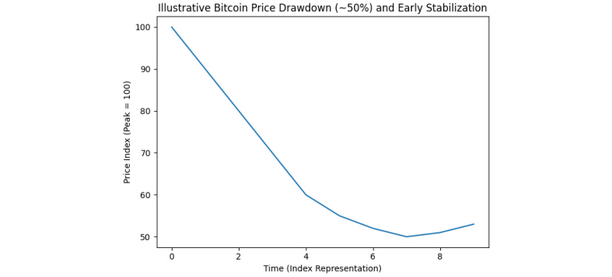
This chart provides an illustrative representation of a 50% drawdown followed by early stabilization.
ETF Flows as a Market Psychology Indicator
ETF capital movements increasingly serve as a proxy for institutional sentiment. Unlike retail spot flows, ETF transactions are reported daily and represent regulated exposure.
When outflows accelerate, it typically signals risk-off positioning. Conversely, renewed inflows during weakness suggest strategic accumulation.
The $1.02 billion inflow over three days may therefore indicate:
- Reduced forced selling
- Portfolio rebalancing into digital assets
- Institutional confidence in long-term Bitcoin positioning
Importantly, the $6.5 billion outflow since October is small relative to the $55 billion accumulated since ETF approval. This implies that the majority of institutional holders remain intact.
Implications for Investors Seeking New Crypto Opportunities
For readers focused on discovering new assets, revenue opportunities, and practical blockchain use cases, several strategic takeaways emerge:
1. Institutional Capital Provides Structural Support
Spot ETFs represent long-duration capital rather than speculative short-term flows. Their presence may reduce extreme volatility over time.
2. Altcoin ETF Momentum Signals Diversification
Ethereum, Solana, and XRP inflows suggest institutional curiosity beyond Bitcoin. This may accelerate development funding, DeFi activity, and enterprise blockchain integrations.
3. Accumulation Phases Favor Builders
Market stabilization periods historically coincide with ecosystem growth. Developers and entrepreneurs often launch infrastructure projects during downturns.
4. Yield Opportunities May Re-Emerge
If ETF inflows continue, capital may rotate into staking, real-world asset tokenization, and yield-generating protocols.
Broader 2026 Trends: Where Institutional Crypto Is Headed
Beyond ETF flows, several structural developments are shaping the digital asset landscape:
- Growing stablecoin integration into traditional finance
- Increasing tokenization of real-world assets
- Institutional custody infrastructure expansion
- Cross-border settlement experimentation using blockchain rails
- Regulatory clarity in multiple jurisdictions
ETF adoption has effectively normalized Bitcoin exposure within traditional portfolio frameworks. Pension funds, RIAs, and family offices now access Bitcoin without custody complexity.
This structural integration differentiates the current cycle from previous retail-driven bull markets.
Conclusion: Stabilization, Not Euphoria
The $1.02 billion inflow into U.S. spot Bitcoin ETFs over three days may not signal an immediate bull market resumption. However, it strongly suggests that aggressive selling pressure is moderating.
The fact that Bitcoin remains approximately 50% below its previous high while institutions are accumulating indicates confidence in long-term value.
For investors seeking new crypto opportunities, the current environment resembles a transition phase:
- Excess leverage appears flushed.
- Institutional positioning is rebuilding.
- Altcoin ecosystems are receiving renewed interest.
- Structural blockchain adoption continues.
Rather than a speculative frenzy, this moment reflects measured capital deployment.
If ETF inflows remain sustained in the coming weeks, this period may ultimately be remembered not as the end of a rally, but as the foundation of the next one.