Main Points :
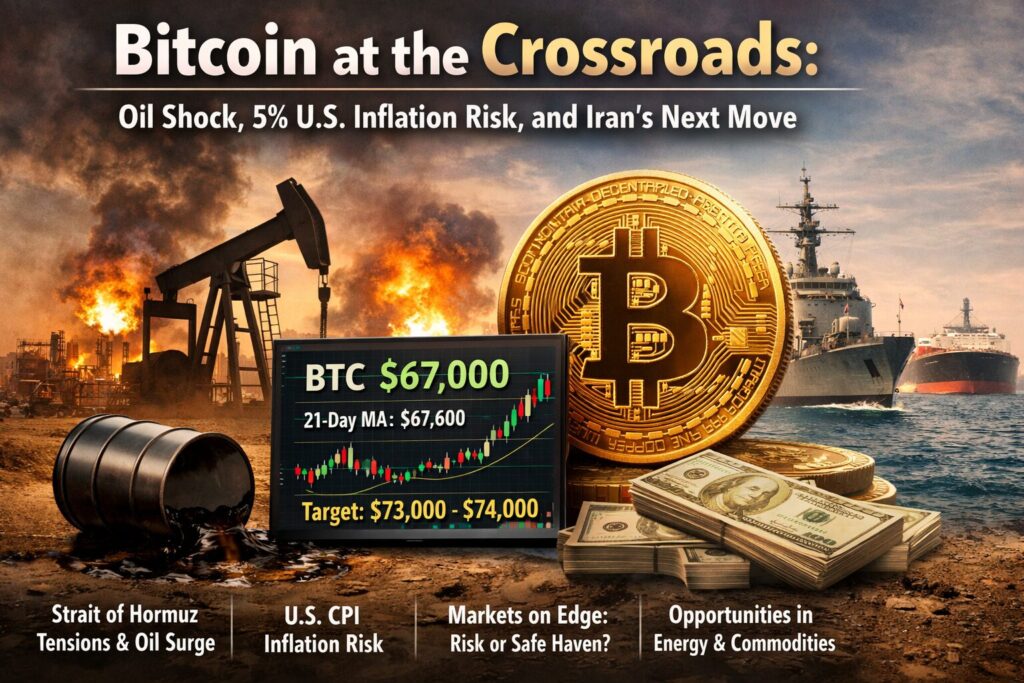
- Bitcoin is consolidating around $67,000 despite heightened geopolitical tensions in the Middle East.
- Traders are watching whether BTC can reclaim the 21-day moving average near $67,600 and target $73,000–$74,000.
- Concerns over a potential closure of the Strait of Hormuz are driving oil volatility.
- Research cited by JPMorgan suggests U.S. CPI could spike toward 5% if oil prices surge.
- The reaction of traditional markets may determine whether Bitcoin acts as a risk asset or a hedge against inflation and capital flight.
- Derivatives positioning suggests both caution and upside optionality in the short term.
- For crypto investors, volatility may create asymmetric entry opportunities in BTC and selected altcoins tied to energy, commodities, and real-world asset tokenization.
1. Bitcoin Stabilizes Near $67,000 Amid Geopolitical Turbulence
Over a volatile weekend marked by rising tensions in the Middle East, Bitcoin (BTC) surprised many traders by holding firm near $67,000. While geopolitical headlines often trigger sharp liquidations in risk assets, BTC’s price action remained relatively contained.
According to data from TradingView, BTC/USD consolidated around the mid-$67,000 range following brief spikes in volatility. U.S. equity futures opened approximately 0.65% lower, signaling cautious sentiment in traditional finance (TradFi). Yet Bitcoin avoided a dramatic breakdown.
Some analysts interpret this as a sign of maturity. In previous cycles, geopolitical stress events often triggered double-digit percentage drawdowns in crypto markets. This time, the reaction was swift but short-lived.
Michael van de Poppe, a well-known crypto analyst, described the initial market reaction as “positive,” emphasizing that much depends on how U.S. markets open and whether Bitcoin can reclaim its 21-day simple moving average near $67,627. He noted that for a relief rally to materialize, BTC must sustain a move above that level and potentially form a higher low pattern on the daily chart.
Another trader, BitBull, highlighted that resistance appears to be flipping into support on higher timeframes. He suggested that a rebound toward $73,000–$74,000 remains plausible if the support structure holds.
This technical structure suggests that markets may have partially priced in geopolitical risk ahead of time.
2. The Strait of Hormuz and Oil’s Inflation Shock
The bigger macro risk lies not in immediate price volatility, but in oil.
The Strait of Hormuz is one of the world’s most critical energy chokepoints. Roughly 20% of global oil supply passes through this narrow waterway connecting the Persian Gulf to global markets.
Reports that Iran is considering measures affecting shipping traffic have intensified fears of supply disruption. Even the perception of potential blockage can drive oil prices sharply higher.
Investment research outlet The Kobeissi Letter cited analysis from JPMorgan Chase, suggesting that if oil prices spike significantly, U.S. inflation (CPI) could rise toward 5%. The last time U.S. CPI approached that level was in March 2023, during the Federal Reserve’s aggressive tightening cycle.
To understand the inflation implications, we must examine historical CPI data.
[U.S. CPI 12-Month Change (%)]
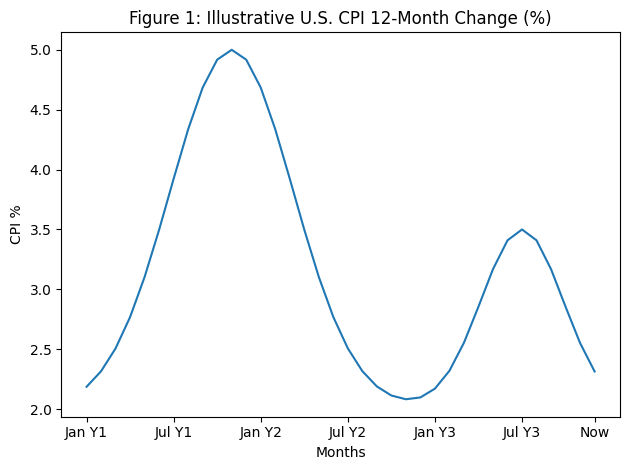
The chart illustrates the previous inflation peak near 5% and subsequent moderation before the current renewed risks.
If oil moves substantially higher, gasoline prices would feed directly into headline CPI. This could reverse the recent disinflationary trend and complicate Federal Reserve policy decisions.
3. Inflation at 5%: What It Means for Bitcoin
Bitcoin’s relationship with inflation has evolved.
In 2020–2021, BTC was widely promoted as “digital gold,” an inflation hedge. However, in 2022–2023, Bitcoin traded more like a high-beta tech stock, falling alongside equities as interest rates rose.
If CPI accelerates back toward 5%, several scenarios emerge:
- Hawkish Fed Response:
If the Federal Reserve signals renewed tightening, liquidity conditions would worsen. Historically, tight liquidity pressures crypto prices in the short term. - Policy Hesitation Due to Growth Concerns:
If policymakers fear recession risks, they may tolerate higher inflation. In that case, Bitcoin could benefit as a store-of-value narrative regains traction. - Capital Flight Hedge:
In regions directly impacted by geopolitical stress, Bitcoin may act as a capital mobility tool.
The dual identity of Bitcoin—as both risk asset and macro hedge—creates a dynamic tension.
4. Derivatives Market Signals
Futures markets show evidence of short-term caution. CME Bitcoin futures gaps around $65,880 remain open, which historically tend to be revisited. Some traders are watching that level as a magnet for price action.
Options markets indicate growing interest in upside call positions. This suggests that while traders are hedging downside risk, they are also positioning for a volatility-driven breakout.
This asymmetry—defensive hedging plus upside optionality—often precedes significant moves.
5. TradFi Reaction: The Missing Variable
Because the geopolitical escalation occurred over the weekend, traditional markets could not fully price the event in real time. Monday’s equity and bond market reaction will likely determine short-term crypto direction.
If oil surges and equities sell off aggressively, Bitcoin may initially correlate downward. However, if the move stabilizes and inflation fears dominate, BTC could decouple.
This pattern has historical precedent: during certain crisis phases, Bitcoin transitions from speculative risk asset to capital flight instrument.
6. Opportunities Beyond BTC: Energy, RWA, and Infrastructure Tokens
For investors seeking new revenue streams, volatility is not merely a threat—it is an opportunity.
Several thematic sectors could benefit:
- Energy-Linked Crypto Projects:
Protocols integrating renewable energy credits or decentralized energy trading. - Real-World Asset (RWA) Tokenization:
Commodities, oil-linked products, and treasury instruments tokenized on-chain. - Infrastructure Plays:
Layer-1 and Layer-2 networks that benefit from increased trading activity.
Macro volatility often increases on-chain activity, derivatives volume, and DeFi utilization.
7. Practical Blockchain Use Cases in an Inflationary Environment
In a scenario where oil-driven inflation resurfaces:
- Stablecoins may see increased demand for cross-border settlement.
- On-chain treasury management tools could gain institutional interest.
- Tokenized commodities may serve as accessible hedging instruments.
For developers and builders, this environment reinforces the importance of infrastructure resilience, compliance-ready systems, and scalable DeFi rails.
8. Technical Outlook: $67,600 as the Pivot
From a technical standpoint:
- Immediate resistance: $67,600 (21-day MA)
- Gap level: $65,880
- Upside target: $73,000–$74,000
If Bitcoin reclaims and holds above the 21-day moving average, bullish momentum may accelerate.
[BTC/USD Daily Chart with 21-Day MA and Key Levels]
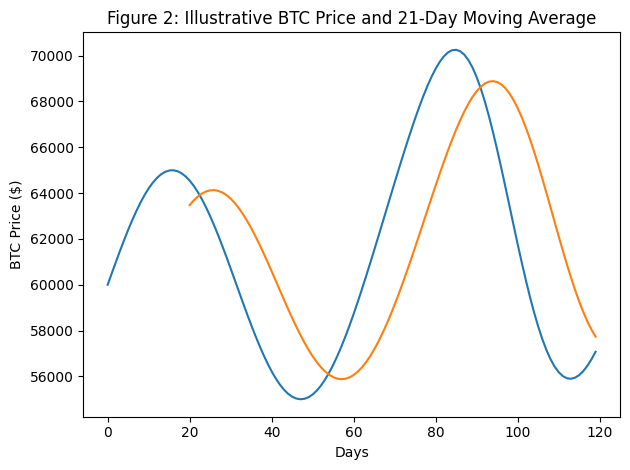
A sustained breakout above $74,000 would likely invalidate short-term bearish structures.
9. Conclusion: Between Oil Shock and Digital Resilience
Bitcoin stands at a macro crossroads.
Oil volatility tied to Middle Eastern tensions, especially around the Strait of Hormuz, introduces real inflation risk. A potential U.S. CPI rebound toward 5% would significantly reshape Federal Reserve expectations and liquidity conditions.
Yet Bitcoin’s stability near $67,000 suggests that markets may already be partially pricing this uncertainty.
For investors:
- Short-term volatility is likely.
- Medium-term direction hinges on inflation trajectory and Fed response.
- Long-term structural adoption continues.
In an era where geopolitical shocks intersect with digital asset maturation, Bitcoin’s evolving identity—as risk asset, inflation hedge, and capital mobility tool—will be tested again.
For those searching for new crypto assets, revenue streams, or practical blockchain applications, the current environment is not merely about price—it is about positioning within structural transformation.