
Main Points :
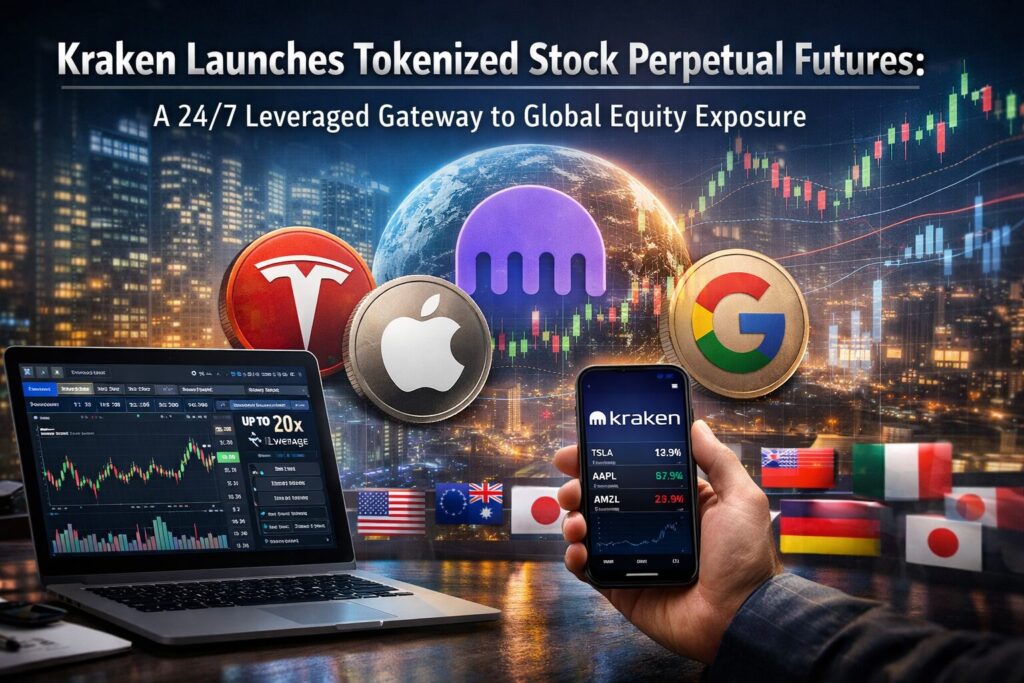
- Kraken has launched tokenized stock perpetual futures for non-U.S. customers, offering up to 20x leverage and 24/7 trading.
- Contracts reference blockchain-based tokenized stock benchmarks built using the xStocks framework.
- The product is available in over 110 countries and represents a first in regulated derivatives markets.
- Kraken previously agreed to acquire Backed Finance AG, the issuer behind xStocks.
- The move reflects a broader trend: crypto exchanges expanding into traditional equity and derivatives markets.
- Competitors including Gemini and Coinbase are accelerating tokenized stock and integrated equity trading offerings.
- The convergence of blockchain and traditional finance is reshaping access, liquidity, and global capital flows.
Kraken Introduces Tokenized Stock Perpetual Futures
Kraken has launched tokenized stock perpetual futures on its derivatives platform, allowing eligible non-U.S. clients to gain leveraged exposure to major U.S. equity indices, gold, and individual stocks such as NVIDIA, Apple, and Tesla.
Unlike traditional equity futures contracts that have expiration dates, these instruments are structured as perpetual futures — meaning they have no maturity. Traders can hold positions indefinitely, subject to funding rates and margin requirements.
Kraken describes the product as the first regulated-market listed tokenized stock perpetual futures offering. It is available in more than 110 countries but explicitly excludes U.S. customers.
The contracts do not represent direct ownership of underlying equities. Instead, they reference blockchain-issued tokenized stock benchmarks created under the xStocks framework.
This distinction is crucial: traders are not buying shares, nor are they holding synthetic depository receipts. They are trading a derivative instrument whose reference price is derived from tokenized representations of real-world stocks.
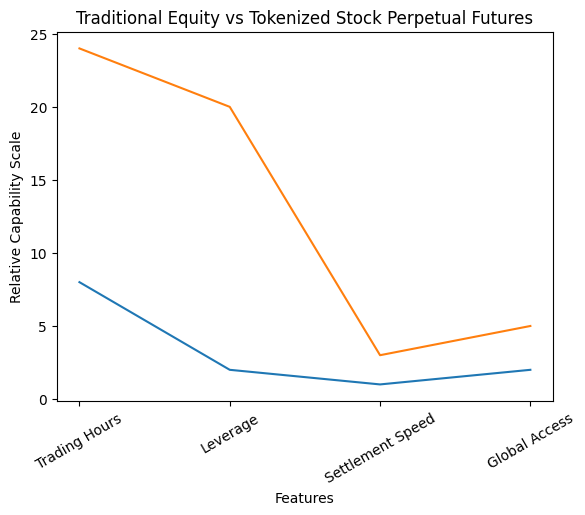
Title: Structural Comparison – Traditional Equity Trading vs Tokenized Stock Perpetual Futures
The xStocks Framework and Blockchain Infrastructure
Kraken’s product leverages the xStocks framework, developed by Backed Finance AG — a firm Kraken agreed to acquire in December.
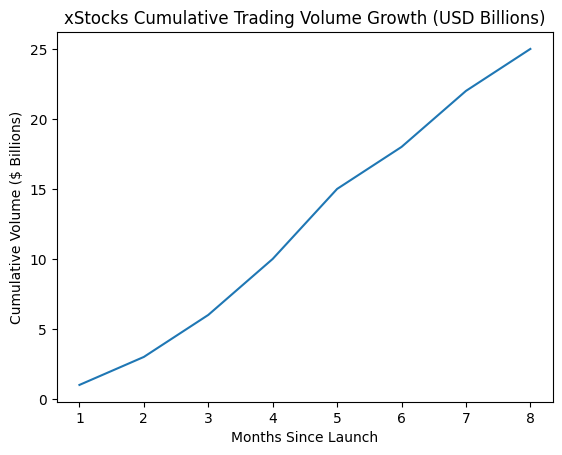
Recently, Kraken announced that cumulative xStocks trading volume surpassed $25 billion in less than eight months since launch.
This milestone signals accelerating demand for tokenized equity exposure.
Title: Growth of xStocks Cumulative Trading Volume (Launch to $25B Milestone)
Tokenized stocks represent blockchain-based instruments that mirror the price of publicly listed equities or ETFs. While not the underlying shares themselves, they provide programmable, borderless access to traditional market exposure.
By combining tokenization with perpetual futures, Kraken effectively adds:
- 24/7 trading
- Leverage up to 20x
- Crypto-native collateral
- Global accessibility outside U.S. jurisdiction
This structure merges the flexibility of crypto derivatives with the economic exposure of equities.
Expanding into Traditional Financial Markets
Kraken’s move reflects a broader structural shift.
In May of last year, Kraken acquired NinjaTrader for approximately $1.5 billion, expanding its access to traditional derivatives markets regulated under the Commodity Futures Trading Commission.
Four months later, in September, Kraken expanded tokenized stock offerings in Europe through Backed’s xStocks, targeting qualified investors.
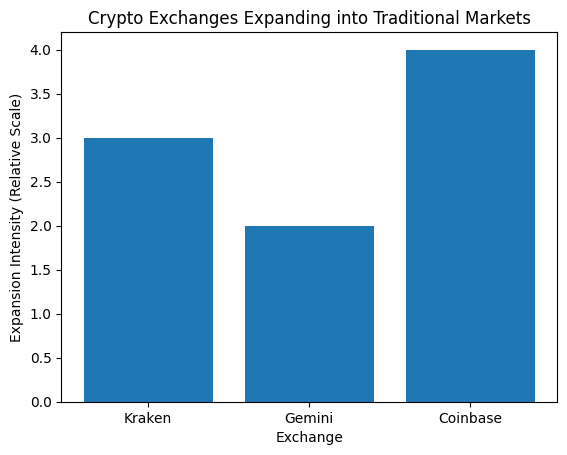
The pattern is clear: major crypto exchanges are not retreating — they are converging with traditional finance.
Competitive Landscape: Gemini and Coinbase
Kraken is not alone.
In June, Gemini, founded by the Winklevoss twins, launched tokenized shares of Strategy (formerly MicroStrategy) for EU users. The following month, it expanded the lineup to include tokenized versions of U.S.-listed companies such as BlackRock, Visa, American Express, Sony, Broadcom, Prologis, and Caterpillar.
Meanwhile, Coinbase — the largest U.S. crypto exchange by spot volume — announced zero-commission stock and ETF trading for U.S. customers. Users can now purchase equities alongside digital assets within a single app.
Coinbase positions this as part of its “all-in-one financial app” strategy.
This signals something important: tokenization and integration are becoming competitive necessities.
Title: Strategic Convergence – Crypto Exchanges Expanding into Traditional Markets
Why This Matters for Investors Seeking New Yield and Opportunities
For readers searching for new crypto assets, alternative income streams, or practical blockchain use cases, this development is significant.
Here’s why:
1. 24/7 Global Equity Access
Traditional equity markets operate on fixed schedules. Tokenized perpetual futures allow exposure around the clock, including weekends and holidays.
This reduces geographic arbitrage limitations and enables risk management during off-hours volatility events.
2. Leverage on Traditional Assets
Crypto traders are accustomed to leverage. Bringing up to 20x leverage to stock exposure introduces higher capital efficiency — but also amplified risk.
For active traders, this creates new strategies:
- Pair trades between crypto and equities
- Hedging tech-stock exposure with BTC positions
- Volatility arbitrage between Nasdaq and crypto markets
3. Capital Efficiency and Cross-Margining
If integrated properly, crypto collateral can back equity exposure.
This is powerful for capital rotation:
BTC gains → collateral → equity exposure → derivatives yield strategies.
4. Tokenization as Infrastructure
Beyond speculation, tokenized stocks demonstrate real-world asset (RWA) tokenization in action.
This infrastructure can extend to:
- Bonds
- Private equity
- Real estate
- Commodities
The tokenized stock market may be the testing ground for much larger capital migration.
Risks and Regulatory Considerations
While promising, risks remain:
- Regulatory fragmentation
- Jurisdictional restrictions (not available to U.S. clients)
- Counterparty risk
- Funding rate volatility in perpetual markets
- Liquidity concentration risk
Furthermore, these instruments are derivatives — not equities. Investors do not receive voting rights or dividends directly.
Risk management remains essential.
Macro Context: The Tokenization Megatrend
Recent industry data shows:
- Growing institutional RWA tokenization initiatives
- Stablecoin market capitalization expansion
- Increased interest in blockchain settlement rails
Major asset managers are exploring tokenized funds, and traditional financial institutions are testing on-chain settlement systems.
Kraken’s launch fits within this megatrend.
The long-term thesis: capital markets will increasingly migrate onto programmable infrastructure.
Conclusion: A Bridge Between Two Financial Worlds
Kraken’s tokenized stock perpetual futures represent more than a product launch.
They symbolize:
- The fusion of crypto derivatives and traditional equities
- The globalization of market access
- The emergence of 24/7 capital markets
- The practical application of tokenization at scale
For investors seeking new crypto-related yield opportunities, this development offers both speculative trading avenues and insight into where capital markets are heading.
Tokenization is no longer theoretical.
It is operational, leveraged, global — and accelerating.
The convergence of blockchain infrastructure and traditional finance is not a distant vision. It is unfolding now.



