
Main Points :
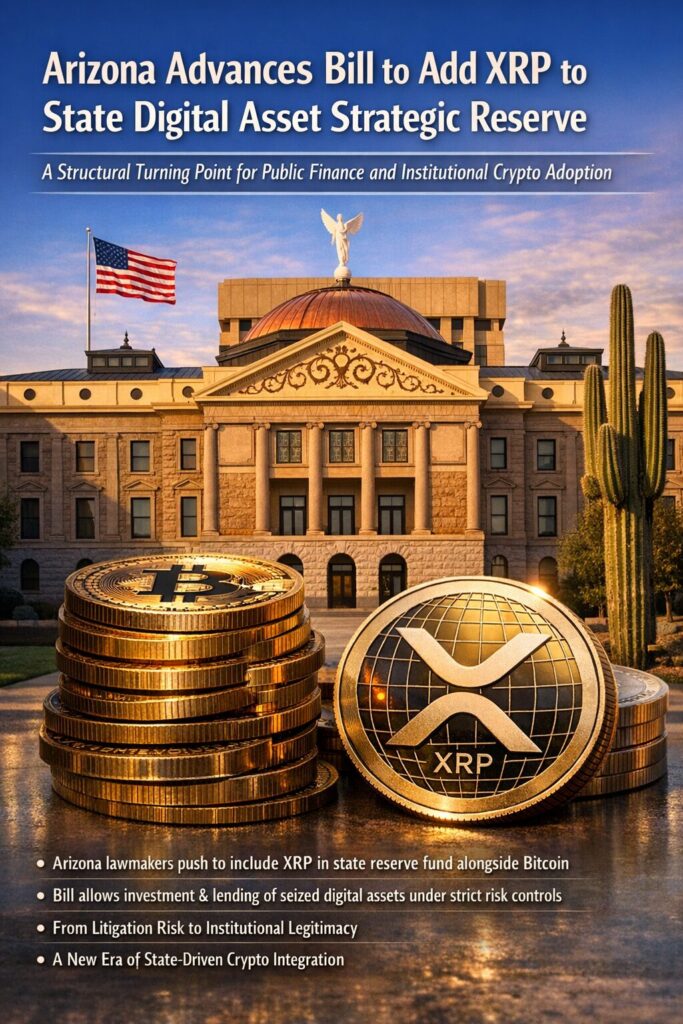
- Arizona lawmakers advanced a bill allowing XRP to be included in a state-managed Digital Asset Strategic Reserve Fund.
- The proposal places XRP alongside Bitcoin in a public finance framework.
- The bill allows investment and lending of seized digital assets under strict risk controls.
- This reflects broader U.S. state-level experimentation with structured digital asset exposure.
- The move signals a shift in narrative from litigation risk toward institutional legitimacy.
- For investors and blockchain professionals, this may mark a new phase of state-driven crypto integration.
1. A Landmark Moment: XRP Moves from Courtroom Debate to Public Treasury Framework
In a significant development for both cryptocurrency markets and public financial policy, the Arizona State Legislature has advanced a bill that would allow XRP to be included as an eligible asset in the state’s proposed Digital Asset Strategic Reserve Fund. The committee vote passed 4–2, pushing the bill further along the legislative process.
While not yet final, the advancement itself is notable. For years, XRP has existed in a regulatory gray zone, particularly due to legal proceedings between Ripple and the U.S. Securities and Exchange Commission. Now, at the state level, Arizona policymakers are not debating XRP’s legal status in abstract terms—they are considering it as part of a sovereign reserve framework.
This transition from litigation-centered narrative to fiscal integration represents a structural shift in how policymakers perceive digital assets.
2. Understanding the Digital Asset Strategic Reserve Fund
The proposed bill establishes a state-managed Digital Asset Strategic Reserve Fund designed to hold eligible digital assets obtained through lawful means such as seizure, forfeiture, legislative appropriation, or asset recovery.
The Arizona State Treasurer would oversee custody, management, and operation under defined statutory guidelines. Importantly, the bill authorizes:
- Investment of reserve-held digital assets
- Lending of digital assets to generate additional yield
- Strict safeguards preventing increased fiscal risk to the state’s general fund
Legislators have indicated that the measure is not expected to impact Arizona’s general fund directly.
By explicitly adding XRP alongside Bitcoin, the framework moves beyond a “Bitcoin-only” reserve model and signals diversification intent.
3. Why Explicitly Naming XRP Matters
In most legislative proposals concerning digital assets, language remains generic—referring to “cryptocurrencies” or “digital assets” without naming specific tokens.
Arizona’s decision to explicitly designate XRP is unusual and symbolically powerful.
This implies legislative acknowledgment of:
- Market liquidity
- Institutional relevance
- Established trading infrastructure
- Strategic role in cross-border payments
This move places XRP not as a speculative token but as a recognized component of financial infrastructure.
4. Market Context: XRP’s Position in the Broader Digital Asset Landscape
[XRP Historical Price Trend (USD)]
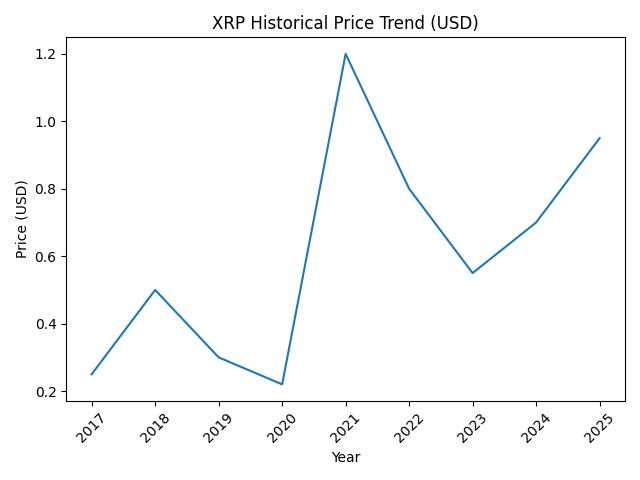
XRP has experienced substantial volatility over the past decade. From trading near $0.25 in 2017, peaking above $1.00 during bull cycles, and stabilizing around the $0.70–$0.95 range in recent periods, XRP remains one of the most liquid non-Bitcoin digital assets.
Despite regulatory headwinds, XRP consistently maintains:
- Top-tier exchange liquidity
- Deep global trading pairs
- Cross-border payment integration use cases
- Institutional corridor partnerships
Unlike purely speculative meme tokens, XRP’s primary narrative has centered on payment rails, settlement efficiency, and enterprise integration.
For state policymakers seeking digital assets with functional infrastructure use cases, XRP presents a differentiated profile compared to purely store-of-value narratives.
5. Broader U.S. State-Level Digital Asset Trend
[Growth in U.S. State Digital Asset Legislative Proposals]
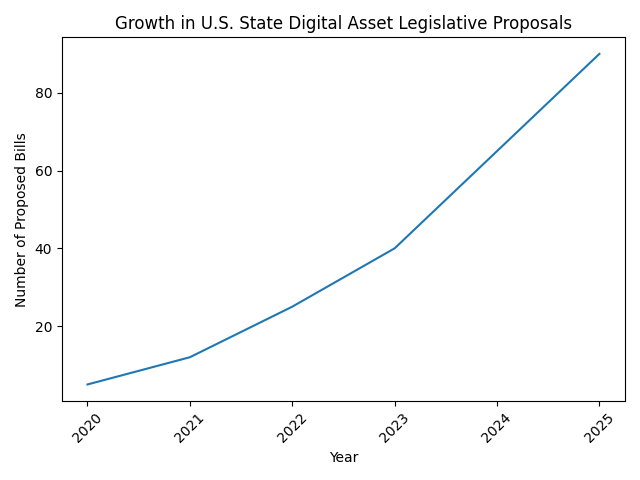
Arizona’s move is not isolated. Across the United States, state legislatures have increasingly introduced bills related to:
- Bitcoin reserves
- Digital asset custody frameworks
- Blockchain-based public record systems
- Crypto taxation policy
- Stablecoin experimentation
The number of state-level proposals has grown significantly over the past five years. This reflects a decentralization of policy experimentation: while federal regulation remains debated, states are actively designing localized frameworks.
Arizona, by advancing beyond conceptual discussion into actionable legislation, positions itself at the forefront of this experimentation.
6. Investment and Lending Mechanism: Yield Within Public Finance
One of the most structurally important components of the bill is authorization for digital asset lending to generate yield, provided it does not increase fiscal risk.
This mirrors institutional crypto treasury strategies in the private sector, where digital assets are not merely held passively but deployed to generate return.
For investors and blockchain operators, this signals something important:
Digital assets are increasingly being treated as productive capital, not just speculative inventory.
If state treasuries adopt structured yield strategies—secured lending, institutional-grade custody, collateralized frameworks—this could normalize crypto-based yield mechanisms within public finance.
7. Diversification Beyond Bitcoin: Strategic Implications
Most digital asset reserve discussions have centered on Bitcoin due to its monetary narrative and scarcity profile.
However, adding XRP suggests diversification based on:
- Transaction utility
- Network efficiency
- Liquidity depth
- Market maturity
This diversification may influence other states considering similar frameworks. Once a precedent is set naming specific assets, subsequent proposals may expand eligible lists.
For emerging projects, this sets a future benchmark: liquidity, regulatory clarity, and institutional integration will likely determine eligibility.
8. Narrative Shift: From Regulatory Risk to Institutional Recognition
For years, XRP’s identity was entangled with regulatory litigation.
Arizona’s proposal reframes XRP not as a regulatory question mark, but as a treasury candidate.
This does not eliminate federal uncertainty. The bill must still pass further votes and survive potential legal scrutiny. However, reaching this legislative stage indicates that policymakers view XRP as sufficiently mature for structured inclusion.
Narrative matters in markets.
When assets transition from controversy to institutional integration, capital perception shifts.
9. Implications for Crypto Investors and Builders
For readers seeking:
- New crypto assets with institutional upside
- Yield-generating opportunities
- Real-world blockchain application
This development suggests several structural themes:
- State-level adoption may precede federal clarity.
- Utility-driven tokens may gain institutional positioning.
- Yield frameworks are becoming normalized.
- Diversification beyond Bitcoin is accelerating.
Builders should note: compliance, transparency, and liquidity depth increasingly matter for public-sector engagement.
Investors should note: assets capable of surviving regulatory cycles may benefit disproportionately from institutional endorsement.
10. What Comes Next?
The bill still faces additional legislative stages. Amendments are possible. Political dynamics may shift.
However, the significance lies not only in passage probability—but in trajectory.
Digital assets are no longer niche experiments. They are entering the vocabulary of public treasury management.
Arizona’s move represents a prototype for how states might integrate crypto within structured fiscal governance.
Conclusion: A Structural Evolution in Public Finance
Arizona advancing XRP inclusion in a state Digital Asset Strategic Reserve Fund marks more than a local legislative action.
It signals:
- Institutional recognition of diversified digital assets.
- A shift from litigation-focused narratives to fiscal integration.
- Growing state-level experimentation with blockchain-based financial infrastructure.
- Movement toward treating digital assets as productive capital.
For the global crypto ecosystem, this may represent the early phase of sovereign-layer digital asset integration.
For XRP specifically, it marks a symbolic pivot—from courtroom argument to treasury asset candidate.
For investors and builders, the message is clear:
The infrastructure phase of crypto adoption is accelerating.



