
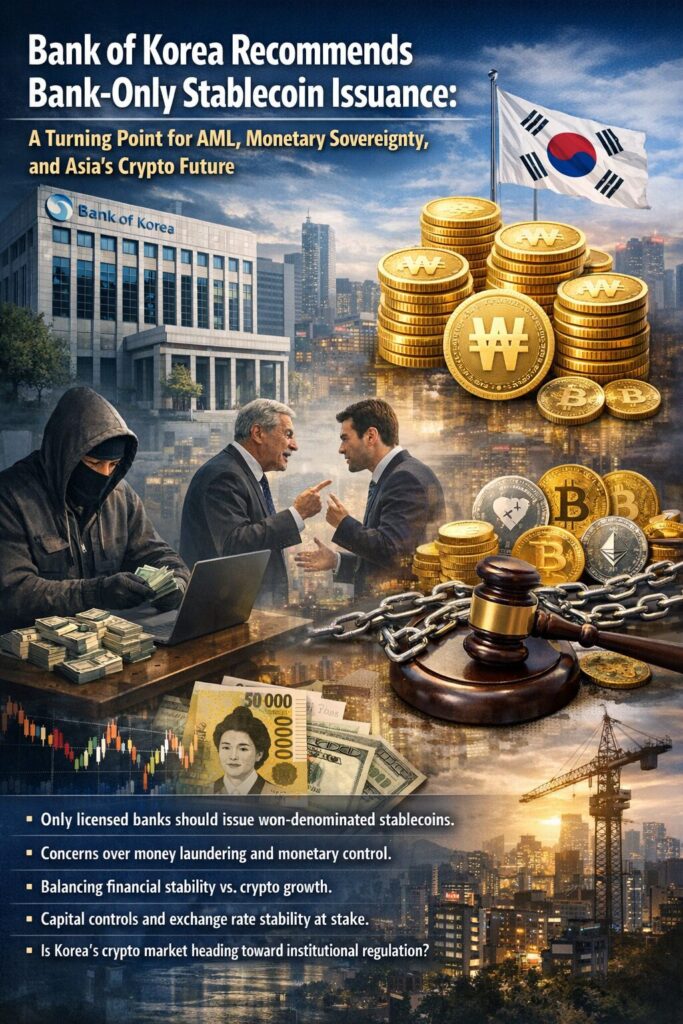
Main Points :
- The Bank of Korea (BOK) recommends that only licensed commercial banks issue Korean won–denominated stablecoins.
- The central bank warns that non-bank issuance could increase money laundering risks and undermine monetary policy.
- Korea’s long-standing principle of separating financial and industrial capital plays a central role.
- Capital controls and foreign exchange stability are major concerns.
- Political tension is emerging between growth-oriented crypto policy and financial stability priorities.
- The decision could determine whether Korea’s crypto market evolves into a regulated institutional ecosystem or remains retail-driven.
- The global stablecoin market continues expanding toward $180B+ capitalization, increasing regulatory urgency worldwide.
Introduction: Why Korea’s Stablecoin Decision Matters Globally
On February 23, 2026, the Bank of Korea (BOK) submitted a formal recommendation to members of the National Assembly urging that Korean won–denominated stablecoins be issued exclusively by licensed commercial banks. The proposal is not merely a technical regulatory adjustment. It represents a defining moment in the global debate over how digital currencies should coexist with sovereign monetary systems.
At stake is far more than compliance. The decision affects:
- Anti-Money Laundering (AML) enforcement
- Monetary policy transmission
- Capital control mechanisms
- The separation of industrial and financial capital
- The structure of Korea’s crypto ecosystem
As stablecoins increasingly function as settlement infrastructure rather than speculative instruments, Korea’s position may influence regulatory frameworks across Asia and beyond.
The Global Stablecoin Context: Rapid Expansion and Systemic Relevance
The global stablecoin market has expanded dramatically over the past six years, transforming from a niche crypto instrument into critical financial plumbing.
[Global Stablecoin Market Capitalization]
As illustrated, global stablecoin capitalization has grown from under $5 billion in 2019 to approximately $180 billion in 2025 (illustrative representation). Even after the 2022–2023 market contraction, stablecoins rebounded as institutions adopted them for:
- Cross-border settlement
- DeFi collateralization
- Remittance infrastructure
- Exchange liquidity provisioning
- On-chain treasury management
With daily transaction volumes often exceeding those of major card networks in certain blockchain ecosystems, regulators increasingly treat stablecoins as systemic financial instruments.
This global backdrop explains why the BOK’s recommendation carries weight far beyond Korea.
The Core Recommendation: Banks Only
The BOK’s central argument is straightforward: only licensed commercial banks should be allowed to issue won-backed stablecoins.
The reasoning is based on three pillars:
1. Full Redemption Capacity
Issuers must hold sufficient cash reserves to meet redemption demands at all times. Banks already operate under capital adequacy and liquidity ratio requirements, including:
- Basel III capital standards
- Liquidity Coverage Ratio (LCR)
- Net Stable Funding Ratio (NSFR)
Fintech and crypto firms, by contrast, may not be subject to equivalent prudential oversight.
2. AML Enforcement
AML controls remain one of the most significant regulatory concerns. Banks are already integrated into:
- Suspicious Transaction Reporting (STR) systems
- KYC frameworks
- Cross-border monitoring systems
- Sanctions screening protocols
Allowing non-bank issuance could create parallel payment rails outside robust AML oversight.
3. Monetary Policy Integrity
Stablecoins denominated in Korean won could weaken monetary policy transmission if they function outside the banking system. Central banks rely on commercial banks as transmission channels for interest rates and liquidity operations.
If large segments of digital payments migrate to non-bank stablecoins, monetary tools could lose effectiveness.
Institutional Integrity and the Separation Principle
Korea historically enforces strict separation between industrial capital and financial capital. This principle prevents large conglomerates (chaebols) or major technology companies from controlling banking functions.
The BOK warns that allowing non-bank firms to issue stablecoins could effectively let them operate as quasi-banks without full regulatory supervision.
This concern is not theoretical.
If a major technology platform issued a widely adopted won stablecoin, it could:
- Hold user deposits
- Process payments
- Facilitate lending through ecosystem finance
- Influence liquidity flows
Such a scenario could blur regulatory boundaries and create systemic concentration risks.
Capital Controls and Foreign Exchange Risk
Korea maintains relatively strict oversight over cross-border won flows. Banks must comply with foreign exchange reporting and capital movement regulations.
The BOK highlights a potential loophole:
If non-bank entities issue stablecoins that can move freely across blockchain networks, they might circumvent existing capital controls.
This raises concerns about:
- Rapid capital flight
- Currency volatility
- Exchange rate destabilization
- Reduced policy control during crises
[Capital Flow Volatility Scenario]
The illustrative chart compares volatility in controlled vs. uncontrolled capital flow environments. While hypothetical, it reflects the BOK’s fear that digital assets could amplify currency instability during stress events.
For a country exposed to export-driven economic cycles and geopolitical tensions, such volatility is not trivial.
Risk Control Comparison: Banks vs Non-Banks
The debate ultimately centers on comparative oversight strength.
[Risk Control Comparison]
The chart illustrates relative strength (hypothetical) in:
- Capital adequacy
- Liquidity buffers
- AML controls
- FX compliance
While fintech firms often innovate faster, banks remain structurally integrated into macroprudential supervision frameworks.
The BOK’s position is that stablecoins are too systemically important to experiment with lighter-touch oversight.
Political Friction: Growth vs Stability
President Lee Jae-myung’s administration has previously signaled openness toward broader crypto liberalization. However, recent market incidents—such as controversies surrounding domestic exchanges—have made deregulation politically sensitive.
The ruling party’s policy committee now faces a complex balancing act:
- Promote digital asset innovation and economic growth
- Maintain financial stability and monetary sovereignty
- Avoid public backlash over fraud or capital flight risks
The draft legislation expected this month will likely determine Korea’s crypto trajectory.
Two Possible Futures for Korea’s Crypto Ecosystem
Scenario A: Bank-Led Institutional Model
If the BOK recommendation prevails:
- Major Korean banks issue compliant won stablecoins.
- Integration with CBDC research accelerates.
- Institutional investors gain confidence.
- AML enforcement strengthens.
- Retail speculation declines relative to institutional adoption.
This could mirror regulated stablecoin frameworks emerging in the United States and the European Union.
Scenario B: Broader Issuance Model
If fintech firms are allowed to issue stablecoins:
- Innovation accelerates.
- Payment experimentation expands.
- DeFi integration deepens.
- Capital control enforcement becomes more complex.
- Regulatory arbitrage risks increase.
This model may resemble early-stage crypto markets characterized by rapid growth but higher volatility.
Strategic Implications for Investors and Builders
For readers seeking new crypto assets and revenue streams, Korea’s direction matters.
If banks dominate issuance:
- Opportunities may emerge in infrastructure providers
- Compliance technology firms may benefit
- Institutional-grade custody solutions gain importance
- Bank partnerships become critical
If non-banks participate:
- DeFi-native Korean stablecoins could appear
- Cross-border arbitrage strategies may develop
- Web3 payment startups could flourish
Either way, stablecoins are shifting from speculative instruments to foundational settlement layers.
Broader Asian Implications
Korea is not alone. Across Asia:
- Japan permits bank and trust-company issued stablecoins.
- Singapore enforces strict reserve and AML requirements.
- Hong Kong is developing licensing frameworks.
- China advances CBDC pilots while restricting private stablecoins.
Korea’s choice may influence regional harmonization or divergence.
Conclusion: A Structural Inflection Point
The Bank of Korea’s recommendation represents more than regulatory conservatism. It reflects a structural question facing every modern economy:
Who should control programmable money?
Stablecoins sit at the intersection of:
- Blockchain innovation
- Monetary sovereignty
- Capital mobility
- Financial stability
- Political accountability
Whether Korea opts for a bank-centered issuance model or broader participation will define not only its domestic crypto ecosystem, but also its strategic positioning in the next phase of global digital finance.
For investors, builders, and policymakers, this is not merely about compliance. It is about architecture.
The architecture chosen today may determine who controls liquidity, settlement, and trust in tomorrow’s financial system.


