Main Points :
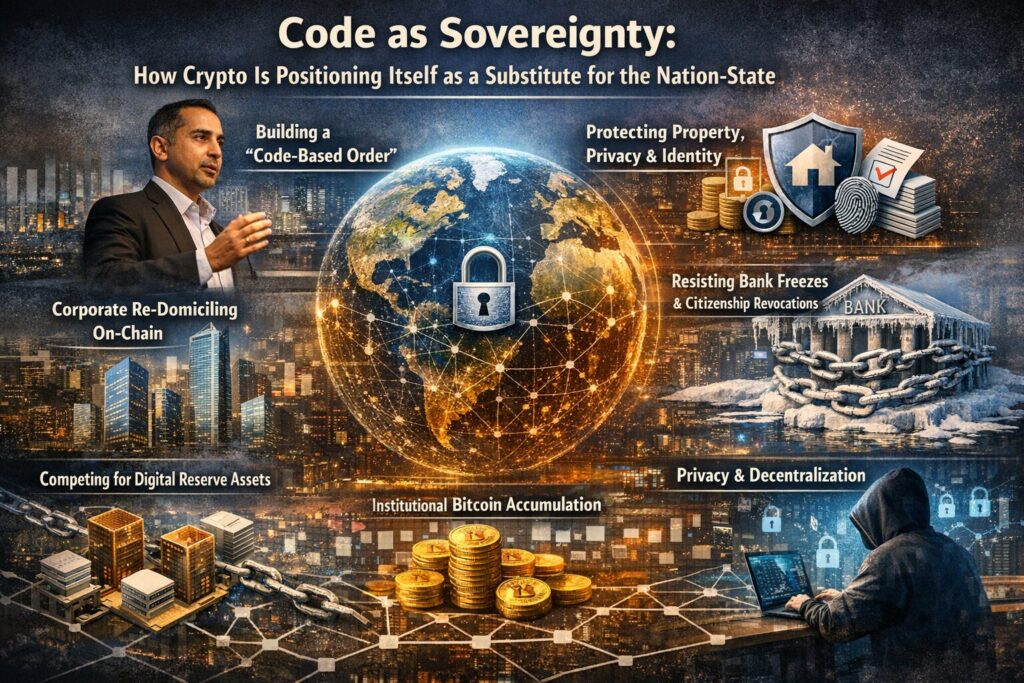
- Former Coinbase CTO Balaji Srinivasan argues that crypto aims to build a “code-based order” to replace the declining “rules-based international order.”
- Blockchain can protect property rights, contracts, privacy, identity, and voting mechanisms without relying on nation-states.
- On-chain assets and identity can resist bank freezes and citizenship revocations.
- Corporations may increasingly “re-domicile” on-chain, protected by smart contracts rather than geography.
- Institutional Bitcoin accumulation suggests a global competition for digital reserve assets.
- Blockchain is simultaneously advancing as both an alternative to and an integrated component of traditional financial systems.
- Privacy is emerging as the key competitive advantage in next-generation blockchain infrastructure.
Code as the New International Law
In February 2026, Balaji Srinivasan, former CTO of Coinbase, publicly stated that cryptocurrency’s core purpose is to establish a “code-based order” as the global rules-based system weakens. His thesis is bold: when nation-states fail to protect property, contracts, identity, or privacy, programmable cryptographic systems can assume those roles.
This statement is not merely philosophical. It reflects an accelerating structural shift in global governance and finance. In Western countries, institutional trust has declined amid political polarization, fiscal instability, and rising sovereign debt. In contrast, certain Eastern systems are characterized by increasing state centralization. Srinivasan suggests that blockchain represents a third path: neither failed states nor all-powerful states, but decentralized cryptographic governance.
The foundational principle is simple but radical: if institutions fail, the internet remains.
Bitcoin, created by Satoshi Nakamoto, was born out of distrust in centralized financial authorities following the 2008 financial crisis. At its core, Bitcoin is not simply a digital currency priced at $65,000 or $70,000 per coin; it is a political innovation. It represents a shift from trust in institutions to trust in verifiable mathematics.
Bitcoin Price Trend (USD)
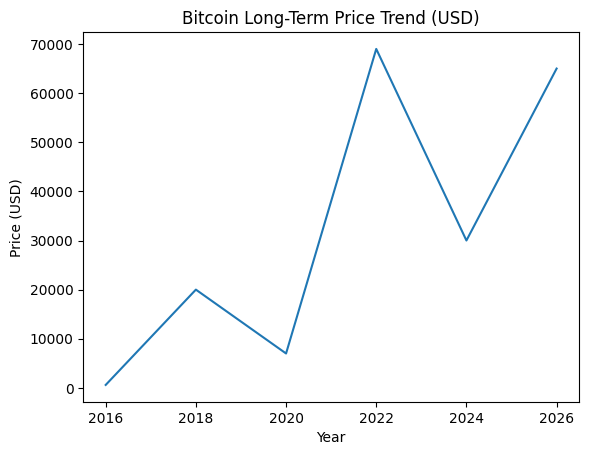
The long-term trajectory of Bitcoin’s price—from under $1,000 in early years to peaks above $69,000 and renewed consolidation around $65,000—demonstrates not just speculation, but persistent structural demand. Despite volatility, the macro trend reflects growing adoption as a sovereign-neutral asset.
Blockchain as an Institutional Substitute
Srinivasan argues that international law historically protected:
- Property rights
- Contract enforcement
- Privacy
- Secure identity
- Voting systems
Blockchain replaces these through:
- Immutable ledgers
- Smart contracts
- Cryptographic identity systems
- Decentralized governance
When banks freeze accounts (debanking) or governments revoke citizenship (denaturalization), traditional systems can strip individuals of economic agency. On-chain systems, however, allow individuals to retain access to assets and digital identity independent of geography.
This concept is no longer theoretical. In the UK, reports have shown significant restrictions on crypto-related transfers. In several jurisdictions, political or compliance-driven account closures have affected entrepreneurs and activists alike. On-chain self-custody offers a structural countermeasure.
From a practical perspective, this is why non-custodial wallets, decentralized exchanges, and self-sovereign identity frameworks are seeing renewed attention in 2026.
The Rise of “Corporate Refugees”
Srinivasan extends the argument beyond individuals. Corporations, too, may seek protection in code.
Traditionally, companies are domiciled in jurisdictions like Delaware or California. However, legal and regulatory unpredictability increases operational risk. Blockchain allows contracts, equity representations, treasury holdings, and governance mechanisms to exist on-chain.
This enables what could be described as corporate “re-domiciliation.” A company could move from one jurisdiction to another more fluidly, as its core operational logic and financial state are anchored on blockchain infrastructure rather than physical territory.
For entrepreneurs seeking capital efficiency and jurisdictional flexibility, this model is increasingly attractive. Tokenized equity, decentralized autonomous organizations (DAOs), and on-chain treasury management tools are expanding rapidly.
Global Crypto Users (Millions)
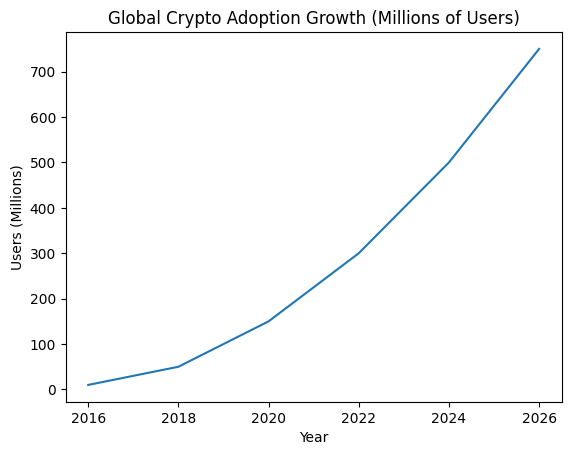
The steady growth in global crypto users—from under 50 million to potentially over 750 million worldwide—signals a deepening base of participants. This adoption growth supports the thesis that blockchain infrastructure is transitioning from fringe innovation to parallel financial architecture.
Failed States vs. Omnipotent States: Code as Equilibrium
Srinivasan frames blockchain as a balance between two extremes:
- Failed states (where institutions cannot protect citizens)
- Omnipotent states (where institutions overreach and dominate citizens)
Cryptographic systems offer predictable, rule-based enforcement without discretionary political interference.
Critics argue that crypto networks are supported by speculation. Srinivasan counters that U.S. states themselves rely heavily on financial engineering and even lottery systems for revenue. The comparison suggests that blockchain’s economic underpinnings are not fundamentally more speculative than sovereign fiscal models.
The key question is durability. Can decentralized networks provide stable, long-term institutional trust?
Institutional behavior suggests growing confidence.
Estimated Institutional BTC Holdings
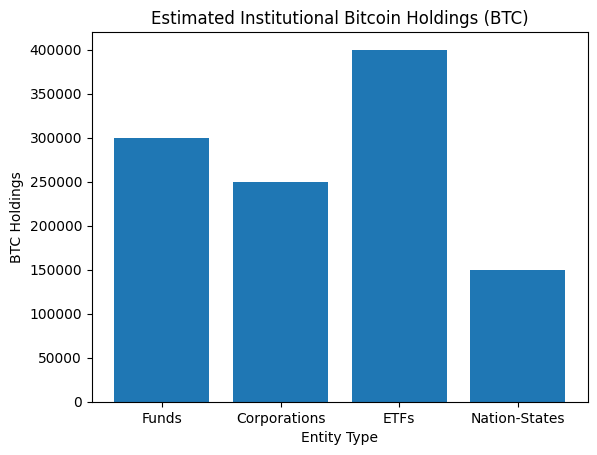
Institutional accumulation of Bitcoin—through ETFs, corporate treasuries, hedge funds, and even nation-state reserves—indicates a competitive dynamic. Some industry leaders predict that within two to three years, a race to secure 1 million BTC positions could emerge.
At a Bitcoin price of $65,000, 1 million BTC represents $65 billion in digital reserve value. In a scenario where Bitcoin reaches $100,000, that figure becomes $100 billion per million BTC. The scale resembles sovereign wealth strategies rather than speculative trading.
Integration vs. Replacement: Two Parallel Tracks
While Srinivasan advocates replacement, U.S. policymakers are simultaneously moving toward integration. Recent discussions around the CLARITY Act suggest regulatory frameworks that formally embed crypto within the financial system.
This creates two parallel paths:
- Replacement: crypto as alternative governance
- Integration: crypto as regulated financial infrastructure
These paths are not mutually exclusive. Blockchain may serve as both safety net and backbone.
For investors seeking new revenue opportunities, this dual dynamic is critical. Infrastructure plays (Layer 1 chains, privacy layers, identity protocols) may benefit from the replacement thesis. Regulated exchanges, custody providers, and ETF issuers may benefit from integration.
Privacy as the Decisive Competitive Advantage
Andreessen Horowitz’s crypto arm recently emphasized that privacy could become the primary competitive advantage in blockchain systems.
If code is to replace institutional protection, privacy must be resilient. Zero-knowledge proofs, encrypted smart contracts, and private identity layers are becoming core infrastructure components.
In practical terms, this suggests capital opportunities in:
- ZK rollups
- Privacy-preserving DeFi
- Decentralized identity protocols
- Secure messaging overlays on blockchain
Privacy is no longer ideological—it is structural.
Strategic Implications for Crypto Entrepreneurs and Investors
For readers seeking new digital asset opportunities and practical blockchain applications, several strategic conclusions emerge:
- Bitcoin is evolving from speculative asset to digital reserve competitor.
- On-chain identity and privacy layers may represent high-growth sectors.
- Corporate blockchain integration will accelerate tokenized assets.
- Jurisdictional arbitrage will increasingly involve digital infrastructure.
- Institutional competition for scarce BTC supply may reshape macro capital flows.
If nation-state reliability declines in certain regions, blockchain adoption may accelerate dramatically.
Conclusion: Code as the Internet’s Constitutional Layer
Balaji Srinivasan’s thesis is provocative but aligned with observable trends. Blockchain is no longer merely financial technology; it is institutional technology.
Whether as replacement or integration, crypto is embedding itself into the global economic order.
If governments falter, code offers resilience.
If governments adapt, code offers efficiency.
Bitcoin’s creation marked the beginning of a political revolution executed in mathematics. At $65,000 per BTC, the market is pricing not just scarcity, but sovereignty.
The coming decade will determine whether blockchain becomes a parallel system—or the foundational one.