
Main Points :
- Nigeria implemented the National Tax Administration Act (NTAA) 2025 on January 1, 2026, integrating crypto transactions into its tax system using TIN and NIN identity verification.
- Instead of blockchain surveillance, authorities rely on existing tax and identity infrastructure.
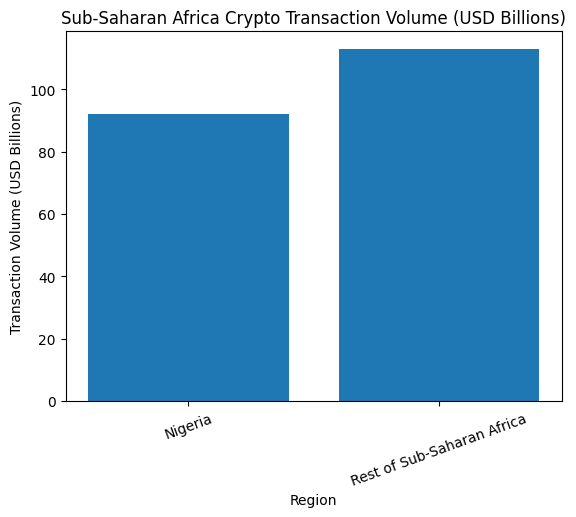
- Nigeria accounts for approximately $92.1 billion of Sub-Saharan Africa’s estimated $205 billion annual crypto transaction volume.
- Stablecoins represent roughly 43% of regional crypto activity, with Nigeria processing around $22 billion in stablecoin transactions.
- Exchanges are positioned as tax collection intermediaries, shifting enforcement burdens to platforms.
- The policy reflects broader fiscal reform goals to raise Nigeria’s tax-to-GDP ratio from about 9.5% toward 18% within three years.
- The framework could become a template for other African countries.
1. Introduction: A New Chapter in African Crypto Governance
On January 1, 2026, Nigeria formally integrated cryptocurrency reporting into its tax system under the National Tax Administration Act (NTAA) 2025. This move represents one of the most structurally significant regulatory developments in Africa’s digital asset ecosystem.
Unlike Japan or the United States—where crypto regulation evolved through layered licensing systems, AML enforcement, securities classification, and exchange supervision—Nigeria chose a different route. Instead of monitoring blockchain networks directly, authorities embedded crypto reporting within the country’s existing taxpayer identification and national identity framework.
This is not merely a compliance reform. It is a fiscal strategy, a technological experiment, and potentially a regulatory template for the continent.
For investors, fintech founders, and blockchain infrastructure builders, understanding Nigeria’s model is critical—not only for exposure to one of the world’s fastest-growing crypto markets, but for anticipating how emerging economies may regulate digital assets going forward.
2. Nigeria: One of the World’s Most Active Crypto Markets
Nigeria consistently ranks among the top three countries globally in cryptocurrency adoption.
Several structural factors explain this:
- Persistent currency volatility of the Nigerian naira.
- Restricted access to foreign exchange.
- High inflation pressures.
- Capital controls limiting dollar access.
- A young, digitally native population.
Sub-Saharan Africa processed approximately $205 billion in cryptocurrency transactions between July 2024 and June 2025. Nigeria accounted for roughly 45% of that activity—about $92.1 billion.
Approximately 22 million Nigerians—around 10% of the population—are estimated to use cryptocurrency.
In practical terms, crypto in Nigeria is not a speculative niche. It is:
- A hedge against currency instability.
- A remittance tool.
- A cross-border payment mechanism.
- A savings alternative via dollar-denominated stablecoins.
This functional adoption explains why taxation has now become a priority for the government.
3. Fiscal Motivation: Expanding the Tax Base
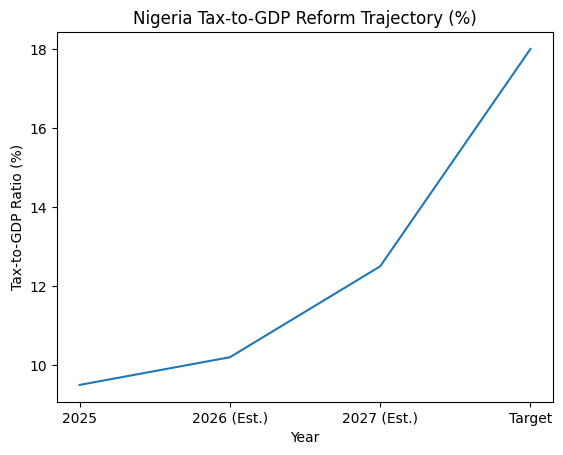
Nigeria’s tax-to-GDP ratio stood at approximately 9.5% in 2025, among the lowest globally. Analysts argue that such a narrow tax base increases reliance on debt and reduces fiscal flexibility.
PwC estimates suggest reforms could lift the ratio to:
- 10.2% in 2026
- Up to 12.5% by 2027 if compliance improves
The government’s longer-term target is 18% within three years.
Importantly, this is not driven by tax rate increases but by base expansion. Cryptocurrency formalization fits neatly into this objective.
By linking digital asset transactions to taxpayer identities (TIN and NIN), authorities aim to:
- Capture previously unreported income.
- Stabilize public revenue.
- Reduce deficit financing.
- Improve fiscal sustainability.
From a macro perspective, crypto taxation is part of structural fiscal consolidation.
4. Regulatory Architecture: Identity Over Blockchain Surveillance
A defining feature of Nigeria’s model is what it does not do.
It does not rely on:
- Direct blockchain transaction monitoring.
- Real-time on-chain analytics infrastructure.
- Heavy state-level blockchain surveillance systems.
Instead, exchanges and crypto platforms must:
- Collect TIN and NIN information.
- Record transaction value.
- Report asset type.
- Submit transaction activity to authorities.
- Withhold and remit taxes when required.
Authorities compare reported activity when assets enter or exit regulated platforms against declared income.
This creates traceability at the fiat on/off-ramp level rather than the blockchain layer.
The advantage: lower infrastructure cost and faster deployment.
The risk: regulatory blind spots if users migrate to self-custody or decentralized finance.
5. Exchanges as Enforcement Centers
The NTAA framework effectively deputizes crypto platforms.
Rather than the government directly collecting crypto taxes, exchanges act as intermediaries:
- Calculating tax liabilities.
- Withholding where required.
- Remitting to the government.
For global exchanges, this introduces cross-border compliance complexity.
Platforms must reconcile:
- Nigerian reporting requirements
- AML rules in home jurisdictions
- OECD-related tax transparency obligations
Exchanges that previously suspended Nigerian services—such as Binance’s prior naira-related adjustments—would face expanded identity and reporting duties upon re-entry.
This increases compliance costs but may also formalize the Nigerian market.
6. Stablecoins: The Core of Africa’s Digital Dollar Economy
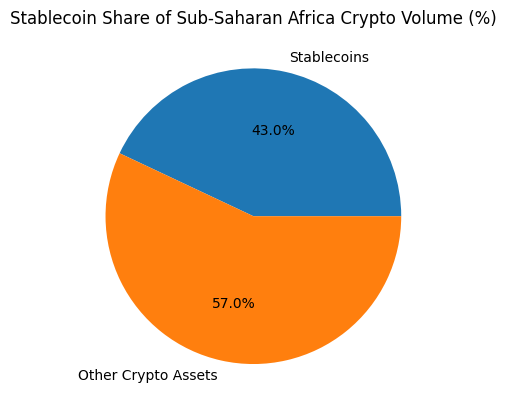
Stablecoins represent approximately 43% of Sub-Saharan Africa’s crypto volume.
Nigeria alone processed an estimated $22 billion in stablecoin transactions between July 2023 and June 2024.
Stablecoins offer:
- Dollar-denominated savings.
- Cross-border remittances without banks.
- Hedging against naira depreciation.
- Lower friction international payments.
For many Nigerians, converting mobile money into stablecoins and sending funds internationally without visiting a bank branch is transformative.
This functional utility explains why crypto adoption continues to expand even amid regulatory tightening.
For investors and builders, stablecoin infrastructure—wallets, compliance layers, on/off-ramps—remains a high-opportunity sector.
7. Market Risks and Compliance Frictions
The 24/7 nature of crypto markets complicates periodic tax reporting systems.
Key challenges include:
- High price volatility affecting taxable calculations.
- Interpretation differences across platforms.
- Technical guidance gaps in early-stage implementation.
- Migration to P2P and DeFi platforms.
If users shift activity to:
- Self-custody wallets,
- Decentralized exchanges,
- Informal P2P networks,
Enforcement effectiveness may decline.
The next 12 months will be critical.
Key metrics to monitor:
- Exchange compliance rates.
- Growth in P2P trading volumes.
- Stablecoin usage trends.
- Reported crypto-related tax revenues.
8. Continental Implications
Kenya, Ghana, and South Africa are observing Nigeria’s approach closely.
For countries with limited blockchain surveillance capacity, Nigeria’s identity-based reporting model offers a scalable template.
However, successful replication requires:
- Robust national ID infrastructure.
- Functional tax administration systems.
- Cooperative exchanges.
- Political will.
Countries lacking identity systems may struggle to replicate the framework.
If Nigeria’s model proves administratively viable and fiscally beneficial, it could shape the next wave of African digital asset regulation.
9. Strategic Implications for Investors and Builders
For readers seeking new crypto assets, income streams, or practical blockchain applications, several implications emerge:
A. Regulatory-Integrated Markets Create Stability
Formal taxation reduces regulatory uncertainty, which may attract institutional capital.
B. Compliance Infrastructure Is an Investment Opportunity
Solutions enabling:
- Automated reporting
- Identity verification
- Tax calculation APIs
may see demand growth.
C. Stablecoins Remain Structural
Dollar-linked digital assets are deeply embedded in African commerce.
D. DeFi vs Centralized Platform Dynamics
If reporting pressures rise, DeFi adoption may accelerate.
10. Conclusion
Nigeria’s NTAA 2025 marks a pivotal moment in African crypto governance.
By integrating cryptocurrency reporting into its tax and identity systems rather than policing the blockchain directly, Nigeria has chosen a pragmatic, infrastructure-leveraging approach.
This is not simply about taxation. It is about fiscal stabilization, revenue expansion, and digital asset formalization within one of the world’s most dynamic crypto markets.
Its success will depend on:
- Administrative execution,
- Platform cooperation,
- User behavior,
- Stablecoin dynamics,
- And cross-border compliance harmonization.
Over the next 12 months, Nigeria’s experiment will provide critical insights—not just for Africa, but for emerging markets globally.
If effective, it may demonstrate that the future of crypto regulation in developing economies lies not in surveillance-heavy blockchain monitoring, but in intelligent integration with existing national systems.