
Main Points :
- Bitcoin whale wallets (1,000–10,000 BTC) have accumulated approximately 230,000 BTC over three months.
- Total whale balances have recovered to pre-October 10, 2025 market crash levels.
- Whale-related exchange flows reached $8.24 billion in the past 30 days — the highest in 14 months.
- Net exchange outflows now represent 3.5% of total exchange BTC supply (30-day MA), signaling tightening liquid supply.
- Average spot order size has stabilized between 950–1,100 BTC — the most consistent large-block trading environment since September 2024.
- Supply dynamics suggest early-stage accumulation rather than distribution.
1. Whale Accumulation Returns After Distribution Phase
Bitcoin’s large holders — commonly referred to as “whales” — are once again reshaping market structure.
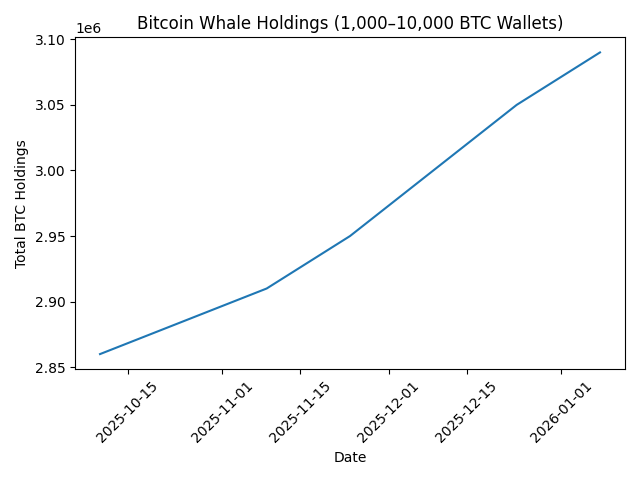
Wallets holding between 1,000 BTC and 10,000 BTC have increased their collective holdings from approximately 2.86 million BTC to 3.09 million BTC over the past three months. This represents a net accumulation of roughly 230,000 BTC, fully recovering the supply reduction seen before the October 10, 2025 market correction.
This accumulation phase follows a broad distribution period that began in August 2025 when Bitcoin reached $124,000. After that peak, BTC struggled to maintain sustained upward momentum. The distribution phase reduced whale balances temporarily, but recent data confirms that this decline has now been fully reversed.
The implications are significant: whales typically accumulate during consolidation periods, not at euphoric highs. Their behavior often precedes medium-term supply squeezes.
[Whale BTC Holdings Trend]
2. Spot Market Order Size Confirms Institutional Presence
On-chain accumulation is reinforced by spot market data.
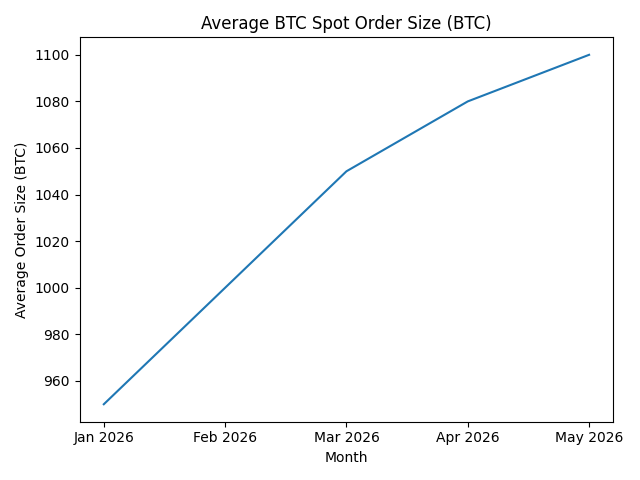
Throughout 2026, average BTC spot order size has stabilized between 950 BTC and 1,100 BTC. This marks the most stable period of large-order participation since September 2024.
During previous corrections — particularly the February–March 2025 adjustment — large orders appeared sporadically, while smaller retail-sized orders dominated trading activity. The current environment differs: block trades are consistent, not reactive.
Large, stable order clusters typically indicate structured buying programs, algorithmic accumulation strategies, or institutional rebalancing.
When average order sizes increase without corresponding price spikes, it often reflects patient accumulation.
[Average BTC Spot Order Size]
3. Exchange Flows Reach 14-Month High — But Net Supply Remains Tight
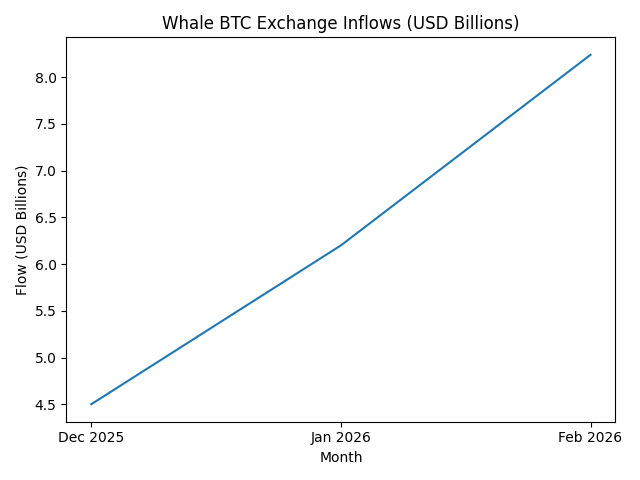
Over the past 30 days, whale-related exchange flows totaled approximately $8.24 billion, marking the highest level in 14 months.
Retail flows reached approximately $11.91 billion during the same period, but remained relatively flat. The retail-to-whale ratio currently stands at 1.45 and is declining as whale deposits increase.
At first glance, rising exchange inflows may appear bearish. However, the critical metric is not gross inflow — it is net exchange balance.
Glassnode data shows that whale outflows (withdrawals from exchanges) represent 3.5% of total exchange BTC supply on a 30-day moving average basis — the strongest pace since November 2024.
Based on current exchange balances, this implies approximately 60,000–100,000 BTC have been withdrawn over the past month.
While total inflows have risen, elevated outflows are offsetting them. Net exchange reserves remain relatively stable — suggesting repositioning rather than aggressive selling.
[Whale Exchange Inflows]
4. Why This Matters for Supply and Liquidity
Bitcoin’s supply dynamics operate differently from traditional assets.
Only about 19.7 million BTC have been mined. A substantial portion is illiquid or lost. Exchange balances represent the most accessible liquid supply.
When whales withdraw BTC from exchanges, liquid supply tightens. When they deposit BTC, liquidity increases.
Currently, we observe:
- Elevated gross flows
- High withdrawal ratio
- Stable net exchange balances
- Rising whale wallet totals
This pattern historically aligns with:
- Accumulation before volatility expansion
- Reduced immediate sell pressure
- Structural tightening in available supply
It does not guarantee price appreciation. However, it reduces downside shock probability caused by large-scale distribution.
5. Macro Overlay: ETF Flows and Institutional Context
Recent institutional participation adds further context.
Spot Bitcoin ETFs in the United States continue to attract steady inflows. Institutional capital is increasingly treating Bitcoin as a strategic allocation rather than speculative trade.
At the same time:
- Global interest rate uncertainty persists
- Sovereign debt expansion continues
- Currency debasement concerns remain elevated
These macro drivers support Bitcoin’s long-term scarcity thesis.
Whale accumulation during macro uncertainty often reflects hedging behavior.
6. Comparing 2025 Distribution vs 2026 Accumulation
August 2025 (BTC at $124,000):
- Whale balances declined
- Exchange balances increased
- Retail enthusiasm peaked
Current environment:
- Whale balances rising
- Exchange net supply stable
- Retail flows flat
- No parabolic price spike
This contrast suggests we are not in a late-stage blowoff cycle.
Instead, the data resembles early accumulation after a correction.
7. Structural Implications for Investors
For readers seeking new crypto assets and yield opportunities, several strategic insights emerge:
- Liquidity compression often precedes volatility expansion.
- Whale accumulation reduces tail-risk probability.
- Stable large-order execution suggests professional capital participation.
- Exchange supply tightness can amplify upside moves if demand accelerates.
This does not imply immediate upside.
But structurally, the market is healthier than during the post-$124,000 distribution phase.
8. Risks to Monitor
Despite constructive supply dynamics, risks remain:
- Macro risk-off shocks
- Regulatory policy shifts
- ETF outflow reversals
- Derivatives leverage imbalances
Monitoring exchange net position change and whale wallet behavior will remain critical indicators.
Conclusion: A Subtle but Meaningful Shift
Bitcoin whale balances have fully recovered to pre-October 2025 levels. Large holders have added approximately 230,000 BTC in three months.
Exchange flow data shows elevated activity, yet net supply remains stable due to strong withdrawal ratios.
Spot market order size stability suggests structured accumulation rather than reactive trading.
Together, these signals point to a subtle but meaningful shift in BTC supply dynamics.
This is not a euphoric phase.
It is a structural one.
If demand returns while supply remains constrained, volatility may expand upward.
For investors seeking long-term positioning, supply tightening often matters more than headlines.