Main Points :
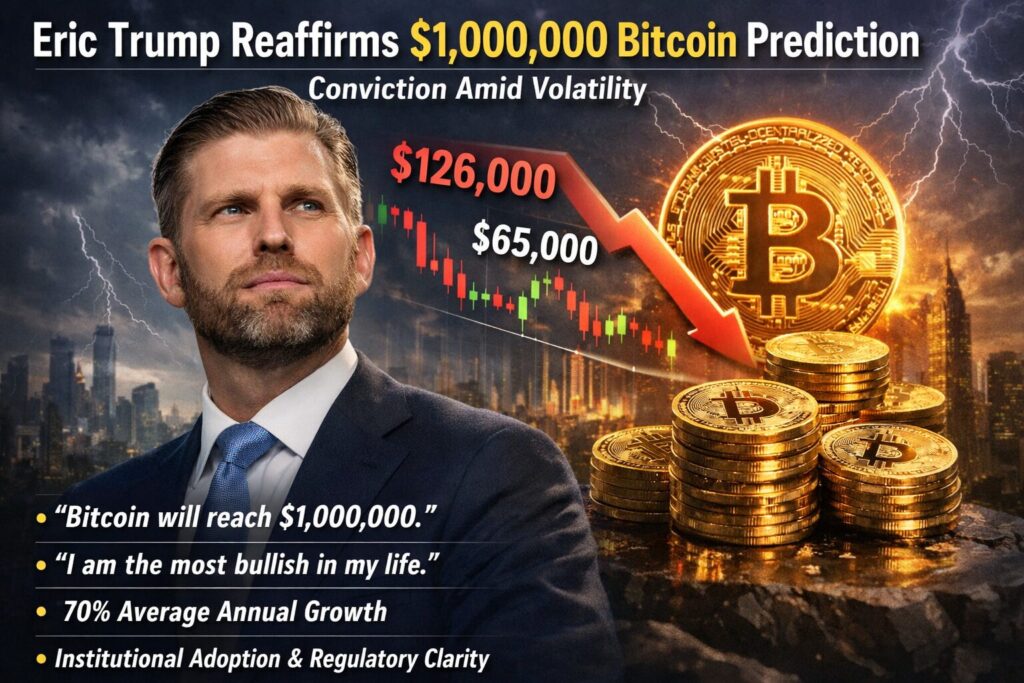
- Eric Trump maintains that Bitcoin will eventually reach $1,000,000.
- Despite a correction from $126,000 to around $65,000, he calls himself “the most bullish in my life.”
- He highlights Bitcoin’s historical ~70% average annual growth over the past decade.
- Institutional adoption and regulatory clarity will determine whether the million-dollar thesis becomes reality.
- Volatility is framed not as weakness, but as a structural feature of asymmetric assets.
“The Most Bullish in My Life”
Eric Trump, the second son of Donald Trump, has once again declared that Bitcoin will ultimately reach $1,000,000. Speaking during an interview with CNBC at the World Liberty Forum held at Mar-a-Lago, he emphasized that despite recent market weakness, his long-term outlook remains unchanged.
Bitcoin recently corrected from its October 2025 all-time high of approximately $126,000 down to roughly $65,000. For many market participants, such a 50% drawdown would be interpreted as a warning sign. For Eric Trump, however, it is confirmation that Bitcoin remains a high-upside, asymmetric asset class.
He described himself as “the most bullish in my life,” arguing that volatility is inseparable from assets with exponential growth potential.
The Historical Growth Argument
Eric Trump’s optimism is rooted in historical performance. Over the past decade, Bitcoin has delivered an average annualized growth rate approaching 70%. While past performance does not guarantee future returns, the compounding effect of such growth rates paints an extraordinary picture.
If an asset grows at 70% annually, it roughly multiplies by 1.7 each year. Starting from $65,000:
- Year 1: ~$110,500
- Year 2: ~$187,850
- Year 3: ~$319,345
- Year 4: ~$542,887
- Year 5: ~$923,000+
Under this simplified model, the $1,000,000 threshold could theoretically be reached within approximately five to six years.
[Bitcoin Price Trend (2016–2026)]
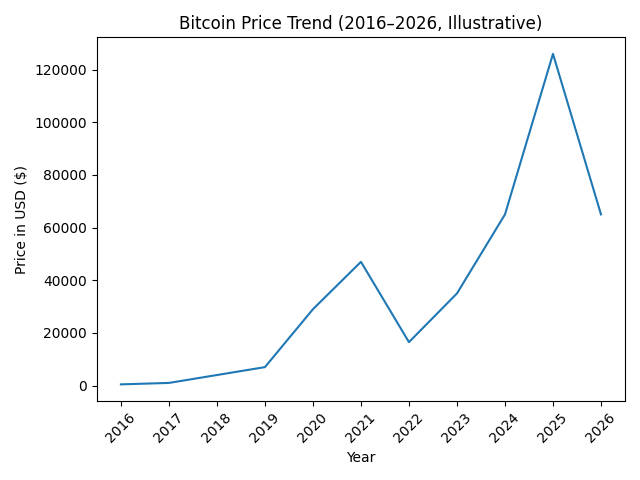
This chart illustrates Bitcoin’s long-term trajectory, showing repeated boom-bust cycles yet a structurally upward trend.
Volatility: Feature, Not Bug
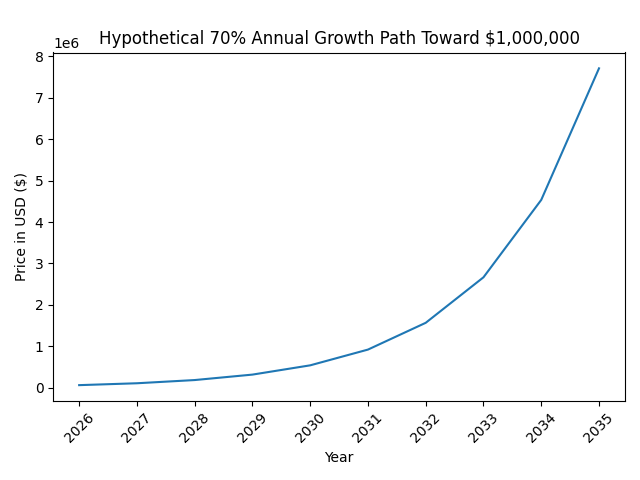
Bitcoin’s correction from $126,000 to $65,000 represents a decline of roughly 48%. In traditional finance, such a move would be catastrophic. In crypto markets, it is cyclical.
[Bitcoin Volatility – $126,000 to $65,000]
Historically, Bitcoin has experienced multiple drawdowns exceeding 70%:
- 2013–2015: -85%
- 2017–2018: -84%
- 2021–2022: -77%
Yet each cycle established a higher long-term base. This cyclical volatility is what creates the asymmetric return profile that long-term holders rely upon.
Eric Trump frames this volatility as necessary for “massive upside potential.” Without risk, there is no exponential reward.
The Institutional Factor
Bitcoin’s path to $1,000,000 cannot rely solely on retail enthusiasm. Institutional participation is critical.
Major asset managers, including ARK Invest led by Cathie Wood, have projected Bitcoin’s market capitalization could reach $16 trillion by 2030 under bullish scenarios. At 21 million coins maximum supply, that implies a price near $760,000 per Bitcoin. Under more aggressive adoption curves, the million-dollar threshold becomes mathematically plausible.
Institutional drivers include:
- Spot Bitcoin ETFs
- Corporate treasury allocations
- Sovereign wealth participation
- Pension fund exposure
- Payment infrastructure integration
If global capital markets increasingly treat Bitcoin as digital gold or digital collateral, its total addressable market expands dramatically.
The Regulatory and Political Dimension
Eric Trump has also suggested that the United States is “winning the digital revolution.” Policy clarity could become a decisive catalyst.
Key regulatory developments to watch:
- Clear tax classification frameworks
- Stablecoin legislation
- Bank custody authorization
- Accounting standard modernization
- Energy policy alignment for mining
Regulatory clarity reduces uncertainty premiums, making institutional capital more comfortable entering the space.
However, political risk cuts both ways. Crypto markets remain sensitive to macroeconomic shifts, central bank policy, and geopolitical instability.
The Digital Gold Thesis
Bitcoin’s million-dollar thesis often rests on comparison with gold.
Gold’s total market capitalization exceeds $13 trillion. If Bitcoin captures even half that valuation, it would approach roughly $6–7 trillion — equivalent to approximately $300,000 per coin. If it surpasses gold entirely, valuations north of $600,000 become conceivable.
The stronger narrative is not replacement, but coexistence:
- Gold: physical store of value
- Bitcoin: digital, portable, programmable scarcity
In emerging markets with capital controls or currency instability, Bitcoin adoption is accelerating not as speculation, but as financial infrastructure.
The Compounding Model Toward $1,000,000
[Hypothetical 70% Growth Path Toward $1,000,000]
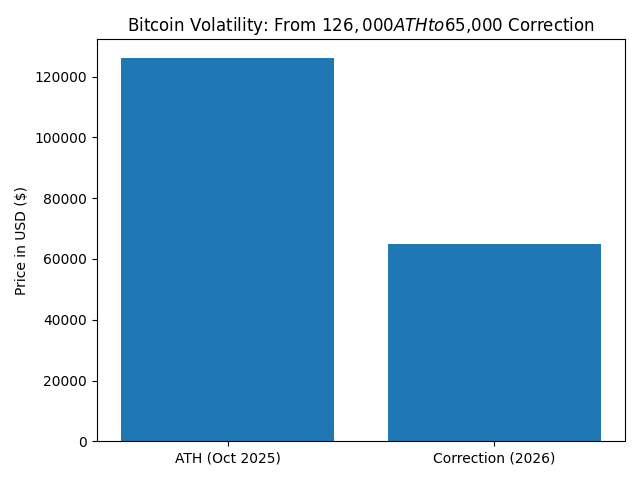
This hypothetical projection assumes 70% annual growth from a $65,000 base. While aggressive, it illustrates how compounding transforms time into price acceleration.
Important caveats:
- Growth rates typically slow as market caps expand.
- Liquidity requirements increase exponentially.
- Macro tightening cycles can delay upside trajectories.
Thus, the million-dollar target is less about a fixed timeline and more about structural adoption.
Risks to the Million-Dollar Thesis
For balanced analysis, consider key risks:
- Regulatory crackdowns
- Technological displacement
- Layer-1 competition
- Macro recession
- ETF capital outflows
- Miner capitulation
Additionally, as market capitalization grows, volatility tends to compress, making 70% annual growth harder to sustain.
Strategic Implications for Investors
For readers seeking new crypto assets, revenue streams, or practical blockchain exposure, Bitcoin’s trajectory has broader implications:
- Layer-2 ecosystems (Lightning, rollups)
- Institutional custody providers
- Mining infrastructure equities
- Treasury-management tokenization
- Payment rails integration
- Cross-border settlement systems
Bitcoin reaching $1,000,000 would likely pull the entire digital asset ecosystem upward.
Long-Term Conviction vs. Short-Term Noise
Eric Trump’s recommendation — “buy now and close your eyes” — reflects maximalist conviction. However, professional portfolio strategy typically requires:
- Position sizing discipline
- Risk-adjusted allocation
- Rebalancing frameworks
- Macro hedging
Blind conviction can succeed in secular bull markets but becomes dangerous during prolonged stagnation phases.
Conclusion: Is $1,000,000 Realistic?
Bitcoin at $1,000,000 implies:
- ~15x from $65,000
- ~$21 trillion market cap
- Deep institutional integration
- Sovereign-level adoption
Is it impossible? No.
Is it inevitable? Also no.
The million-dollar thesis depends on whether Bitcoin becomes:
- A global reserve collateral asset
- A digital gold successor
- A programmable monetary base layer
Eric Trump’s conviction mirrors a broader ideological shift: Bitcoin is no longer viewed solely as speculation but increasingly as macro-hedge infrastructure.
Volatility will continue. Political cycles will shift. Liquidity will ebb and flow. Yet if the long-term structural narrative holds, today’s $65,000 may one day be remembered as a consolidation phase — not a ceiling.
Time, regulation, adoption, and macroeconomic alignment will determine whether $1,000,000 is prophecy or optimism.