Main Points :
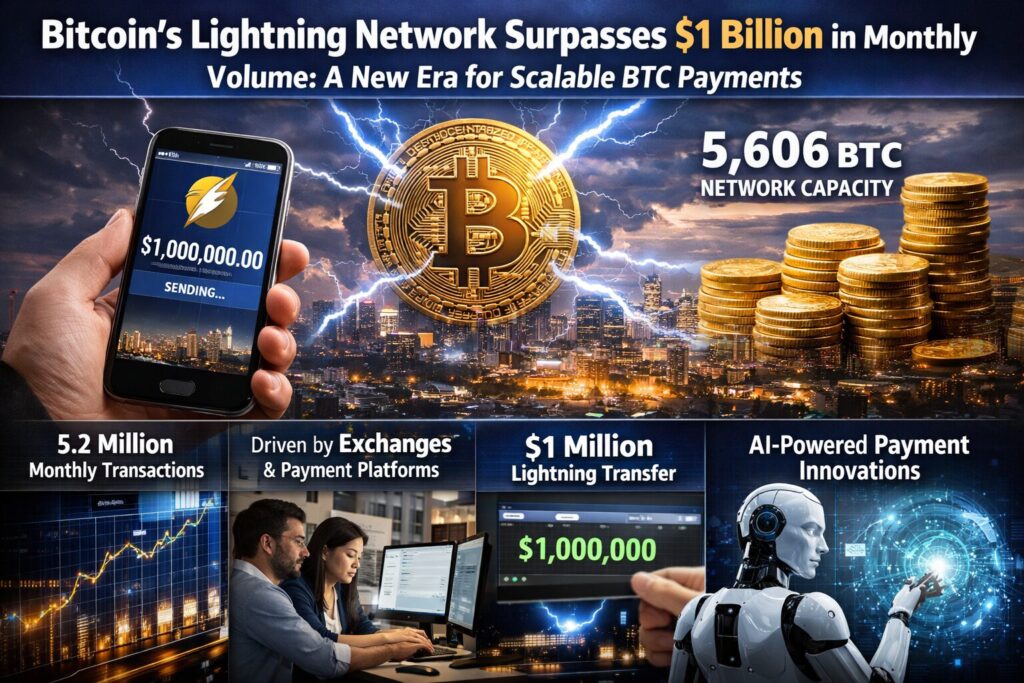
- The Bitcoin Lightning Network exceeded $1 billion in estimated monthly transaction volume in November 2025.
- Monthly transactions reached approximately 5.2 million, despite relatively flat BTC price action during the year.
- Adoption has been driven primarily by exchanges and payment-integrated businesses, rather than speculative cycles.
- Network capacity climbed to 5,606 BTC, reflecting increasing liquidity and institutional usage.
- Institutional transfers—including a $1 million Lightning transaction—demonstrate growing large-value viability.
- AI-driven payment experimentation may further accelerate Lightning adoption.
Introduction: From Store of Value to Medium of Exchange
For years, Bitcoin has been characterized primarily as “digital gold”—a hedge asset, a reserve instrument, and a macro-sensitive store of value. Yet the original Bitcoin white paper described a peer-to-peer electronic cash system. The tension between these two identities has defined Bitcoin’s evolution.
In November 2025, a significant milestone signaled that Bitcoin’s payments narrative is no longer theoretical. According to a report by Bitcoin financial services firm River, the Lightning Network recorded an estimated $1.1 billion in monthly transaction volume, with around 5.2 million transactions processed.
This achievement is particularly notable because it occurred during a relatively stagnant price environment. Unlike previous surges tied to bull-market speculation, this growth appears to be rooted in practical usage—exchanges, businesses, and infrastructure providers integrating Lightning for real economic activity.
For investors and builders searching for new revenue models and blockchain use cases, Lightning’s progress may signal a structural shift in how Bitcoin participates in the global payments economy.
Section 1: Lightning Network Surpasses $1 Billion — What It Really Means
Transaction Growth Despite Price Stability
November 2025’s estimated $1.1 billion monthly volume marks a psychological and operational threshold. Importantly, this growth occurred while Bitcoin’s price remained relatively range-bound, showing limited dramatic upside during much of the year.
This decoupling of payment growth from price speculation suggests:
- Organic usage expansion
- Infrastructure maturation
- Exchange integration standardization
- Merchant acceptance growth
Unlike 2023, when Lightning saw a peak of approximately 6.6 million monthly transactions driven largely by gaming and messaging micro-payment experiments, 2025’s growth appears more diversified and commercially grounded.
Exchange-Led Adoption
Major exchanges integrating Lightning withdrawals and deposits have significantly reduced:
- On-chain fees
- Settlement time
- Hot wallet congestion
- Withdrawal batching overhead
Lightning enables near-instant settlement in seconds rather than the ~10-minute average block confirmation on Bitcoin’s base layer.
This matters for exchanges because:
- It lowers operational costs
- Improves user experience
- Enables micro-withdrawals
- Supports arbitrage and rapid capital mobility
For institutional liquidity desks, speed equals competitive advantage.
Section 2: How the Lightning Network Works — Infrastructure That Scales
Payment Channels and Off-Chain Settlement
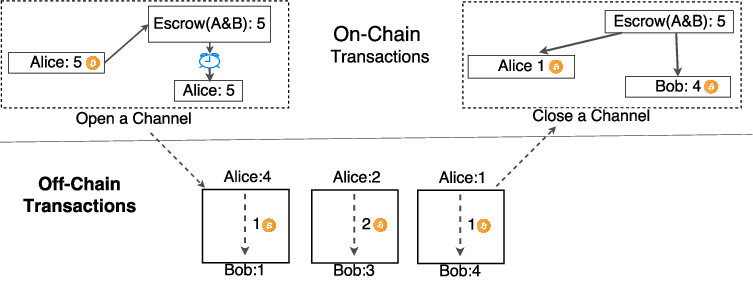
The Lightning Network operates by opening bi-directional payment channels between two parties. Instead of recording every transaction on the Bitcoin blockchain:
- Participants lock BTC into a channel.
- Unlimited micro-transactions occur off-chain.
- Only the net balance is recorded on-chain when the channel closes.
This architecture dramatically reduces:
- Blockchain congestion
- Transaction fees
- Settlement latency
While Bitcoin blocks take approximately 10 minutes on average, Lightning transactions settle in seconds.
Rising Network Capacity
In December 2025, Lightning Network capacity reached 5,606 BTC locked across channels. At a hypothetical BTC price of $60,000, this represents over $336 million in liquidity capacity.
Capacity growth is critical because it reflects:
- Trust in the network
- Commercial utility
- Institutional participation
- Market-making liquidity
Higher capacity improves routing efficiency and transaction reliability.
Section 3: Institutional Validation — The $1 Million Lightning Transfer
In February 2025, institutional trading and lending firm Secure Digital Markets reportedly transferred $1 million via Lightning to crypto exchange Kraken.
This transaction demonstrated:
- Lightning can support seven-figure transfers
- Institutional compliance frameworks can integrate Lightning
- Liquidity depth is maturing
Historically, Lightning was viewed as suitable primarily for micro-payments. Institutional transfers shift that narrative toward hybrid scalability: micro + macro utility.
Section 4: AI Payments and Machine-to-Machine Economies
River’s report projects that Lightning usage could surge further as individuals and businesses experiment with AI-driven payments.
Potential applications include:
- Autonomous AI agents paying APIs
- Machine-to-machine micropayments
- Real-time data streaming monetization
- Usage-based computing models
Traditional payment rails struggle with sub-cent transactions. Lightning’s minimal fees make micro-economic design viable.
If AI services increasingly charge per request, per token, or per computation, Lightning could become the settlement layer for programmable value.
Section 5: Investment Implications — Beyond Speculation
Revenue Models Emerging
For readers seeking income opportunities and blockchain utility, Lightning’s expansion opens multiple vectors:
1. Infrastructure Providers
Running Lightning nodes and routing liquidity.
2. Merchant Integration
Payment processors enabling BTC Lightning acceptance.
3. Exchange Fee Arbitrage
Lower withdrawal costs increase user retention.
4. Liquidity Provision
Channel capital allocation strategies.
5. Fintech Layering
Embedding Lightning into remittance corridors.
Lightning vs. Stablecoin Rails
While stablecoins dominate transaction volume globally, Lightning offers:
- Native BTC settlement
- No custodial issuer
- Decentralized architecture
- Reduced counterparty risk
As regulatory scrutiny increases globally, decentralized payment rails may gain comparative resilience.
Section 6: Comparing 2023 Micro-Payment Boom vs 2025 Institutional Growth
| Year | Driver | Volume Profile | Sustainability |
|---|---|---|---|
| 2023 | Gaming & messaging experiments | Micro-heavy | Speculative spike |
| 2025 | Exchanges & institutions | Balanced | Structural |
The shift suggests Lightning is transitioning from experimental to infrastructural.
Section 7: Challenges Ahead
Despite progress, several risks remain:
- Liquidity fragmentation
- Routing complexity
- UX friction
- Custodial Lightning risks
- Regulatory classification uncertainty
Additionally, competition from layer-2 ecosystems on Ethereum and emerging high-throughput blockchains remains intense.
Conclusion: A Turning Point for Bitcoin’s Payment Thesis
The Lightning Network crossing $1 billion in monthly transaction volume is more than a headline milestone. It represents:
- A maturation of Bitcoin’s payment layer
- Institutional validation
- Infrastructure-driven adoption
- A bridge between digital gold and digital cash
For investors and builders, the opportunity lies not merely in BTC price appreciation, but in participating in the economic layer forming on top of Bitcoin.
As AI, fintech, and global payment corridors evolve, Lightning may become one of the most underestimated infrastructures in the crypto economy.
The narrative is shifting—from “Can Bitcoin scale?” to “Bitcoin is scaling.”