
Main Points :
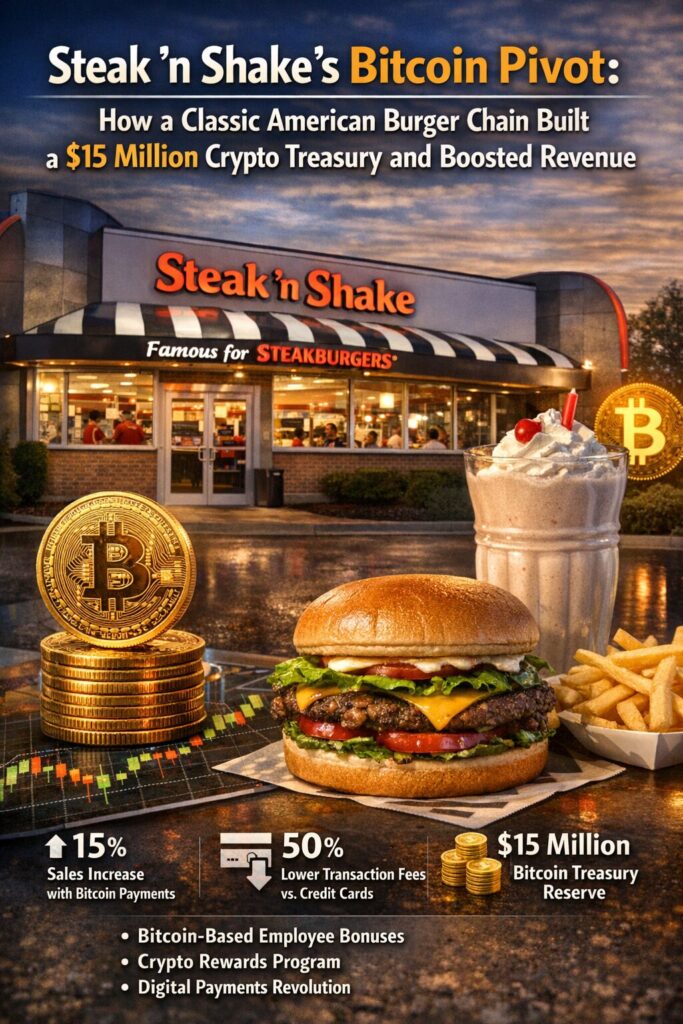
- Steak ’n Shake introduced Bitcoin payments nationwide and reported a 15% increase in same-store sales within nine months.
- The company claims transaction fees were reduced by nearly 50% compared to traditional credit card processing.
- Instead of converting Bitcoin into dollars, the chain accumulated receipts into a $15 million Bitcoin treasury reserve.
- A Bitcoin-based employee bonus program was introduced, linking customer crypto spending to workforce incentives.
- The strategy reflects a broader trend of businesses integrating digital assets into payments, treasury management, and loyalty systems.
Introduction: From Burgers to Bitcoin

The American fast-food chain Steak ‘n Shake has taken a bold step into the world of digital assets by integrating Bitcoin payments across its U.S. locations. Nine months after launching the initiative, the company reports significant gains: higher customer engagement, double-digit revenue growth, reduced payment processing costs, and the accumulation of a $15 million Bitcoin treasury.
Rather than treating crypto payments as a marketing gimmick, Steak ’n Shake positions the move as a structural shift in the fast-food business model — combining payments, savings, treasury management, and employee incentives into one integrated financial ecosystem.
For readers seeking new crypto assets, alternative revenue streams, or practical blockchain use cases, this case offers an important real-world experiment: Can a mainstream consumer brand turn digital currency into a strategic advantage?
Revenue Growth After Bitcoin Adoption
15% Same-Store Sales Increase
According to company statements, since launching Bitcoin payments in May 2025, Steak ’n Shake recorded a 15% increase in same-store sales within nine months. By 2026, some locations reportedly achieved 18% growth, marking the first double-digit increase in years.
While traditional marketing campaigns often produce short-term spikes, management attributes this growth to:
- Increased customer engagement from crypto communities
- Higher frequency of visits
- Social media virality and digital word-of-mouth
- Brand differentiation in a competitive fast-food market
Bitcoin acceptance created a perception shift. The brand was no longer just a legacy burger chain — it became associated with financial innovation and digital-native consumers.
Payment Cost Reduction: Cutting Fees in Half
Lower Transaction Costs Compared to Credit Cards
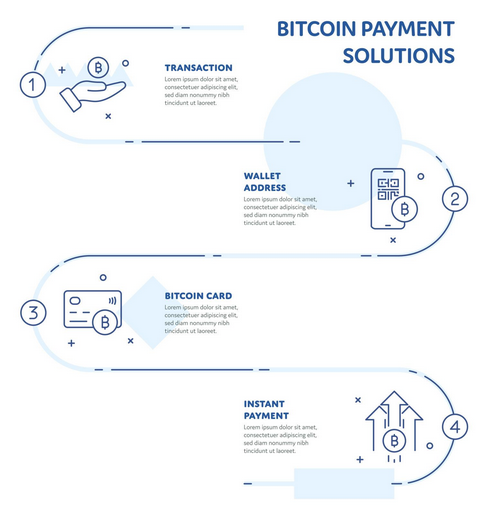
Restaurants traditionally operate on thin margins, often losing 2%–3.5% per transaction to credit card processors. Steak ’n Shake claims that within two weeks of implementing Bitcoin payments, processing fees were reduced by nearly 50%.
If a credit card transaction costs 3%, and Bitcoin processing reduces it closer to 1.5% (depending on infrastructure such as Lightning Network or payment processors), the savings at scale can materially impact profitability.
For a restaurant generating $1 billion in annual revenue, even a 1% reduction in payment fees equates to $10 million in savings annually.
This aligns with a broader global trend where companies experiment with crypto rails to lower payment friction, particularly in industries with high transaction volumes.
Building a $15 Million Bitcoin Treasury
Strategic Reserve Instead of Dollar Conversion
Instead of converting Bitcoin payments into dollars, Steak ’n Shake allocated all crypto receipts to a strategic Bitcoin treasury reserve.
Over nine months, through daily revenue accumulation and additional purchases, the reserve reportedly reached $15 million.
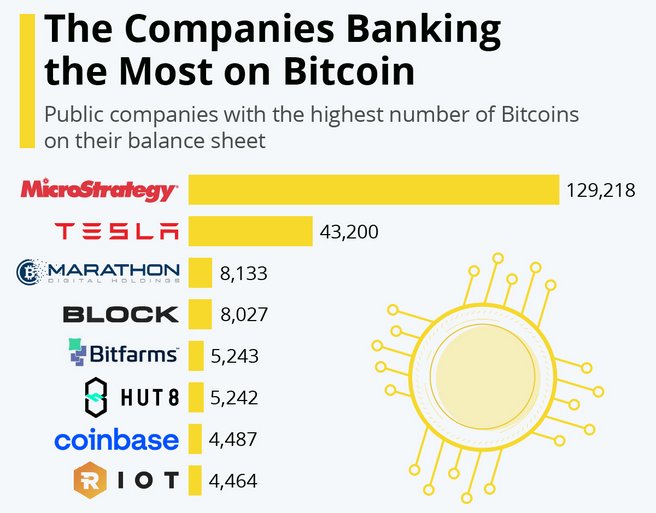
This strategy echoes treasury models used by companies like MicroStrategy, which famously adopted Bitcoin as a primary treasury reserve asset.
However, Steak ’n Shake’s model differs in one crucial way: the Bitcoin accumulation is directly linked to customer transactions, creating a circular economic loop:
- Customers spend Bitcoin.
- The company retains Bitcoin instead of converting it.
- The reserve grows.
- The reserve funds employee incentives and long-term growth.
This transforms Bitcoin from a speculative asset into a functional treasury component embedded in operations.
Employee Incentives Paid in Bitcoin
$0.21 Per Hour in Bitcoin Bonuses
Beginning March 1, company-operated store employees began earning Bitcoin bonuses at a rate of approximately $0.21 per hour worked, with a two-year vesting period.
A full-time employee working 40 hours per week could accumulate roughly:
- 40 hours × 52 weeks × $0.21 = $436.80 per year in Bitcoin
However, the actual value fluctuates based on Bitcoin’s market price at vesting.
This initiative connects:
- Customer spending
- Company treasury growth
- Employee compensation
The company argues that this structure strengthens service quality by aligning incentives with demand growth. Critics, however, point to vesting delays and the exclusion of franchise employees.
Still, it represents one of the first large-scale experiments linking hourly wage bonuses directly to a crypto treasury model.
Broader Industry Context: Crypto in Retail and Payments
Steak ’n Shake’s move does not occur in isolation. Several trends support the viability of such experiments:
1. Institutional Crypto Adoption
Major financial firms continue integrating digital assets into infrastructure. Payment networks experiment with blockchain settlement. Spot Bitcoin ETFs have expanded institutional exposure.
2. Consumer Crypto Normalization
Younger demographics increasingly hold digital assets. Accepting crypto can serve as a marketing bridge to Web3-native consumers.
3. Treasury Diversification
With inflationary pressures and dollar volatility concerns, some corporations view Bitcoin as digital gold — a hedge against currency debasement.
4. Loyalty and Incentive Innovation
Crypto allows programmable incentives. Businesses can structure rewards that appreciate over time, unlike fixed loyalty points.
Risk Considerations
Despite the positive narrative, risks remain:
- Bitcoin price volatility can impact balance sheet valuation.
- Regulatory changes could affect accounting treatment.
- Liquidity constraints if the reserve is held long term.
- Public criticism over speculative employee compensation.
The success of such a model depends on disciplined treasury management and clear accounting frameworks.
Graph Insertion Instructions
“Revenue Growth After Bitcoin Adoption”
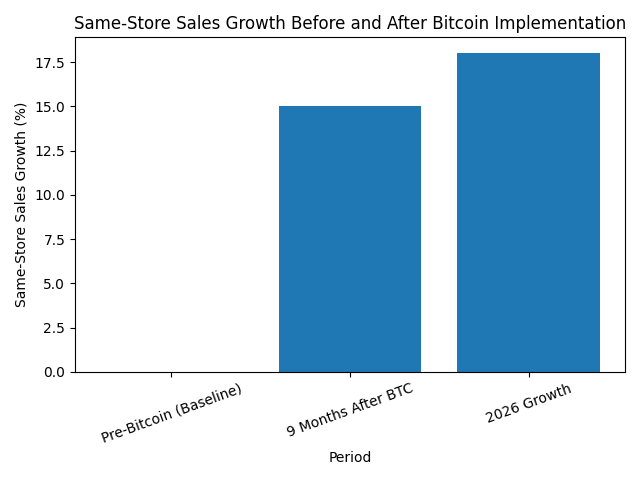
Same-Store Sales Growth Before and After Bitcoin Implementation
“Building a $15 Million Bitcoin Treasury”
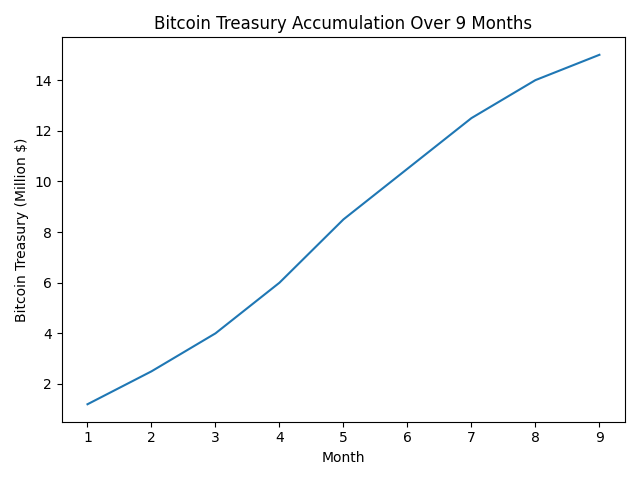
Bitcoin Treasury Accumulation Over Time (9 Months)
Strategic Implications for Crypto Investors and Builders
For readers exploring new revenue streams or blockchain applications, several lessons emerge:
- Crypto payments can reduce operating costs.
- Treasury accumulation creates asymmetric upside.
- Employee token incentives align stakeholders.
- Branding advantage can translate into measurable revenue.
- Real-world adoption strengthens Bitcoin’s long-term thesis.
The Steak ’n Shake experiment demonstrates that blockchain is not confined to exchanges or DeFi protocols. It can operate inside everyday consumer businesses.
Conclusion: A Fast-Food Financial Experiment
Steak ’n Shake’s integration of Bitcoin payments represents more than a publicity stunt. It is a live case study in:
- Payment cost restructuring
- Treasury diversification
- Incentive redesign
- Brand repositioning
By linking customer crypto payments to treasury growth and employee bonuses, the company created a circular economic model that blends operations and digital assets.
Whether this model scales across retail remains to be seen. But one point is clear: cryptocurrency adoption is moving beyond speculation into operational finance.
For investors, entrepreneurs, and blockchain practitioners, the message is unmistakable — the next wave of crypto growth may not come solely from new tokens, but from traditional businesses reengineering their financial systems around digital assets.


