
Main Points :
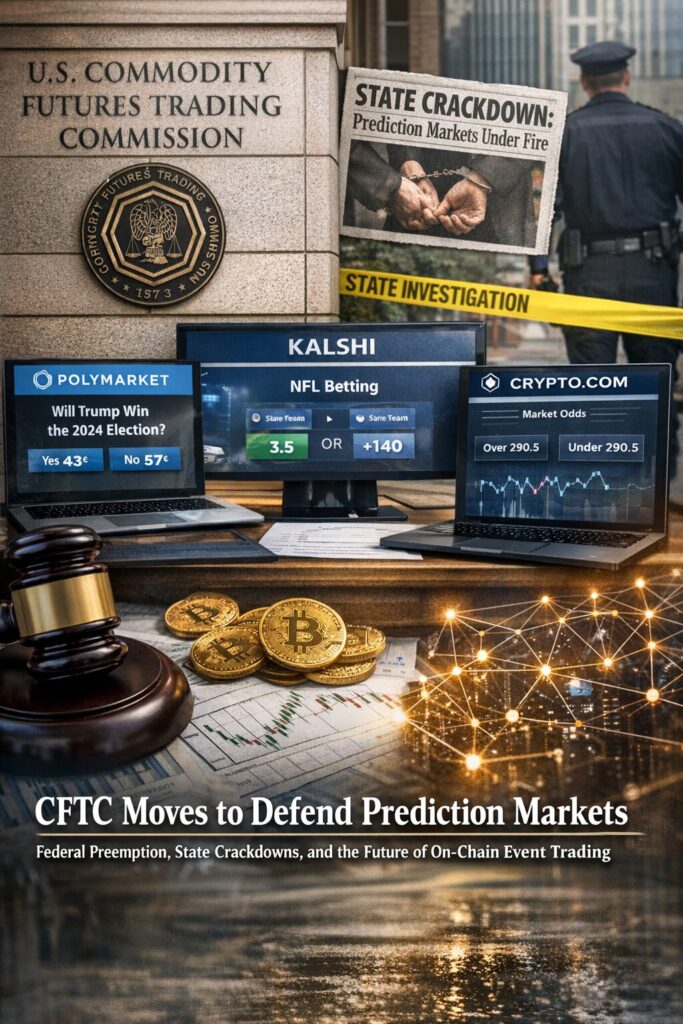
- The U.S. Commodity Futures Trading Commission (CFTC) has filed an amicus brief asserting exclusive federal jurisdiction over prediction markets.
- Platforms such as Polymarket, Kalshi, and Crypto.com face increasing state-level enforcement actions, particularly over sports and election-related markets.
- The legal battle centers on whether prediction markets qualify as regulated derivatives or unlicensed gambling.
- The outcome could redefine innovation pathways for blockchain-based financial products in the United States.
- Institutional involvement and crypto-native event trading continue to expand despite regulatory uncertainty.
Federal vs. State: The Jurisdictional Battle Over Prediction Markets
In a significant escalation of regulatory tensions in the United States, the Commodity Futures Trading Commission (CFTC) has filed an amicus brief defending its authority over prediction markets such as Polymarket, Kalshi, and Crypto.com.
The legal maneuver comes amid aggressive actions by several U.S. state regulators who argue that certain prediction markets — particularly those tied to sports outcomes — constitute unauthorized gambling operations rather than federally regulated derivatives.
CFTC leadership has emphasized that Congress granted the agency broad authority over commodity-linked contracts, including event-based derivatives. According to the agency’s position, state regulators should not override or fragment this federal oversight framework.
This dispute is not merely a bureaucratic turf war. It represents a fundamental test of how innovative financial products — especially blockchain-based markets — are categorized, supervised, and scaled within the United States.
What Exactly Is a Prediction Market?
Prediction markets allow participants to buy and sell contracts tied to future outcomes — elections, economic indicators, corporate earnings, or sporting events. These contracts typically settle at $1 if an event occurs and $0 if it does not.
For example:
- “Will the U.S. unemployment rate exceed 5% by Q4?”
- “Will Candidate X win the 2028 presidential election?”
- “Will Team A win the championship?”
From a structural standpoint, these resemble binary options or event contracts — a form of derivatives trading.
Kalshi operates as a federally regulated Designated Contract Market (DCM) under CFTC oversight. Polymarket, by contrast, has historically operated offshore while leveraging blockchain settlement infrastructure.
The legal controversy emerges when these markets overlap with traditional gambling categories — especially sports betting — which is typically regulated at the state level.
Why States Are Pushing Back
Several states — including Massachusetts, Tennessee, Nevada, and New York — have initiated enforcement actions or investigations against prediction market platforms.
Their core arguments:
- Sports-related event contracts are indistinguishable from sports betting.
- Platforms lack appropriate state gambling licenses.
- Consumers may not understand the difference between regulated derivatives and wagering.
In 2025, Polymarket re-entered the U.S. market after prior regulatory scrutiny. Since then, it has faced renewed investigations and even class-action litigation in Manhattan alleging that it operates as a nationwide sportsbook under another label.
Kalshi reportedly faces at least 19 legal challenges, yet it continues to assert that its federal designation shields it from state-level interference.
The CFTC’s Strategic Amicus Brief
An amicus brief — literally “friend of the court” — allows a federal agency to provide legal interpretation without being a direct party to a case.
The CFTC’s filing argues:
- Congress granted the CFTC exclusive authority over commodity-related event contracts.
- State actions risk undermining a unified derivatives regulatory framework.
- Prediction markets contribute to price discovery and risk hedging.
This is a decisive moment because it signals that the federal government is willing to defend innovative derivatives markets from fragmented state-level enforcement.
If courts side with the CFTC, prediction markets may gain regulatory clarity.
If courts favor states, platforms could face a patchwork of licensing requirements or outright bans.
The Innovation Question: Derivatives or Gambling?
At the heart of this dispute is classification.
If prediction markets are:
- Derivatives → Federally regulated, scalable, potentially institutional-grade.
- Gambling → State-regulated, geographically fragmented, heavily restricted.
For crypto-native platforms, this distinction is existential.
Prediction markets built on blockchain infrastructure offer:
- Transparent settlement
- Non-custodial trading (in some models)
- Global liquidity pools
- Programmable compliance features
But without regulatory clarity, institutional capital remains cautious.
Market Opportunity: The Growth of Event-Based Trading
Globally, prediction markets are gaining traction as information markets.
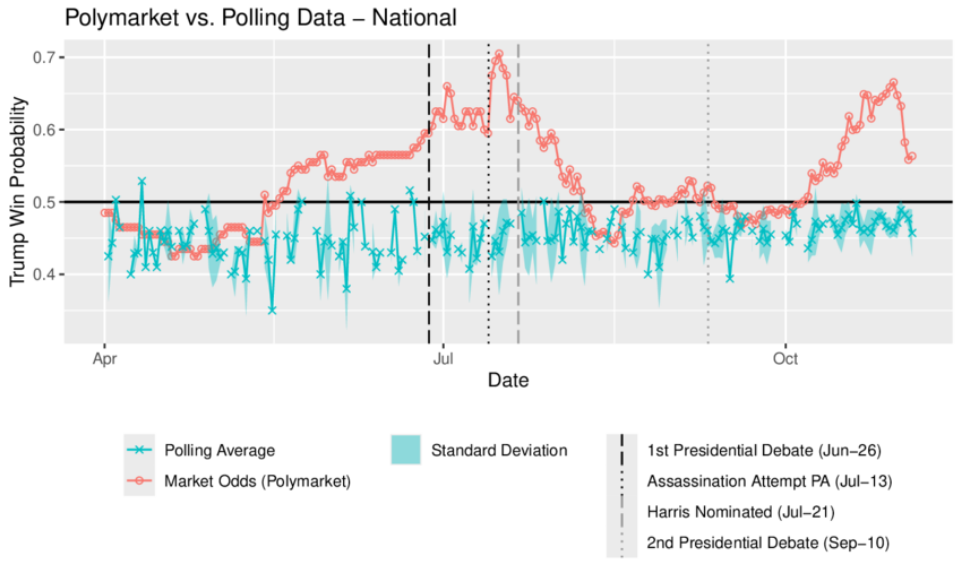
Research has shown that event markets can sometimes outperform polls or analyst forecasts in predicting outcomes.
In crypto ecosystems, event trading integrates naturally with:
- Stablecoins
- Automated market makers
- On-chain order books
- Tokenized derivatives
If federal oversight prevails, the U.S. could see:
- Institutional participation
- Structured products based on event contracts
- Integration with traditional clearinghouses
If state crackdowns succeed, liquidity may migrate offshore.
Chart: Regulatory Scenarios and Market Impact
[“Regulatory Outcome Matrix”]
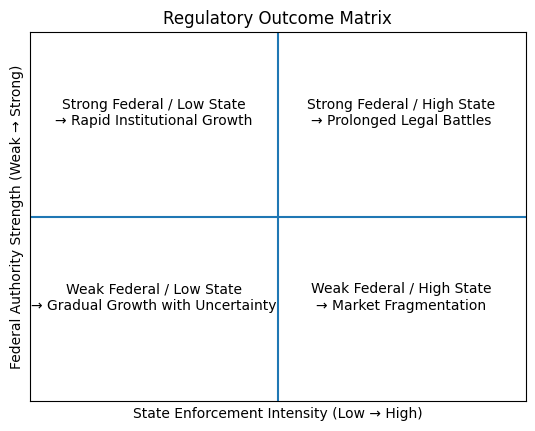
Description of the image:
A 2×2 matrix showing:
Vertical axis: Federal Authority Strength (Weak → Strong)
Horizontal axis: State Enforcement Intensity (Low → High)
Quadrants illustrate:
- Strong Federal / Low State → Rapid Institutional Growth
- Strong Federal / High State → Prolonged Legal Battles
- Weak Federal / High State → Market Fragmentation
- Weak Federal / Low State → Regulatory Uncertainty but Gradual Growth
Revenue Models Emerging in Prediction Markets
For readers seeking new income streams or blockchain use cases, prediction markets present several monetization layers:
- Market making spreads
- Liquidity incentives
- Fee-sharing governance tokens
- Structured hedging products
- Institutional data licensing
Some crypto exchanges are exploring hybrid models where event contracts integrate with spot and futures trading.
For example, election volatility markets could hedge macro exposure.
Weather derivatives could hedge agricultural risk.
Sports-based event contracts could intersect with media rights tokenization.
Competitive Landscape
Beyond Polymarket and Kalshi, other players are indirectly involved.
Coinbase CEO Brian Armstrong has warned that overzealous state enforcement may stifle innovation.
If exchanges integrate event contracts:
- They gain new user engagement streams.
- They diversify revenue beyond traditional spot fees.
- They create hedging tools tied to macro volatility.
The U.S. market’s resolution will likely influence global regulatory positioning.
Strategic Implications for Blockchain Builders
For developers and founders:
- Regulatory modularity matters.
- Jurisdictional clarity impacts token design.
- On-chain compliance tools will become competitive advantages.
- Hybrid on/off-chain models may dominate.
Builders designing new platforms should:
- Separate sports and economic markets structurally.
- Implement geo-fencing capabilities.
- Integrate KYC layers adaptable to jurisdiction.
- Prepare contingency structures for regulatory shifts.
Broader Crypto Context (2026 Trends)
Recent broader industry trends include:
- Institutional re-engagement with derivatives markets.
- Growth in stablecoin-based settlement.
- Expansion of tokenized real-world assets.
- Increasing legal differentiation between utility tokens and financial contracts.
Prediction markets sit at the intersection of all these themes.
They combine:
- Speculation
- Hedging
- Data markets
- Behavioral finance
- Blockchain transparency
This makes them both innovative and controversial.
Conclusion: A Defining Moment for U.S. Financial Innovation
The CFTC’s defense of prediction markets represents more than a legal filing.
It signals a struggle over who defines financial innovation in America.
If federal jurisdiction prevails, prediction markets may mature into institutional-grade derivatives integrated with blockchain infrastructure.
If states win, fragmentation may push innovation offshore — repeating patterns seen in other crypto sectors.
For investors and builders seeking emerging opportunities, prediction markets represent:
- Regulatory arbitrage potential
- Derivatives innovation
- On-chain liquidity expansion
- Information-as-an-asset monetization
The next court decisions could determine whether the U.S. becomes a leader in regulated event-based derivatives — or a jurisdiction that drives innovation abroad.


