
Main Points :
- The President of the Deutsche Bundesbank argues that CBDCs and euro-denominated stablecoins can strengthen the euro’s international role.
- Retail and wholesale CBDCs serve different strategic purposes: consumer payments, financial infrastructure resilience, and programmable interbank settlement.
- A euro stablecoin ecosystem could reduce Europe’s dependence on $-denominated stablecoins and foreign payment rails.
- Geoeconomic fragmentation and slowing growth make monetary sovereignty and payment independence strategic priorities.
- The European Central Bank is accelerating development of the digital euro, targeting potential introduction by 2029.
- Competition from $-based stablecoins poses policy, monetary, and systemic risks for Europe.
- For crypto investors and blockchain entrepreneurs, euro-denominated digital money represents a structural opportunity.
I. Europe at a Strategic Crossroads
In a speech titled “Europe’s Priorities and Challenges in a Changing Global Environment,” Joachim Nagel, President of the Deutsche Bundesbank, outlined a clear and strategic vision: central bank digital currencies (CBDCs) and euro-denominated stablecoins are not merely technological experiments—they are instruments for strengthening the euro’s international role.
Europe, he noted, is deeply embedded in global trade and value chains. However, geopolitical fragmentation, supply-chain realignment, and shifting financial power centers have reduced Europe’s growth momentum and competitiveness in recent years. In such an environment, monetary sovereignty and payment infrastructure independence become strategic assets.
Strengthening the international role of the euro is therefore not just about prestige. It is about resilience—ensuring that European individuals, businesses, and financial institutions can transact efficiently without excessive reliance on non-European systems.
II. What Is a CBDC—and Why It Matters
A Central Bank Digital Currency (CBDC) is digital legal tender issued directly by a central bank. Unlike decentralized cryptocurrencies, a CBDC represents sovereign money in digital form.
In Europe’s case, the digital euro would be issued under the authority of the European Central Bank and the Eurosystem. Its design differs fundamentally from crypto-assets:
- It is legal tender.
- It carries central bank backing.
- It operates within regulated monetary policy frameworks.
The strategic significance lies in infrastructure. If European citizens rely heavily on private payment providers or foreign stablecoins, monetary influence gradually shifts outward. A digital euro provides a sovereign digital settlement layer.
III. Retail CBDC: A European Payment Backbone
Nagel emphasized ongoing work toward a retail CBDC—intended for everyday use by individuals and companies.
Strategic Implications
A retail digital euro would:
- Operate on European infrastructure.
- Provide a unified cross-border digital payment system across the eurozone.
- Reduce dependence on non-European card networks and tech platforms.
Currently, Europe’s retail payment ecosystem relies significantly on global card networks and technology providers. While efficient, this creates structural dependencies.
A retail CBDC could become Europe’s first fully integrated, pan-European digital payment solution accessible to both individuals and enterprises.
Below is a conceptual chart illustrating Europe’s evolving digital payment structure:
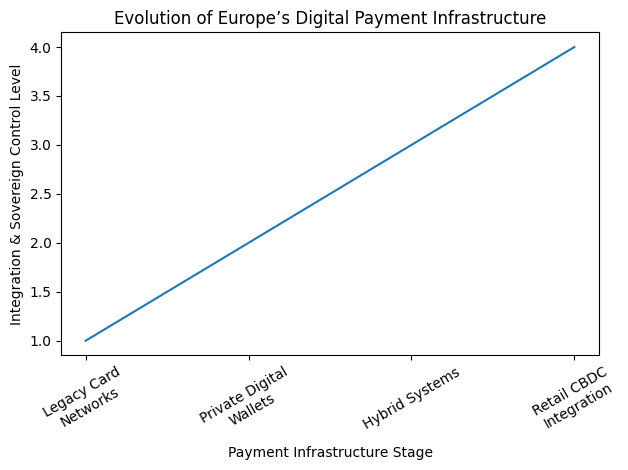
Conceptual evolution from legacy payment rails toward retail CBDC integration.
IV. Wholesale CBDC: Programmable Institutional Settlement
Nagel also highlighted preparations for a wholesale CBDC—designed for interbank and institutional settlement.
Unlike retail CBDCs, wholesale CBDCs would:
- Enable programmable payments.
- Facilitate automated collateral transfers.
- Improve cross-border securities settlement.
- Enhance liquidity management efficiency.
Programmable settlement mechanisms can significantly reduce operational risk and reconciliation delays in capital markets.
In a world where tokenized assets are gaining traction—ranging from tokenized bonds to digital commercial paper—a wholesale CBDC provides a risk-free settlement asset.
For financial institutions and blockchain infrastructure developers, this opens the door to programmable finance layers built atop sovereign money.
V. The Euro Stablecoin Debate
Beyond CBDCs, Nagel expressed support for euro-denominated stablecoins.
Today, the stablecoin market is overwhelmingly dominated by $-based instruments such as USDT and USDC. These tokens serve as the primary liquidity rails in global crypto markets.
Strategic Risk
When international trade and digital asset markets settle predominantly in $-based stablecoins:
- Monetary influence concentrates around the dollar.
- Europe’s policy transmission may weaken.
- Financial stability exposure increases.
Nagel previously voiced concerns that the dominance of $ stablecoins could affect European financial autonomy and monetary policy effectiveness.
Strategic Opportunity
A well-regulated euro stablecoin ecosystem could:
- Enable low-cost international payments.
- Support decentralized finance (DeFi) denominated in euros.
- Strengthen the euro’s digital presence in emerging markets.
- Facilitate cross-border commerce within Africa and Eastern Europe.
For crypto investors seeking new revenue streams, euro-denominated stablecoins represent a structural growth frontier.
VI. Global Context: The Digital Currency Race
Europe is not alone.
- The People’s Bank of China has expanded pilots of the digital yuan.
- The U.S. continues evaluating digital dollar frameworks while private stablecoins dominate.
- Emerging markets increasingly use stablecoins for remittances and trade settlement.
The European Central Bank is accelerating digital euro development, targeting potential rollout around 2029.
Geoeconomic fragmentation makes digital currency architecture part of strategic statecraft.
VII. Implications for Crypto Investors and Builders
For readers searching for new crypto assets and blockchain-based revenue opportunities, this policy shift carries several implications:
1. Infrastructure Plays
Payment gateways, custody solutions, compliance middleware, and digital identity systems will see increased demand.
2. Tokenization Ecosystems
Wholesale CBDCs align with tokenized securities platforms.
3. Euro-Based DeFi
If euro stablecoins gain traction, liquidity pools, derivatives markets, and lending protocols denominated in euros may expand.
4. Regulatory Arbitrage Shrinks
Europe’s Markets in Crypto-Assets (MiCA) framework already provides regulatory clarity, making compliant euro stablecoins more viable.
VIII. Economic Growth, Competitiveness, and Monetary Strength
Nagel’s broader speech addressed slowing European growth and reduced competitiveness.
Strengthening the euro’s international role is tied to:
- Deepening internal capital markets.
- Reducing fragmentation across member states.
- Expanding trade partnerships.
- Enhancing financial infrastructure sovereignty.
Digital money—both CBDC and stablecoin—acts as a lever in this transformation.
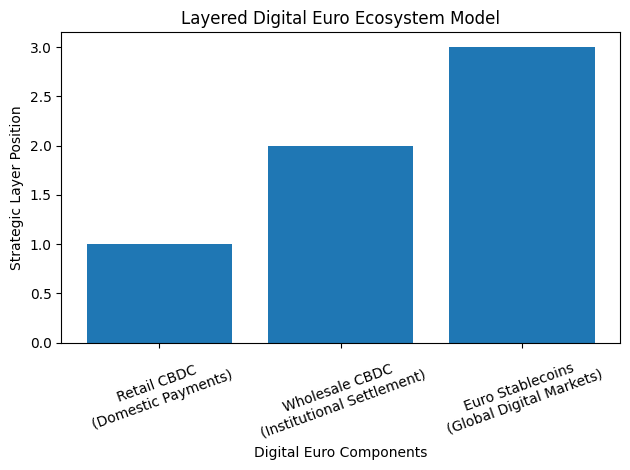
IX. Conceptual Model: Digital Euro Ecosystem
Layered model—Retail CBDC, Wholesale CBDC, and Euro Stablecoins interacting across domestic and international markets.
X. Conclusion: A Monetary Pivot Toward Digital Sovereignty
Joachim Nagel’s remarks reflect a strategic pivot rather than a mere technological update.
CBDCs and euro stablecoins are framed not as competitors, but as complementary tools:
- Retail CBDC strengthens domestic payment independence.
- Wholesale CBDC modernizes institutional settlement.
- Euro stablecoins extend the euro’s reach into global digital markets.
In an era of geopolitical fragmentation, monetary strength increasingly depends on digital infrastructure control.
For investors and blockchain practitioners, the digital euro narrative signals a structural shift: the convergence of sovereign finance and decentralized infrastructure.
The euro’s next chapter may not be written in paper—but in programmable code.