
Main Points :
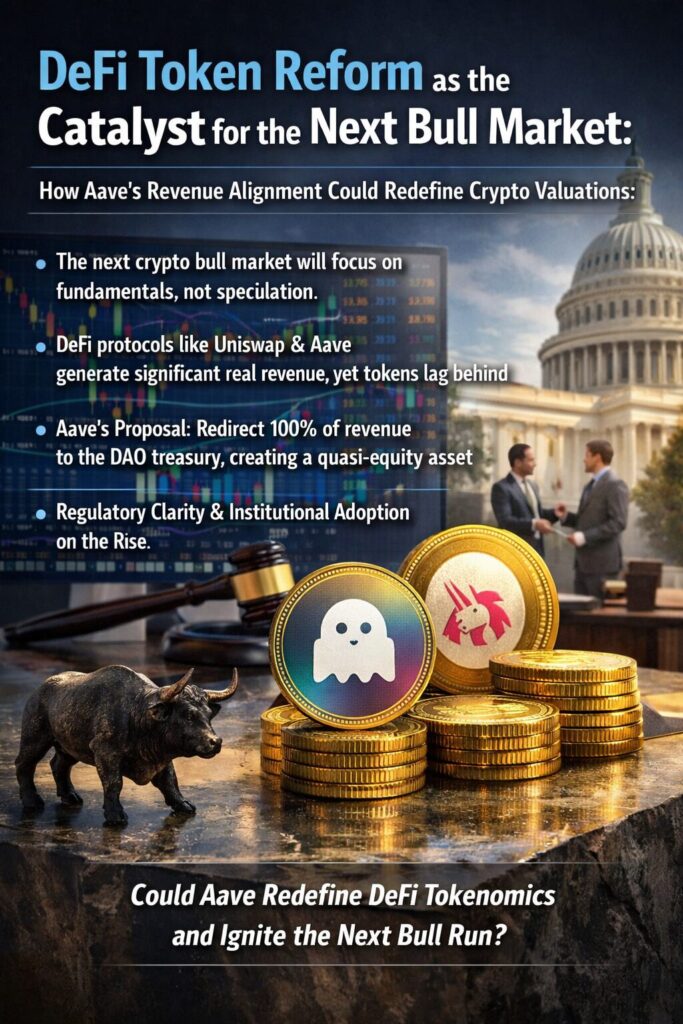
- The next crypto bull market is likely to focus on fundamentals, not speculation.
- DeFi protocols such as Uniswap and Aave generate substantial real revenue, yet their tokens underperform.
- Governance-only tokens have historically lacked direct claims on revenue due to regulatory risk.
- Aave’s new proposal aims to redirect 100% of product revenue to the DAO treasury, potentially transforming AAVE into a quasi-equity asset.
- If successful, this model could reshape DeFi tokenomics and trigger a sector-wide revaluation.
- Regulatory clarity in the United States and growing institutional interest may accelerate this transition.
1. A Structural Shift in Crypto: From Narrative to Fundamentals
The crypto market has endured a prolonged bearish cycle through 2025 and into 2026. Prices across major assets stagnated, liquidity tightened, and speculative enthusiasm faded. However, according to Matt Hougan, Chief Investment Officer at Bitwise Asset Management, this downturn may represent not a collapse of innovation but a structural transition.
Hougan argues that the next bull market will not be driven primarily by meme coins, hype, or reflexive liquidity. Instead, capital will flow toward projects demonstrating measurable fundamentals:
- Active users
- Revenue generation
- Sustainable cash flows
- Real product-market fit
Among crypto sectors, DeFi (Decentralized Finance) stands out as uniquely positioned to meet these criteria.
DeFi refers to blockchain-based financial services operating without centralized intermediaries. Lending, borrowing, trading, derivatives, and stablecoin issuance occur via smart contracts. Unlike speculative Layer-1 tokens promising future ecosystems, many DeFi platforms are already functioning at scale.
For example, Uniswap frequently rivals or surpasses major centralized exchanges in spot trading volume. Meanwhile, Aave generates more than $100 million in annual revenue.
Yet despite these impressive metrics, DeFi tokens remain deeply discounted.
2. The Governance Token Problem
To understand this disconnect, one must revisit regulatory history.
During the Biden administration, the U.S. Securities and Exchange Commission aggressively applied the Howey Test. If token holders were deemed to expect profit derived from the efforts of others, the asset could be classified as a security.
To avoid enforcement actions, most DeFi protocols structured tokens purely as governance instruments. Token holders could vote on protocol upgrades, parameter changes, and treasury usage—but they had no explicit claim on revenue or profits.
This design created a paradox:
- Platforms generated substantial fees.
- Token holders controlled governance.
- But token holders had no guaranteed economic participation.
As a result, while usage climbed, token prices stagnated or declined. Over the past year:
- AAVE declined roughly 50%.
- UNI has traded largely sideways since 2022.
Investors increasingly questioned why they should value governance tokens if they behaved more like political rights than financial assets.
3. Aave’s “Aave Will Win” Proposal: A Turning Point?
On February 12, 2026, Aave Labs introduced a governance proposal titled “Aave Will Win.”
The proposal outlines a major restructuring:
- 100% of revenue generated by Aave-branded products (website, upcoming mobile app, Aave Card, institutional services) would flow to the DAO treasury.
- An Aave Foundation would be established to manage trademarks and intellectual property.
- In exchange, Aave Labs would receive:
- $25 million in stablecoins
- 75,000 AAVE tokens
- Up to $17.5 million in grants
The total package approximates $50 million.
AAVE Token Price vs. Estimated Annual Revenue (USD)
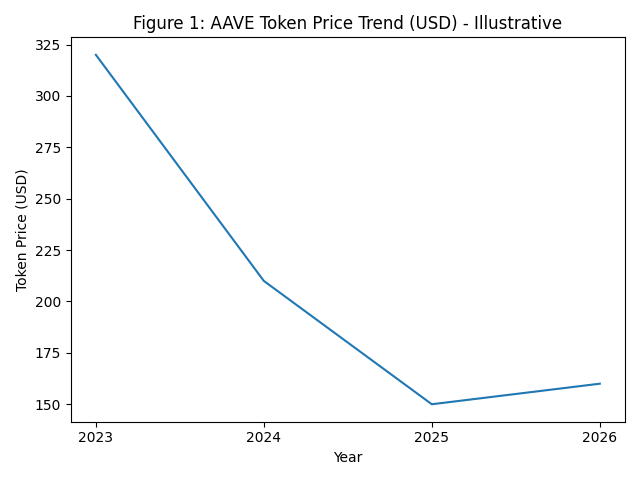
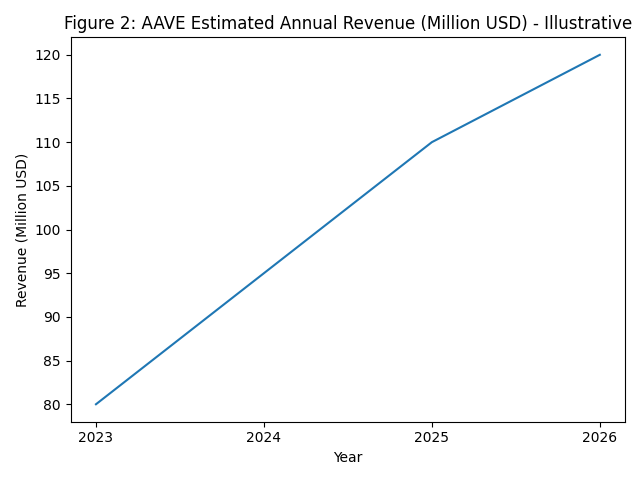
(Bar chart comparing token price decline vs. stable or rising revenue)
This proposal effectively attempts to transform AAVE from a governance token into something closer to equity in a decentralized financial services platform.
If all product revenue accrues to the DAO, token holders collectively control a treasury funded by operational income. The DAO could then:
- Distribute yield
- Fund buybacks
- Reinvest in ecosystem growth
- Accumulate reserves
In theory, this aligns token value directly with cash flow generation.
4. Controversy and Governance Friction
The proposal has not been universally welcomed.
Some community members argue the compensation package for Aave Labs is excessive. Others question how “revenue” is defined and whether Labs retains discretion in its classification.
This tension stems partly from a prior dispute: in late 2025, it emerged that certain swap fees were flowing to Aave Labs’ wallet rather than the DAO treasury. That revelation intensified scrutiny over ownership and control.
Previous Revenue Flow vs. Proposed Revenue Flow (DAO-Centric Model)
(Flowchart illustrating revenue redirection to DAO treasury)
The current proposal seeks to resolve that structural conflict by codifying revenue alignment.
Hougan interprets the move as a necessary evolution. If DeFi tokens remain disconnected from cash flow, they will struggle to attract long-term capital.
5. Why This Matters for the Entire DeFi Sector
If Aave succeeds, the implications extend beyond one protocol.
Other major DeFi platforms face similar tokenomics dilemmas:
- Uniswap governance debates around fee switches.
- MakerDAO restructuring into subDAOs.
- Liquid staking protocols distributing real yield to token holders.
Investors are increasingly demanding measurable return mechanisms rather than speculative governance narratives.
A sector-wide shift toward revenue-linked tokens could:
- Increase valuation transparency.
- Reduce reflexive volatility.
- Attract institutional capital seeking yield-bearing digital assets.
- Create equity-like valuation frameworks (P/E ratios, revenue multiples).
Governance-Only Tokens vs. Revenue-Linked Tokens – Hypothetical Valuation Models
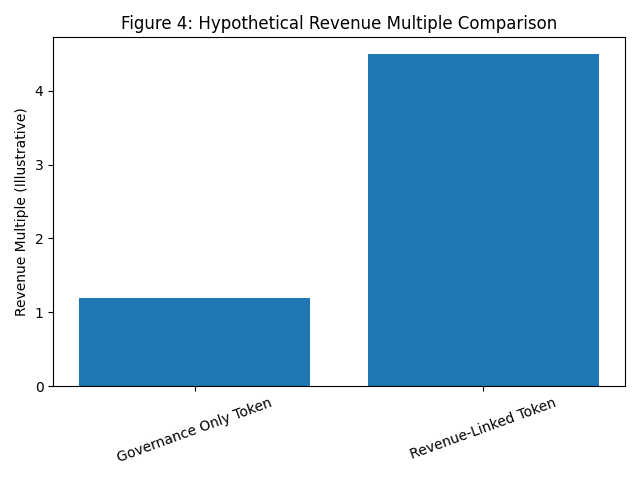
The transition from “governance rights” to “economic participation” may be the defining structural change of the next cycle.
6. Regulatory Backdrop and Institutional Interest
The regulatory environment is evolving. While the SEC’s prior enforcement stance discouraged revenue sharing, more recent court rulings and policy debates suggest greater nuance in digital asset classification.
Simultaneously:
- Spot Bitcoin ETFs normalized institutional crypto exposure.
- On-chain lending volumes are rebounding.
- Stablecoin usage continues expanding globally.
Institutional allocators increasingly ask: which protocols generate sustainable yield?
DeFi may answer that question—if its token structures mature.
7. Investment Implications: What to Watch
For investors seeking new crypto revenue streams and practical blockchain use cases, several signals matter:
- DAO treasury transparency.
- Formal revenue allocation mechanisms.
- Legal structuring of IP and trademarks.
- Token buyback or yield programs.
- Governance participation rates.
Aave’s proposal is not merely a tokenomic tweak. It represents a test case: can decentralized finance behave like a decentralized corporation?
If yes, DeFi tokens may transition from speculative instruments to cash-flow-backed digital equity analogs.
8. Broader Market Outlook: Can This End the Bear Market?
Bear markets end when narratives align with fundamentals.
In 2017, ICO speculation drove valuations.
In 2021, liquidity and DeFi summer propelled growth.
In the next cycle, revenue may be the driver.
If DeFi tokens begin pricing in actual earnings, the sector could undergo a structural rerating.
This does not guarantee immediate upside. Governance disputes, regulatory ambiguity, and macroeconomic tightening remain risks. But a credible path toward revenue-linked valuation models could restore investor confidence.
Conclusion
DeFi stands at an inflection point.
Despite generating real revenue and serving millions of users, many DeFi tokens remain undervalued because they lack direct economic rights. Aave’s “Aave Will Win” proposal attempts to correct that misalignment by channeling 100% of product revenue to the DAO treasury, effectively evolving AAVE toward a quasi-equity structure.
If implemented successfully, this reform could:
- Redefine DeFi tokenomics
- Attract institutional capital
- Establish valuation frameworks grounded in cash flow
- Potentially catalyze the next crypto bull market
The bear market may not end with hype—but with accounting.


