

Main Points :
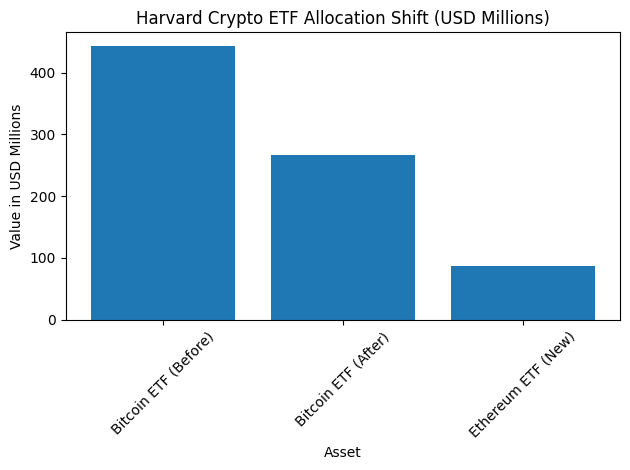
- Harvard Management Company reduced its BlackRock spot Bitcoin ETF holdings by approximately 21%, lowering exposure from $442.9 million to $265.8 million.
- The fund initiated a new position in BlackRock’s spot Ethereum ETF valued at approximately $87 million.
- These moves occurred during a period of significant volatility, with Bitcoin falling from above $120,000 to below $90,000 and Ethereum declining from above $4,000 to below $3,000.
- Crypto ETFs represented roughly 0.62% of Harvard’s $56.9 billion endowment.
- The timing coincides with renewed institutional interest in AI-linked crypto strategies such as Numerai.
Introduction: Institutional Capital Is Not Leaving Crypto — It Is Rotating
Harvard University’s endowment, managed by Harvard Management Company (HMC), recently disclosed a notable shift in its crypto exposure. Rather than exiting digital assets, the fund reduced its position in BlackRock’s iShares Bitcoin Trust ETF while initiating a new allocation into the iShares Ethereum Trust ETF.
According to filings submitted to the U.S. Securities and Exchange Commission, Harvard decreased its Bitcoin ETF holdings from $442.9 million in Q3 2025 to $265.8 million as of December 31, 2025. The number of shares dropped from 6.8 million to 5.4 million, representing a sale of more than one million shares.
Simultaneously, Harvard purchased more than 3.8 million shares of BlackRock’s Ethereum ETF, with a valuation of approximately $87 million at year-end.
This was not a retreat from crypto. It was a rotation.
Section 1: Market Context — Volatility as a Catalyst
The portfolio adjustment occurred amid a pronounced correction in the crypto market.
Bitcoin declined from above $120,000 in early July 2025 to below $90,000 by January 2026. Ethereum fell from above $4,000 to below $3,000 during the same period.
[BTC & ETH Price Trend]
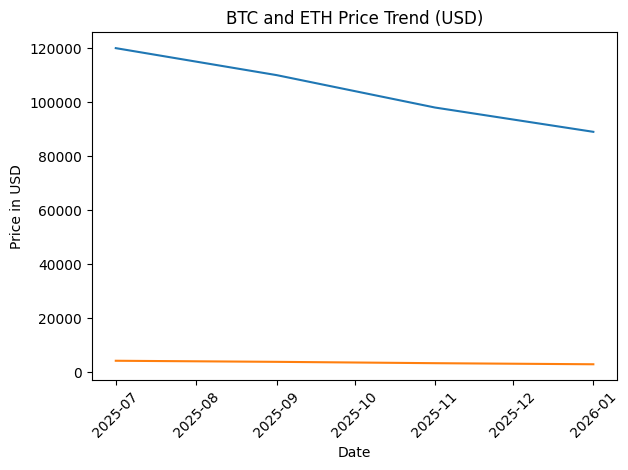
This drawdown reflects classic post-cycle cooling after significant ETF-driven inflows earlier in 2025. Institutional demand for spot Bitcoin ETFs surged following regulatory approvals, pushing prices to new highs. However, macroeconomic tightening, U.S. rate expectations, and profit-taking triggered a broad pullback.
For long-term capital allocators like Harvard, volatility is not merely risk — it is an entry optimization mechanism.
Section 2: Allocation Perspective — 0.62% Is Not a Bet-the-Fund Move
As of June 30, 2025, Harvard’s endowment stood at $56.9 billion. Even after the rebalancing, total crypto ETF exposure amounted to roughly $352.8 million ($265.8 million Bitcoin + $87 million Ethereum).
[Harvard Crypto ETF Allocation Shift]
[Crypto Exposure vs Total Endowment]
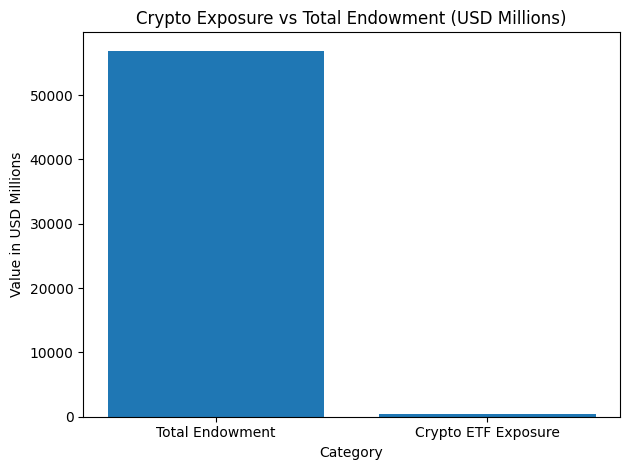
This represents approximately 0.62% of total assets.
For institutional investors, such sizing indicates:
- Strategic optionality
- Volatility tolerance without systemic risk
- Exposure to asymmetric upside without compromising liquidity
In other words, Harvard treats crypto as a venture-style allocation embedded within a diversified global portfolio.
Section 3: Why Ethereum Now?
The key question is not why Bitcoin was reduced — but why Ethereum was added.
Three structural reasons stand out:
- ETF Maturity and Liquidity Expansion
Spot Ethereum ETFs have gradually gained liquidity depth. BlackRock’s Ethereum Trust provides institutional-grade custody, transparency, and regulated access, reducing friction for large allocators. - Staking Economics
Unlike Bitcoin, Ethereum offers staking yield potential. Even though ETFs may not directly distribute staking rewards, the underlying economic model supports value accrual mechanisms beyond pure price appreciation. - AI and DeFi Infrastructure Narrative
Ethereum continues to dominate decentralized finance (DeFi), tokenization pilots, and AI-linked smart contract frameworks. As AI-driven hedge funds such as Numerai expand, Ethereum-based infrastructure becomes strategically relevant.
Section 4: The Numerai Connection — Elite Capital and AI Integration
Around the same period, Numerai announced it had raised $30 million in a funding round reportedly backed by “elite university endowments.” While specific names were not disclosed, market participants speculated involvement from institutions like Harvard.
Following the announcement, Numerai’s native token NMR surged more than 40%.
This highlights a broader theme:
Institutional capital is exploring AI-native crypto models, not just passive exposure.
Ethereum’s programmable architecture is central to that narrative.
Section 5: Broader Institutional Trend — Bitcoin as Store of Value, Ethereum as Infrastructure
Over the past two years, Bitcoin has solidified its role as digital gold — a macro hedge, reserve diversification tool, and ETF-accessible commodity.
Ethereum, meanwhile, is increasingly viewed as:
- A decentralized computation layer
- A tokenization settlement backbone
- A yield-bearing network asset
Harvard’s move may signal an internal thesis shift:
From pure store-of-value exposure toward infrastructure participation.
Section 6: What This Means for Crypto Investors Seeking New Opportunities
For readers seeking new digital asset opportunities, this rotation offers three insights:
- Institutions Do Not Chase Tops
Harvard reduced exposure near post-ETF highs and diversified during correction. - Ethereum Remains Structurally Strategic
Despite volatility, ETH remains central to institutional blockchain allocation. - AI-Crypto Convergence Is Accelerating
Projects integrating AI, decentralized data science, and programmable finance may attract next-cycle capital.
Section 7: Risk Factors to Monitor
This is not a one-way bullish narrative. Risks remain:
- Regulatory developments affecting ETF structures
- Ethereum scaling competition (Layer-2 fragmentation)
- Macroeconomic tightening cycles
- ETF flow reversals
However, institutional participation tends to stabilize long-term capital structure.
Conclusion: Rotation, Not Retreat
Harvard’s rebalancing should not be interpreted as diminishing confidence in crypto. Instead, it reflects:
- Tactical profit management
- Structural diversification
- Infrastructure positioning
- Optionality preservation
The allocation remains modest relative to total assets, yet strategically meaningful.
For forward-looking investors, the key takeaway is clear:
Institutional capital is evolving its crypto exposure from single-asset conviction to ecosystem strategy.
The question is no longer “Bitcoin or nothing.”
It is becoming:
“What part of the crypto stack do we want to own?”


